Building a Freeway Across the Hinterland
This paper uses an imagined example to show how a project moves through the Council of Fifty. The communities, people, and figures are invented. The steps follow the working arrangement described in the Council of Fifty papers, and they are consistent with the NewVistas Constitution.
Introduction
Fifty communities share a region. Between them lies the hinterland, where the grain farms, grazing lands, mines, and wells are found. In this example, the only road across the hinterland is an old county road. Freight trucks travel slowly along it, and a resident who wants to visit a friend in another community can spend most of a day in the car.
This paper follows a freeway from the idea of one president to the day residents begin to use it. It shows who does what at each stage, and how fifty independent communities can build one road without any of them giving up its independence.
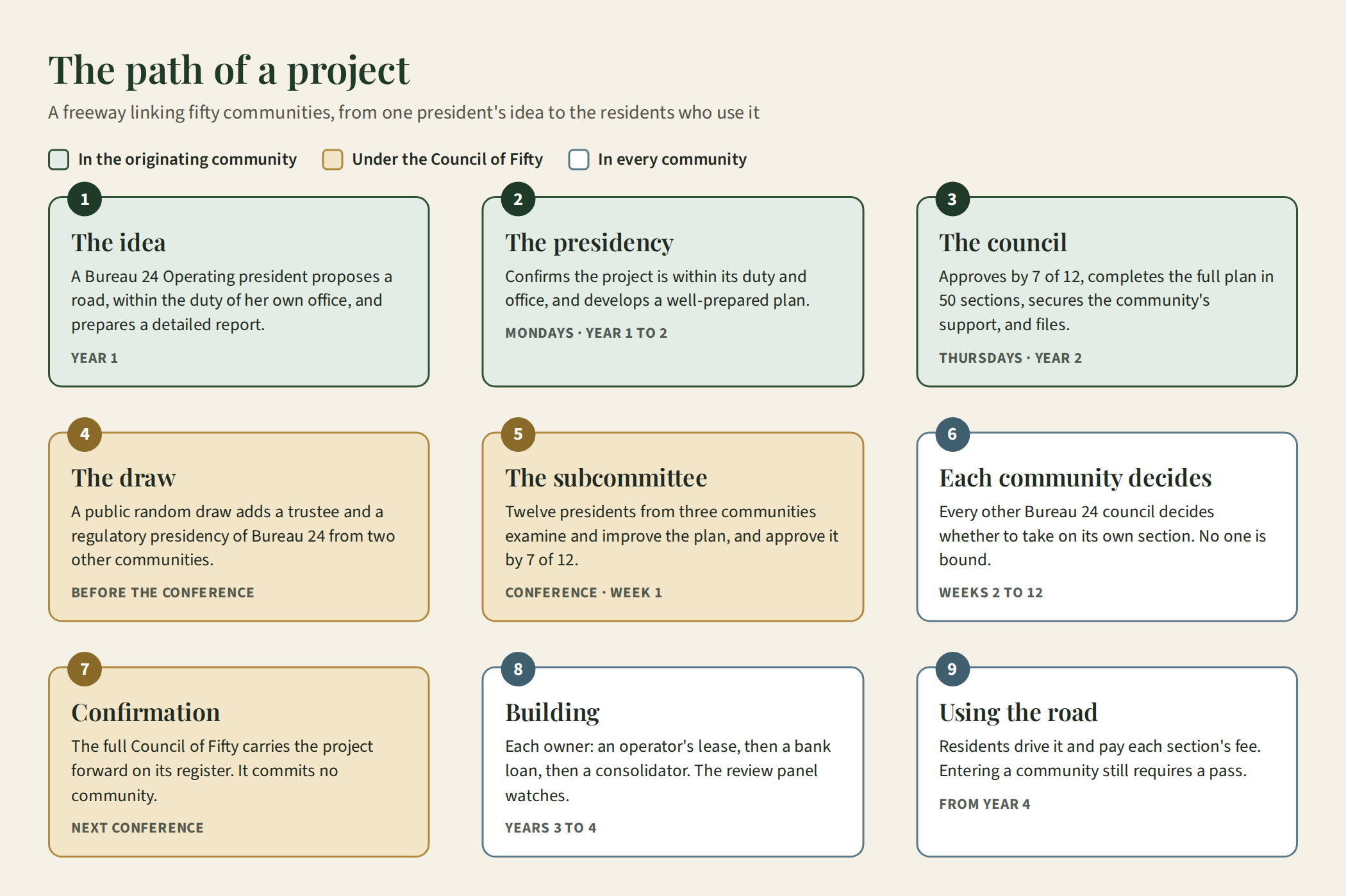
The idea
Maria Delgado is an Operating president of Bureau 24, Transportation, in the Bridger community. Roads fall within the duty of her office. This matters, because the constitution requires every president to learn his duty and act in the office in which he is appointed. Maria could not propose a farm or a pipeline, because those belong to other bureaus. A road, however, is a project she is permitted to propose.
Maria spent several months preparing a detailed report, with the help of the AI tools her bureau leased. The report studied the traffic between the communities and compared three possible routes across the hinterland. It also gave a first estimate of the cost, and explained how the road might pay for itself through the fees its users would pay.
The presidency’s review
Maria presented the report to her presidency of four at its Monday meeting. The presidency first confirmed that the project lay within the duty and office of Bureau 24. It then asked whether Bridger could meet the need on its own, through a bylaw, a contract, or a bureau standard. It could not, because the road would cross the hinterland and serve every community in the region.
Over the following weeks, the presidency developed the report into a plan. It dropped one of the three routes, because that route crossed a wetland. It then tested the other two routes against the farms and grazing lands they would pass through. The presidency approved the plan by three votes of four and sent it to the council.
The council’s plan
The Bureau 24 council of twelve is made up of Bridger’s Operating presidency and the trustee and regulatory presidencies who serve the bureau. The council approved the plan by nine votes of twelve. It then spent most of a year making the plan thorough enough to present to the other forty-nine communities. The environmental study of the chosen route alone took four months. The council also worked out the cost, how the building would be contracted, how long it would take, and how the road would pay for itself.
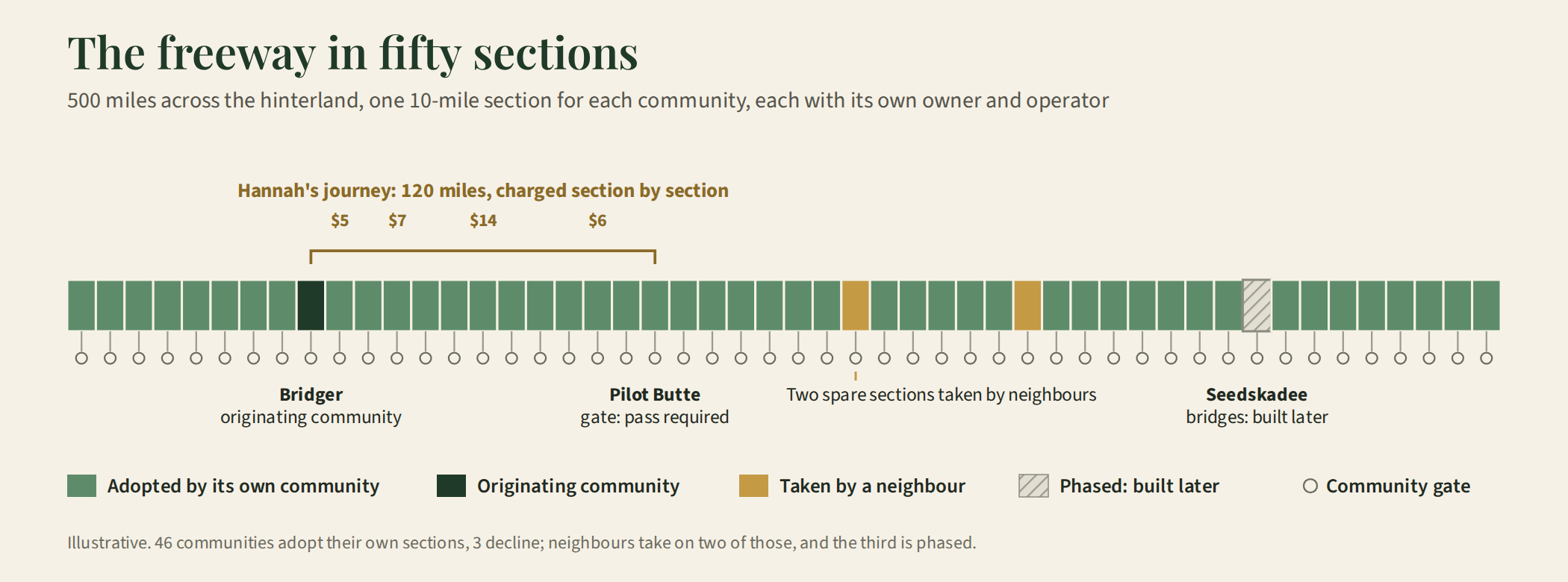
The trustees reminded the council that Bridger has no budget, and that no other community has one either. The question was therefore not who would pay for the road. The question was whether each part of the road could carry its own loan. This shaped the whole design. The council divided the 500-mile route into fifty sections of ten miles each, one for each community. Every section would follow one common design, and the plan set out how each section would join the next. As a result, each section would have its own owner and its own operator, and each would have to earn its own way.
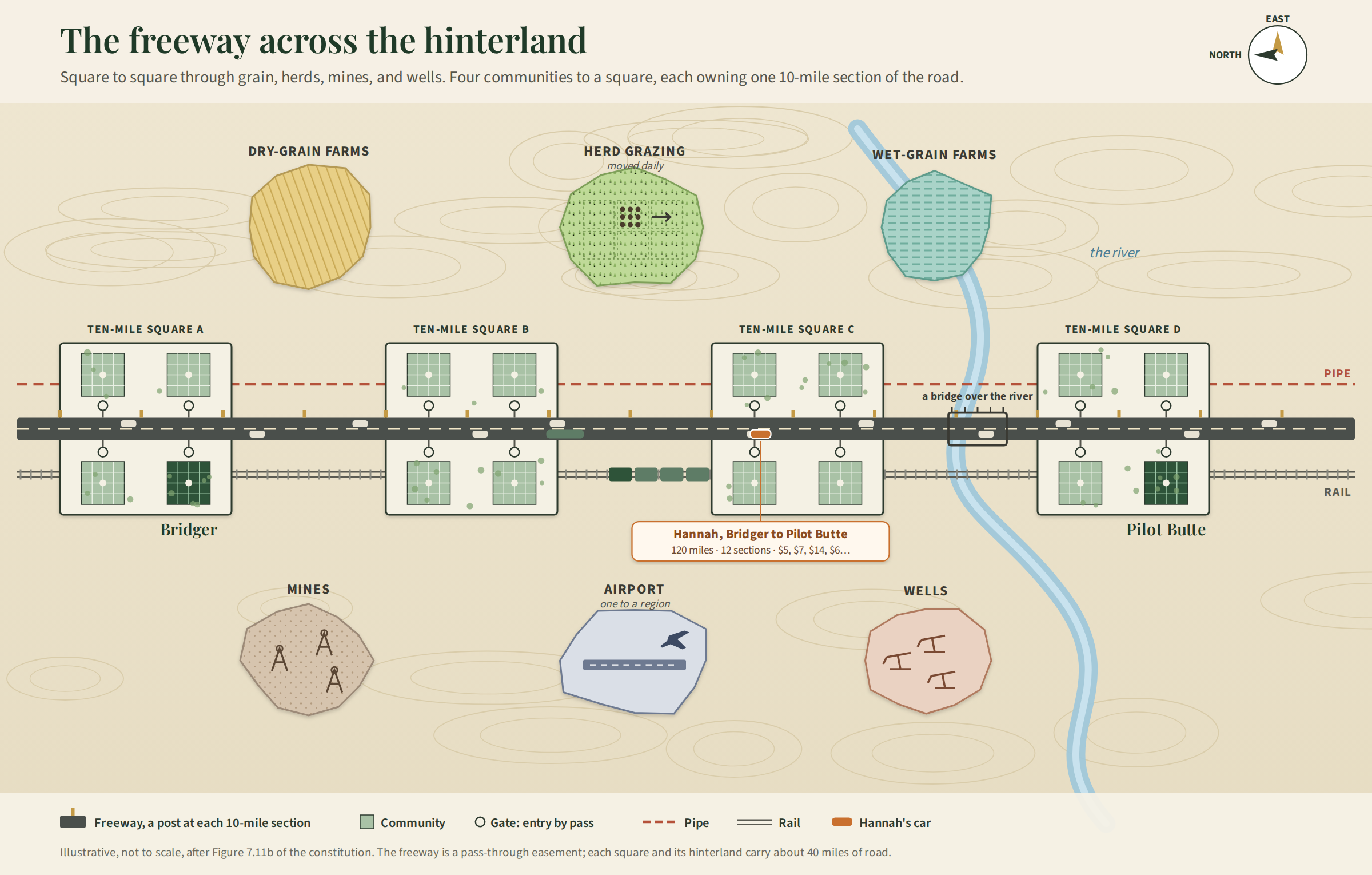
Before filing the plan, the council made sure that the rest of Bridger supported it. This was especially important for Bureau 2, which would hold the title to Bridger’s own section and borrow the money to build it. The council also tested the design with the Bureau 24 councils of several other communities. These preparatory sessions were held under the auspices of the Council of Fifty. They were private while they took place, but every session was minuted, and the minutes were published once the plan was filed. The council filed the plan at the end of week 12, about eighteen months after Maria began her report.
Selecting the subcommittee
When the agenda was published, the members of the subcommittee were drawn in the usual way. A random number was taken from a public source at a time announced in advance, and a published procedure used it to make the draw. Anyone can repeat the procedure and obtain the same result. Because an Operating presidency was presenting the plan, the draw selected one trustee presidency and one regulatory presidency that serve Bureau 24. These came from two different communities among the other forty-nine. The draw selected the trustees of Little America and the regulators of Pilot Butte.
The subcommittee met for the first time on the Tuesday afternoon of the conference. It was made up of twelve presidents from three communities. Three were partnered men, three were partnered women, three were single men, and three were single women. All of them were responsible for transportation in their own communities. Maria’s presidency presided, with its members taking turns, as the presenting presidency always does.
The conference
The subcommittee began to question the plan at once. Ruth Ames, one of the trustees from Little America, studied the costings. Most sections would cost about $40 million, but Seedskadee’s section needed three bridges and would cost about $95 million. She asked for that section to be set out on its own, with its expected traffic, because she doubted that its fees would ever cover its loan.
Kofi Mensah, one of the regulators from Pilot Butte, raised a different concern. The plan allowed the operators to use cameras to charge people who threw litter on the road. He agreed with this, but he asked that the cameras be used only to enforce the road’s own rules. He also asked that footage of anyone who had broken no rule should not be kept. The subcommittee wrote both conditions into the plan.
Through Wednesday, the Bureau 24 exchange read each evening’s draft and sent comments back the next morning. The exchange is made up of the transportation presidents of all fifty communities. On Thursday, the subcommittee approved the revised plan by ten votes of twelve. The trustees and the regulators each signed a finding to go with it. That afternoon, the closing plenary published the plan for every community to consider.
Decisions in each community
After the conference, the Bureau 24 council in each of the other forty-nine communities considered the plan. Each council decided whether its community would take on its own ten-mile section. Each council first made sure of the support of its own Bureau 2. Its Bureaus 19, 20, and 21 then tested whether its section would be complete, wanted, and viable. In this arrangement, no community decided for any other community.
Forty-six communities adopted their sections, and three declined. Seedskadee explained its decision openly. Its section, with the three bridges, would cost more than twice the average, and it would carry less traffic than most sections. The figures did not work, so Seedskadee declined.
Two neighbouring communities each agreed to take on one of the spare sections. Taking on a spare section involves the same steps as taking on a community’s own section. The neighbour’s Bureau 2 holds the title and borrows for it, and its Bureau 24 finds an operator to lease it. The neighbour then answers for the section until it is complete. This means that each of these two communities owned twenty miles of road instead of ten. They agreed because the figures worked. The spare sections lay next to their own sections, on stretches with good traffic. For instance, an operator who already ran one section could also run the next one at little extra cost.
The bridge section had no taker, so the plan was phased. That section would be built later, once the rest of the road had shown how much traffic it would draw. The three communities that declined remained in good standing.
Confirmation by the Council of Fifty
At the next conference, the full Council of Fifty voted to carry the freeway forward as a Council of Fifty project. This vote did not bind any community, because every community had already made its own decision. It meant that the project was entered on the Council’s register. It also meant that the twelve seats of the subcommittee would follow the project as its review panel until the last section was finished.
Building the road
In Bridger, as in every community that adopted a section, Bureau 24 governed the work and Bureau 2 held the title. Neither bureau spent any money. Bureau 24 first invited proposals from businesses that wanted to operate Bridger’s section. The proposal that passed Bureaus 19, 20, and 21 came from Sam Whitfield’s business. Sam agreed to lease the section, and he showed that his fees would cover the loan payments with room to spare. Only then did Bureau 2 apply to the bank for a loan. Once the loan was approved, a consolidator built the section on construction financing. Meanwhile, Sam signed agreements with the operators of the neighbouring sections on how their sections would join.
The review panel met at each conference and published its findings. In the second year, it reported that two sections were three months behind schedule. Both owning councils published their responses before the next conference. One council explained a contractor’s delay and how it would be recovered. The other explained a change of route around a wetland that the environmental study had underestimated. The panel did not instruct anyone. Its role was to make sure that every problem received an answer.
When a section was built, tested, and earning the revenue its plan required, its long-term financing closed. Its operator then took custody of it. The review panel’s work ended when the last section reached this point.
Using the road
About four years after Maria began her report, Hannah Brooks, a resident of Bridger, rented a car to visit a friend in Pilot Butte. Pilot Butte is 120 miles south of Bridger. On the old county road, the trip would have taken most of the day. On the freeway, it took a little under two hours.
Hannah’s app charged her each time she entered a new section. The first section cost five dollars, and the next cost seven. A section with a long bridge over a river cost fourteen dollars. Each fee was set by the business that ran that section, to cover its maintenance, its loan, and its profit. On the way, a truck carrying goods from outside the region overtook her. The truck could cross the whole region without entering any community, because the public has a right of passage along the freeway. In return, it had to follow the road’s rules on speed, weight, and litter. Later, a passenger in another car threw a bottle out of the window. The cost of clearing it was charged to that car’s account within seconds.
Leaving the freeway at Pilot Butte was different. Hannah had arranged her visit the week before. She held a pass she had paid for, and her friend had booked a guest suite in her building. Her entry had also been approved. The gate therefore opened when she arrived. The truck could travel the freeway as far as it wished, but it could not have entered through that gate.
Hannah knew nothing about Maria’s report, the draw, or the forty-six councils that had each decided to build ten miles of road. She simply noticed that the drive was quick and that the road was clean.
The project at a glance
What the example shows
- Every project begins within a president’s own office. The freeway began with a transportation president, and every presidency that examined it was responsible for transportation.
- The Council of Fifty does not act as a boss over the communities. It decided nothing for any community, and three communities declined without penalty.
- There are no cooperatives and no budgets. Every section had one owner, and each section was financed by a loan that an operator’s lease had to cover.
- No standing body governs a project. The review panel watched the work and published its findings, but it never governed.