Three Days Every Third Week
The hinterland roster, the same in every quarter: seven companies, three twelve-hour shifts a turn, and the thirteenth week kept for the community
November 7, 2026
Summary
Each community grows its grain and grazes its herds on hinterland as near as the land allows. The work is done away from home, on twelve-hour shifts. The roster set out here meets four conditions:
an owner’s days away are the same in every quarter;
no owner works more than the community’s twenty-hour week;
every owner has the thirteenth week off with the community;
the shifts stay within what people can sustain.
The roster:
Seven companies. Seven Business Enterprises share each hinterland post on one lease.
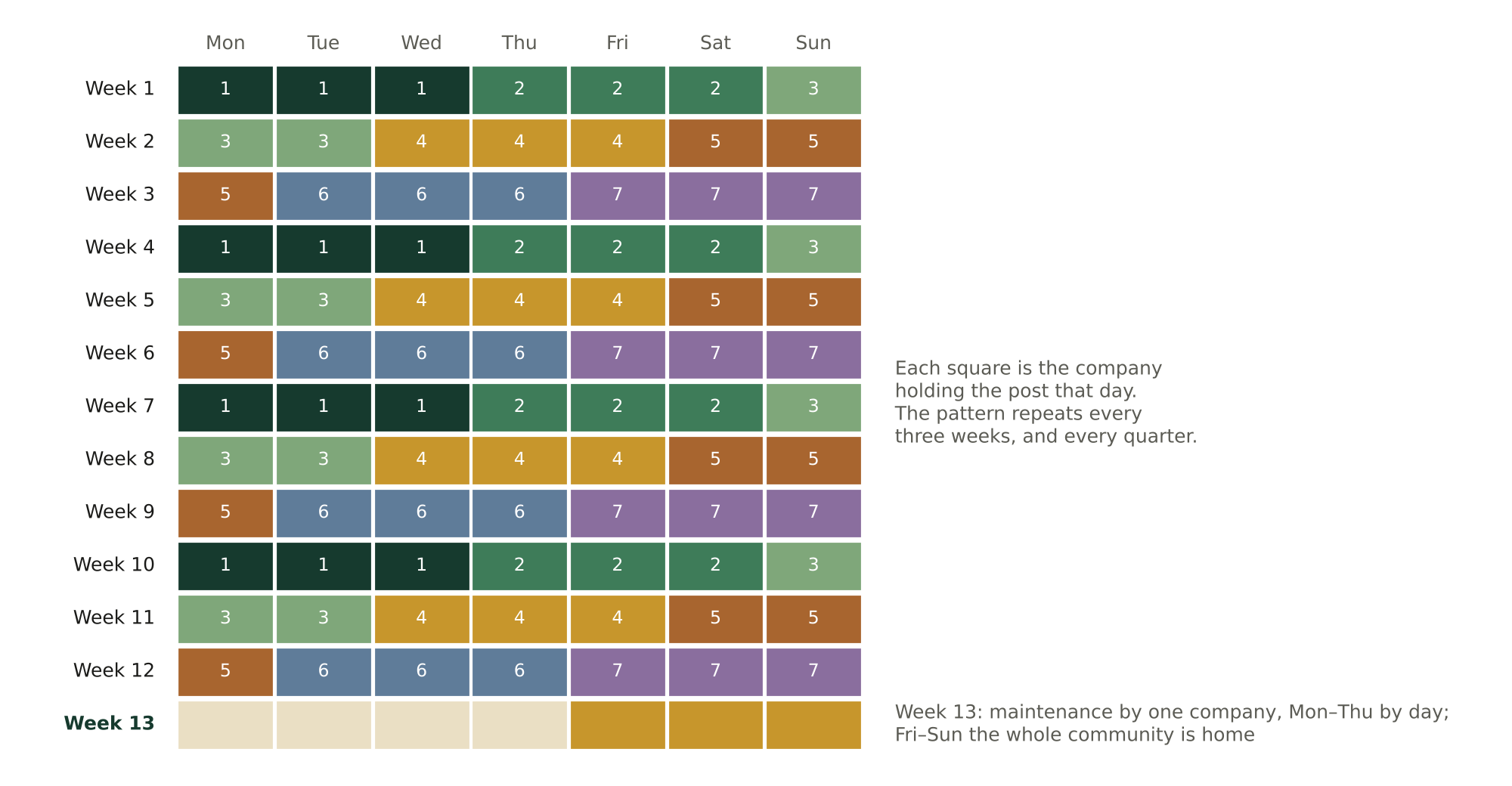
Three-day turns. Weeks 1 to 12 of each quarter are 84 days, which divide exactly into 28 turns of three days. Each company holds every seventh turn. It goes out on the same three days of the week every third week, in the same weeks of every quarter. Company 1, for example, goes Monday to Wednesday of weeks 1, 4, 7 and 10.
Three twelves. In a turn each owner works three twelve-hour shifts, all by day or all by night. The company’s owners take days and nights in turn.
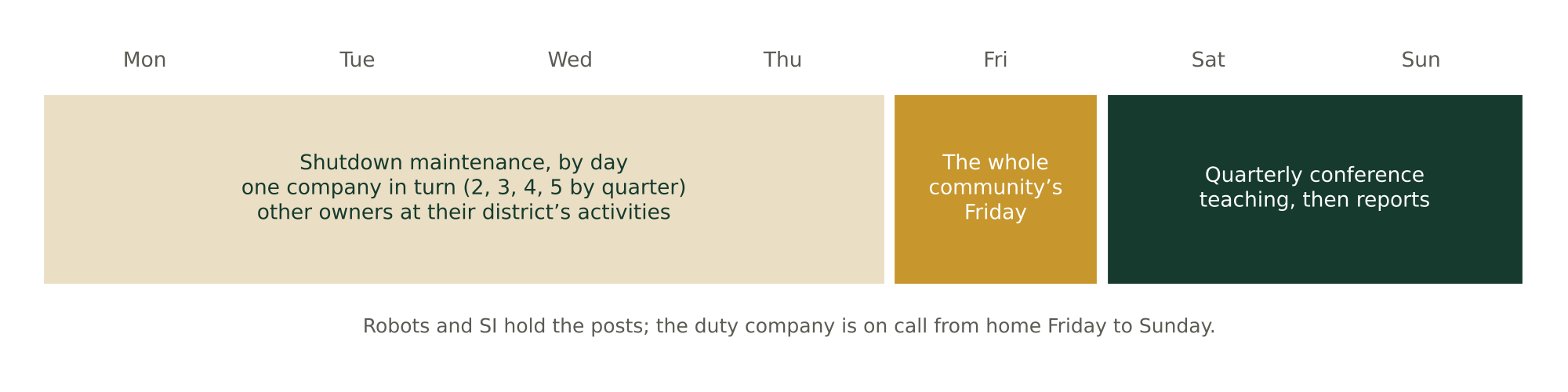
The thirteenth week. No turn is held in the thirteenth week or in Leap Week. Every company is trained to maintain its post as well as to work it. One company in turn does the post’s shutdown maintenance from Monday to Thursday of the thirteenth week, by day: company 2 in the first quarter, 3 in the second, 4 in the third and 5 in the fourth. From Friday to Sunday nobody is away. Robots and SI hold the posts and the duty company is on call from home, so every hinterland owner is at the community’s Friday and at the quarterly conference, every quarter.
Each owner works 12 shifts a quarter: about 148 hours with handovers, against the community’s 240. That leaves room within the twenty-hour week for a business at home if the owner wants one. No owner ever works more than three twelve-hour shifts in a row. The cost is more owners per post: 14 instead of about 9.
1. Why every rotation drifted
The earlier roster, One Week in Four, gave each company every fourth week, counted straight through the year. A quarter has thirteen weeks, and thirteen is a prime number. Any rotation that runs straight through the thirteenth weeks therefore repeats every quarter only if its cycle is one week or thirteen weeks:
every fourth week puts a company’s weeks one week earlier in each new quarter;
every third week puts them two weeks earlier.
This holds whatever the number of companies or the length of the turns. The way out is to stop the rotation for the thirteenth week. Weeks 1 to 12 divide by 2, 3, 4, 6 and 12, so a rotation over those twelve weeks alone repeats exactly in every quarter. The thirteenth week is then held by robots, SI and relief, while the hinterland rests with the community.
That also meets the condition that every hinterland owner has the community’s week off.
2. Would fewer days and more companies solve it?
Yes, once the thirteenth week is set apart. Shorter turns serve three purposes:
The calendar. The 84 days of weeks 1 to 12 divide into 28 turns of three days. Seven companies holding every seventh turn come round every 21 days, which is exactly three weeks, so each company keeps the same days of the week.
The body. Three twelve-hour shifts in a row is the most the UK Health and Safety Executive advises for long shifts and for nights. With all days or all nights in a turn, nobody switches from days to nights mid-turn.
The hours. Four turns of three shifts a quarter is 144 hours, comfortably below the community’s 240.
Other ways of keeping the calendar fixed were tested:
| Calendar the same every quarter | Hours a quarter (community: 240) | Longest run of 12-hour shifts | Owners per post | Thirteenth week at home | |
|---|---|---|---|---|---|
| A. One Week in Four: four companies, every fourth week, counted straight through | no: drifts one week a quarter | about 222 in most quarters, 296 in one | 3 | 9⅓ | three quarters in four |
| B. As A for weeks 1–12, with the stint that runs into week 13 finished in week 1 | yes | about 222 | 3 | 9⅓ | yes, but one company’s stint is split by the thirteenth week every quarter |
| C. Thirteen companies, one week a quarter each | yes | about 74 | 3 | about 30 | no: one company always holds week 13 |
| D. Seven companies, three-day turns every third week (recommended) | yes | about 148 | 3 | 14 | yes |
| E. Seven companies, two-day turns every second week | yes | about 150 | 2 | 14 | yes, but twice the trips |
Table 1. Rosters tested for a calendar that is the same in every quarter.
D gives the simplest rule and the lightest load on the body. It keeps the hours well within the twenty-hour week and needs no special handling at the end of a quarter. B keeps the hours nearer the community’s, but it splits one company’s stint across the thirteenth week every quarter. C takes far more owners, and E doubles the trips for the same hours.
3. What the body can sustain
| Finding | Source |
|---|---|
| Risk on 12-hour shifts is about 27.5% above 8-hour shifts; by the twelfth hour it is double the average of the first eight | Folkard and Tucker, 2003 |
| Against the first night, risk is 6% higher on the second night, 17% on the third and 36% on the fourth | Folkard and Tucker, 2003 |
| Limit runs of shifts over 8 hours, and of nights, to 2–3; at most 12 hours a shift; at least 11 hours between shifts | HSE, Managing shift work (HSG256) |
| At least two nights of full sleep when changing between days and nights; rotate forward | HSG256 |
| At least six hours of uninterrupted sleep on a tour | HSE offshore guidance |
The three-day turn meets each of these:
Runs: three shifts at most.
Days and nights: never mixed within a turn.
Recovery: at least 18 days at home before the next turn.
Rest between shifts: 12 hours.
Changing from nights to days: an owner who did nights in one turn does days in the next, three weeks later, long past the two nights of sleep the guidance asks for.
Nights a year: six in a quarter, twenty-four in a year.
4. The roster
| Company | Days of the turn | Weeks of every quarter |
|---|---|---|
| 1 | Monday to Wednesday | 1, 4, 7, 10 |
| 2 | Thursday to Saturday | 1, 4, 7, 10 |
| 3 | Sunday to Tuesday | 1–2, 4–5, 7–8, 10–11 |
| 4 | Wednesday to Friday | 2, 5, 8, 11 |
| 5 | Saturday to Monday | 2–3, 5–6, 8–9, 11–12 |
| 6 | Tuesday to Thursday | 3, 6, 9, 12 |
| 7 | Friday to Sunday | 3, 6, 9, 12 |
Table 2. The seven companies’ turns, the same in every quarter. Week 13 and Leap Week hold no turn.
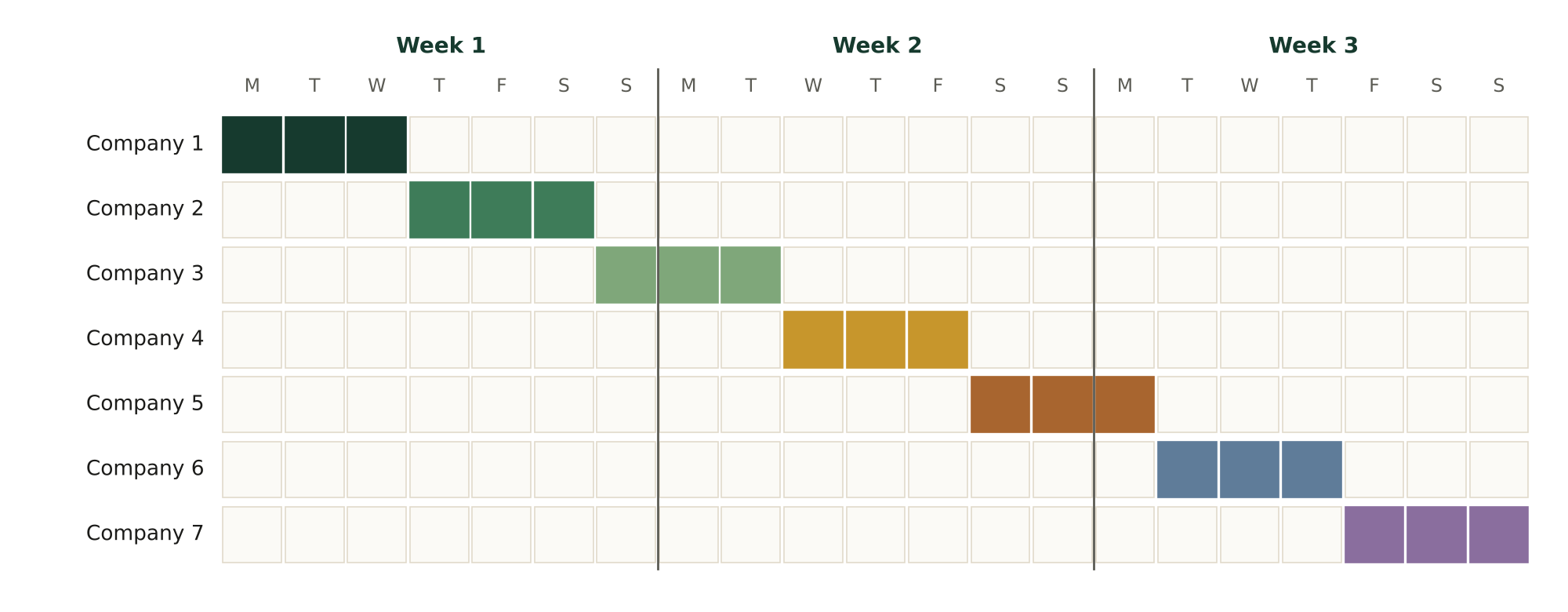
How a turn runs:
Timing. A turn begins at 06:00 on its first day. The day owners work 06:00 to 18:00 on the three days. The night owners work 18:00 to 06:00 on the three nights, the last ending at 06:00 on the morning after the turn.
Handover. The outgoing night owner hands over to the incoming day owner at 06:00, and each evening the day owner hands to the night owner. SI keeps the record of each handover.
Size. A company holds each post with one day owner and one night owner. A post open only by day needs only the day owner.
Days and nights in turn. An owner who works days in weeks 1 and 7 works nights in weeks 4 and 10. A company’s owners alternate turn by turn.
Seasons. At sowing and harvest a company sends more owners on the same days. Small posts, such as one well or one herd watch, share a company with neighbouring communities’ posts in the same field, under the Council of Fifty’s coordination of the hinterland.
5. The thirteenth week and Leap Week
The thirteenth week is when the whole community gathers:
Monday to Thursday: each district’s own activities in its building.
Friday: Bureau 6 gathers the whole community.
Saturday and Sunday: the quarterly conference teaches and then takes its reports.
It is also when the calendar shuts plants down for maintenance. The hinterland needs that maintenance too: the overhaul of the herd robots, the mine and the drill rig, the inspection of wells and lines, and the repair of fences, water points and stores. The question is who does it without anyone losing the community’s week.
5.1 Options for the thirteenth week
| Business enough to sustain it | Away from the community’s Friday and conference | Knows the post | Verdict | |
|---|---|---|---|---|
| A separate company only for the thirteenth week | no: four weeks a year, about 190 hours | every quarter, always | no: there four weeks a year | rejected |
| A relief company that takes its own week off in another week | thin | every quarter | partly | rejected |
| All seven companies in turn for the whole week | yes: part of the post’s lease | once in seven quarters, the whole week | yes | possible, but the Friday and conference are lost |
| A share of each company’s owners every quarter | yes | a few owners every quarter | yes | crews split; owners of companies 1 and 7 would run straight from turn to duty |
| One company in turn, Monday to Thursday only; nobody away Friday to Sunday | yes | never | yes | adopted |
Table 3. Ways to hold the thirteenth week.
A company that worked only the thirteenth week would have four weeks of work a year. That is too little to keep a business, too little to keep its skills, and it would always be away when the community gathers. The answer is to make the week’s maintenance part of every company’s own lease, and to keep it off the days that matter most to the community.
5.2 The rule
Every company is trained and certified to maintain its post as well as to work it. The owners who work the post through the quarter are the ones who know what it needs, and small jobs are done in the turns as they arise.
Shutdown maintenance is done Monday to Thursday of the thirteenth week, by day, by one of the post’s companies in turn. That company brings all its owners: the day owners and the night owners of its turns both work by day, so the overhaul has twice the usual hands. Specialist Business Enterprises join it for the robots and plant.
Friday to Sunday nobody is away. Robots and SI hold the herds and watch the wells and lines, and the duty company is on call from home. Every hinterland owner is at the whole community’s Friday and at the quarterly conference, in every quarter.
Leap Week is held like Friday to Sunday. No duty is worked; robots and SI hold the posts and the fourth quarter’s duty company is on call from home.
5.3 Which company
The duty falls to companies 2, 3, 4 and 5: company 2 in the first quarter, 3 in the second, 4 in the third and 5 in the fourth. Each holds the same thirteenth week every year. Those four have at least six days at home on each side of the duty:
| Company | Days home before the duty | Days home after it | Duty |
|---|---|---|---|
| 1 | 18 | 3½ | none: begins every quarter on Monday of week 1 |
| 2 | 15 | 6½ | first quarter |
| 3 | 12 | 9½ | second quarter |
| 4 | 9 | 12½ | third quarter |
| 5 | 6 | 15½ | fourth quarter |
| 6 | 3 | 18½ | none: works Tuesday to Thursday of week 12 |
| 7 | 0 | 21½ | none: its nights end on Monday morning of week 13 |
Table 4. Rest around a Monday-to-Thursday duty in week 13.
Company 7 cannot take the duty, because its last turn of the quarter ends on the Monday morning the duty begins. Companies 1 and 6 would have only a long weekend on one side. These three companies already carry the quarter’s edges instead: company 7 works the weekend that opens the community’s ten-day break every quarter, company 6 works up to the Thursday before it, and company 1 starts each quarter on its first morning. Each company chooses its turn when it is formed, and owners are paid for the responsibility carried.
A duty company’s owners miss their district’s own activities from Monday to Thursday once a year, and never the community’s Friday or the conference. Their hours that quarter rise from about 148 to about 196, still within the community’s 240.
6. Hours and pay
| Community owner | Hinterland owner | |
|---|---|---|
| Hours a quarter | about 240 (20 × 12) | about 148 (12 shifts × 12, plus handovers) |
| Hours a year | about 960 | about 592 |
| Days away a quarter | none | 12, in four turns |
| Community Friday and conference attended | all four | all four; one duty company misses Monday to Thursday of one thirteenth week a year |
| Longest run of shifts | 5-hour shifts on 4 days | 3 twelve-hour shifts |
Table 5. The two working years compared.
The twenty-hour objective is a standard of plan design. A hinterland owner’s turns stay well inside it. The rest of the twenty hours, if the owner wants them, may go to a business at home in the 18 days between turns. Owners are paid for the responsibility carried, as every continuous service is.
7. Making the twelve hours safe
Breaks: a short break every two hours and a meal break in each shift, counted within the twelve hours.
Heavy work by day: heavy, dangerous or safety-critical work is done in the first eight hours of a day shift. Robots and SI carry the night wherever they can, and a night post is kept only where the work needs a person present.
Sleep: the lodging is leased like every other space and meets the community’s private-domain rule: a private bed and bath, air and acoustic separation, no forced bunking.
Nobody drives. Owners go out and come home by pod or robotaxi, so nobody drives tired after a night.
Records: every hour worked is recorded, and SI watches for fatigue.
8. The rule in full
Remote work. Every remote work of the hinterland — the herd, the grain, the well, the mine, the pipeline, the remote freeway, the rail, the tube, and the drill lot in the ring — is held in turns of three days by seven Business Enterprises on one lease and one set of assets. Weeks one to twelve of each quarter divide into twenty-eight turns, and each Business Enterprise holds every seventh, so that it goes out on the same three days of the week every third week, in the same weeks of every quarter. In a turn each owner works three shifts of twelve hours, all by day or all by night, and the owners take days and nights in turn. No owner works more than twelve shifts a quarter, within the twenty-hour week and its thirteenth week; the rest of the twenty hours may go to a business at home. No turn is held in the thirteenth week or in Leap Week. Every Business Enterprise of a post is trained to maintain it as well as to work it, and its shutdown maintenance is done from Monday to Thursday of the thirteenth week, by day, by the second Business Enterprise of the turns in the first quarter, the third in the second, the fourth in the third, and the fifth in the fourth. From Friday to Sunday, and through Leap Week, nobody is away: robots and SI hold the herds and watch the wells and lines, and the duty Business Enterprise is on call from home, so every owner keeps the community’s Friday and the quarterly conference. A community’s hinterland lies as near as the land allows. Heavy and safety-critical work is done by day; robots and SI carry the night wherever they can, and a night post is kept only where the work needs a person present. Nobody lives at the post, and nobody drives: owners go out and come home by pod or robotaxi. Where robots carry the work, as with the hinterland herds, several Business Enterprises lease the same robots, each under its own lease for its own shifts, custody passing at each shift on the robots’ record; the work is supervised largely from the square, and specialist Business Enterprises do the repairs. The lodging of a turn is leased like every other space and meets the community’s private-domain rule: a private bed and bath, air and acoustic separation, and no forced bunking.
Sources
Folkard, S. and Tucker, P. (2003), “Shift work, safety and productivity,” Occupational Medicine 53: 95–101; summary at NIOSH, work schedules abstracts.
Health and Safety Executive, Managing shift work (HSG256), pp. 23–29.
Health and Safety Executive, Offshore working hours guidance.
NewVistas, Twenty Hours, Four Days, and the Thirteenth Week, Bureau 6 white paper (October 10, 2026).
NewVistas, The 13-Week Quarter Calendar and Leap Week System.