Part Ten: The Environment — The Thousand Year Standard

residential windows and public community buildings, as well as from other vantage points throughout each of the 96 villages and 24 district buildings.
FOOD, LAND & RESTORATION — Fill the world while consuming less of it
NewVistas is designed to support a larger population on much less land—and return the rest to restoration. Compact settlement, vertical and controlled-environment farming, and a plant-centered diet sharply reduce humanity’s footprint. Even with half again of today’s population, the full NewVistas pattern would use about one-third of the land civilization uses now and only about one-eighth of the planet’s land surface. The land freed by this shift is not abandoned—it is restored.
Freed Land is Actively Tended
Roughly twelve to thirteen million square miles, which is about the scale of today’s farmland, would be released if NewVistas communities were implemented. But wilderness does not maintain itself once people are its only occupants: large animals must be restored or represented by managed herds, and fire must be reintroduced under control. In this way, grasslands, forests, rivers, and coasts can recover and remain healthy. NewVistas communities could occupy those lands, while Enterprise Owners operating under Bureau 6 would manage them as travel and leisure become a major field of enterprises.
The remaining land is freed not to sit idle, but to recover—a fully inhabited earth ends greener and healthier.
On the Worldwide Settlement Pattern
The savings come from density, vertical and controlled-environment farming, and the limited consumption of grass-fed meat, an increase of whole grains as the staple, and no food crops grown for fuel. These practices are governed by the standards of the District’s Bureau 4 that oversees Food, Nutrition, Agriculture & Health.
Summary
Food, Land & Restoration captures the concept’s central promise: fill the world while using less of it. Density, controlled-environment farming, and a plantcentered diet would reduce the human footprint from about one-third of land for civilization to roughly one-eighth of the planet’s land surface, freeing an area comparable to all current farmland. That land is then restored rather than abandoned, with herds and controlled fire returned under Leisure Bureau 6. To make this lasting, the system needs a governing rule for land use: “the Thousand-Year Standard.”
The Thousand-Year Standard
The standard establishes a demanding test where every practice is judged by one question:
“Repeated for a thousand years, would it leave the community’s soil, water, biodiversity, productive capacity, and human health stronger or weaker?”
Any activity that consumes a resource faster than nature can renew it fails that test, regardless of how profitable it may appear in the short term.
A food system that delivers abundant calories while exhausting soil, shrinking biodiversity, or draining water is not a success; it is a deferred failure. Profit cannot redeem a system that destroys the conditions that make production possible. The true measure is endurance, not output.
The standard therefore demands active enterprises, not disguised extraction.
Strengthen the Biological Base
Water makes the case unmistakable. Pumping ancient aquifer water to grow grain in a desert is not sustainable agriculture; it is the liquidation of water accumulated over millennia, and the NewVistas standard rightly prohibits it. The affirmative obligation is just as strong:
Every Business Enterprise must preserve or improve the biological assets it depends on while still carrying its Owner’s Draw, meeting its obligations, and generating residual.
This principle mirrors Materials Continuity in the material sequence: recover first, and reject speculative extraction. Food/Health Bureau 4 gives the standard force through published rules on soil health, food safety, biodiversity, and agricultural suitability. It defines the boundary conditions clearly, without taking over the farms themselves.
Summary
The Thousand-Year Standard permits only practices that can plausibly endure for a thousand years. Anything that depletes resources faster than they renew must be rejected, no matter how profitable it looks today. Unsustainable extraction-such as mining aquifer water to grow desert grain-is not innovation; it is depletion by another name. Each enterprise must preserve or improve the biological base it relies on while producing enough output and residual to meet its obligations. Governed by Food/Health Bureau 4, the standard advances a clear principle: agriculture must strengthen the living systems it uses, and ecological siting is the practical tool for deciding where each kind of farming belongs.
Ecological Siting The landscape determines the farming type.
The governing principle of all hinterland agriculture is ecological siting:
The landscape must determine the farming system, not be forced to accommodate it.
Durable abundance comes only when each system stays within its natural ecological limits.
NewVistas therefore rejects practices that fight the land: irrigating dry ground for rice, draining aquifers to keep grain alive through drought, or imposing grazing on landscapes that did not evolve with large herbivores. Where a crop’s natural conditions are absent, the more responsible-and more resilient-choice is to leave the land as wilderness.
Restoration, Not Imposition
When systems such as grazing, and dry and wet farming are properly sited, agriculture becomes a restorative force rather than an extractive burden.
- Dry farming builds soil carbon through disciplined rotation;
- Wet farming works with existing flood cycles instead of resisting them;
- Grazing, limited to grasslands shaped by megafauna, restores a broken biological loop as: ○hooves open the soil surface; ○manure returns nutrients; ○rotation gives the land time to recover.
Grazing siting is therefore not merely an economic decision—it is an ecological obligation. The land itself provides the proof. The Food/Health Bureau 4 establishes agricultural-suitability, aquiferprotection, and ecological-placement standards, while Metrics Bureau 18 measures soil health, water infiltration, and biodiversity over time. In this system, siting is validated by results, not rhetoric.
Summary
Ecological siting makes a simple but powerful claim: the landscape should determine the farming system. Dry farms belong where rainfall is sufficient, wet farms where water is naturally abundant, and grazing only where grasslands were shaped by large herds. Within those limits, agriculture can restore as it produces, and Bureau 18 can verify progress in soil, water, and biodiversity. This living diversity is not a constraint on prosperity; it is the basis of it.
Biodiversity as Capital
Thousands of species for resilience.
Biodiversity is not a luxury or an ornament; it is productive capital. A food civilization built on narrow crop genetics, monoculture, and standardized commodities is unnecessarily vulnerable, while one that deliberately cultivates thousands of species and varieties builds resilience into its foundation.
That resilience has concrete value: diversity shields communities against crop disease, climate instability, market shocks, nutritional erosion, and ecological disruption. In practice, variety is the insurance policy that keeps the food system functioning when any single crop, supply chain, or market fails.
Biodiversity must be treated as productive capital. Preserved through cultivation, not locked away in storage.
NewVistas box-garden greenhouses and parkstreet systems turn preservation into daily practice by operating as living seed networks. Rare herbs, heirloom cultivars, regionally adapted varieties, medicinal plants, pollinator flowers, and specialty crops remain viable because they are grown, used, observed, and adapted-not sealed away in passive vaults—keeping the genetic library alive within the community itself.
Health/Food Bureau 4 gives these systems credibility by setting admissibility, safety, medicinalquality, and food-chain standards. Publication Bureau 17 makes them durable by training people in seed preservation, medicinal cultivation, and pollinator Business Enterprise, ensuring that biodiversity is not only protected but actively renewed across generations.
Summary
Biodiversity as capital makes a simple but powerful claim:
Genetic, culinary, medicinal, and ecological variety is a productive asset, not a decorative preference.
A food civilization that cultivates thousands of species and varieties is better equipped to withstand disease, climate volatility, market disruption, and nutritional decline. By preserving this diversity through active cultivation in box-garden greenhouses and park streets-living seed networks rather than passive vaults-the system keeps resilience embedded in everyday life. Bureau 4 supplies the standards, Bureau 17 transmits the practices, and footprint accounting proves that biodiversity is an economic strategy as much as an ecological one.
Footprint Accounting:
True land cost made visible in the economics
The environmental rule succeeds because it uses economics instead of prohibition. By building the true land and resource cost into the price of each good, the footprint fee makes every choice honest: the burden is no longer hidden, shifted, or ignored.
High-impact goods are not outlawed; they remain available to anyone who chooses them. Refined flour, added sugar and fat, alcohol, coffee, tea, and chocolate carry a confidential, per-individual footprint fee that reflects true land and resource cost, calibrated by Metrics Bureau 18 under Food/Health Bureau 4 standards. Bureau 18 measures and calibrates; it collects no funds and sets no personal penalties, and the individual calculation remains inside the participant’s own proof and accounting environment. Whole and cracked grain, along with genuine whole-grain bread, carry no footprint fee, while refined flour and foods with significant added sugar or fat bear it.. The fee is not a tax and creates no taxing authority: it is a published price signal on burden, each product’s base rate and escalation curve is set by Bureau 4 on Bureau 18 calibrations assessed per individual.
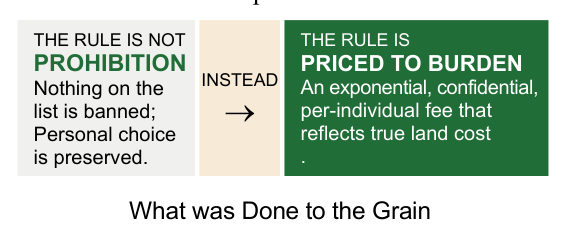
The fee is grounded in actual burden, not in marketing labels. What matters is what was done to the grain: whole and cracked grain, along with genuine whole-grain bread, remain ordinary untaxed food, while refined flour and foods with significant added sugar or fat become taxed luxuries. Cookies, cakes, pastries, and most mass-produced white bread therefore belong in the same category. This approach makes the healthier, lower-footprint choice the easiest and cheapest one, guiding behavior through open-terms price signals rather than force. The goods are never forbidden; they are priced according to the burden they impose, making diet architecture a matter of open-terms economic accountability rather than state prohibition.
The fee draws authority from Metrics Bureau 18 measurements and the standards of the domain Health/Food Bureau 4. Because it is confidential and per-individual, it changes incentives without exposing anyone’s private diet. This makes the system both effective and dignified, linking the environmental rule directly to the community’s economic system.
Summary
Footprint accounting gives the environmental rule its practical force by replacing bans with accountable pricing. A confidential exponential, per-individual fee that rises with use makes the true land cost of highburden goods visible in their price, so impact cannot be hidden or passed on to others. Nothing is forbidden: refined confection, alcohol, coffee, and similar goods remain available, but they are priced according to burden, based on what was done to the food rather than what it is called, using Metrics Bureau 18 measurements and Health/Food Bureau 4 standards. With price replacing prohibition, the thousand-year timeline turns restraint into an honest economic signal and closes the loop back to Food, Land & Restoration.
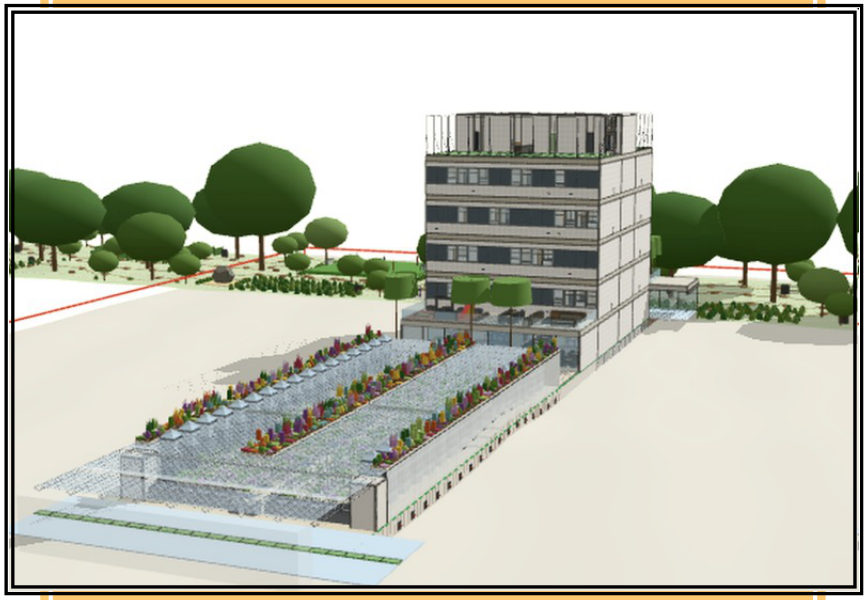
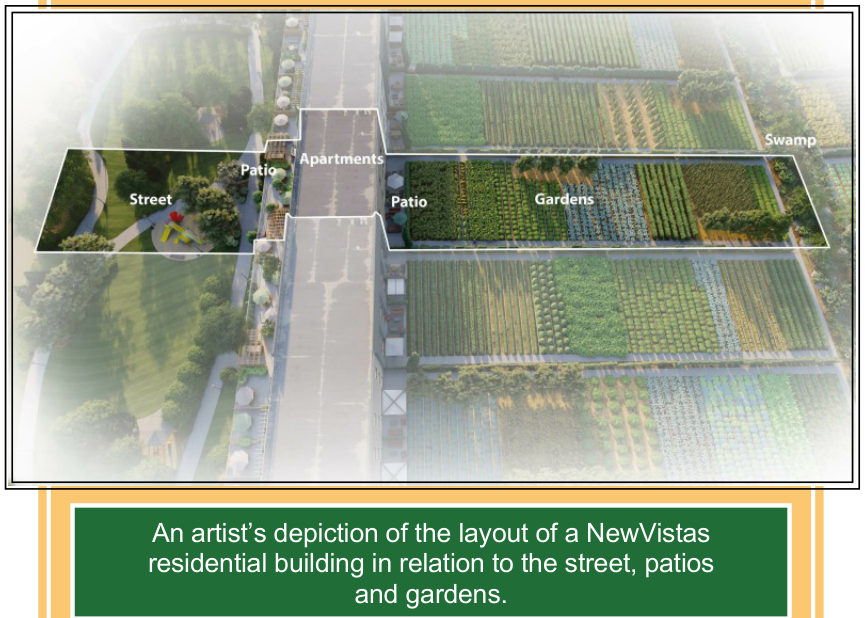
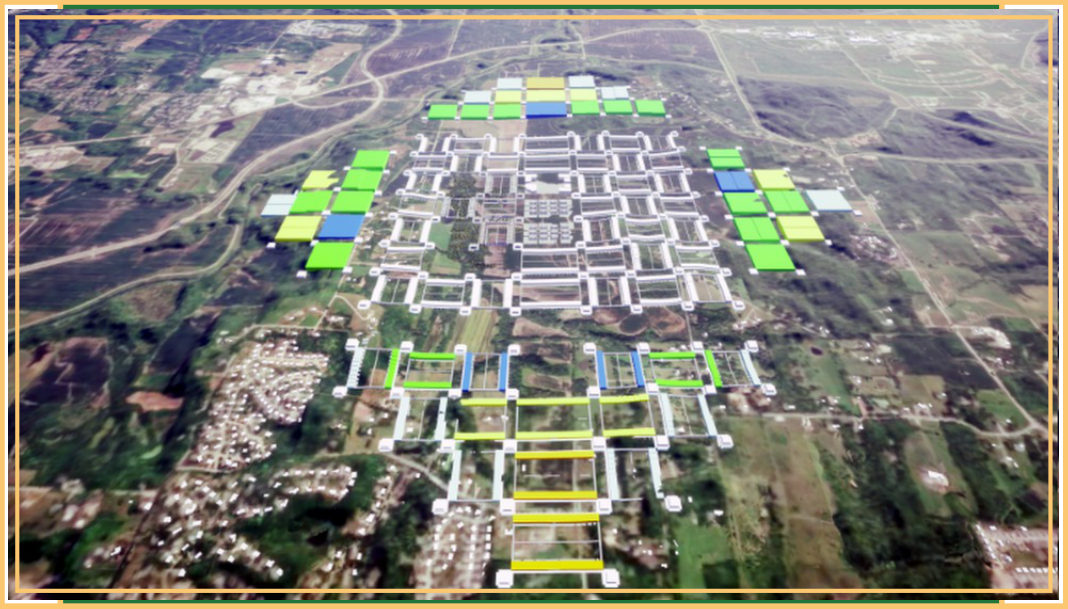
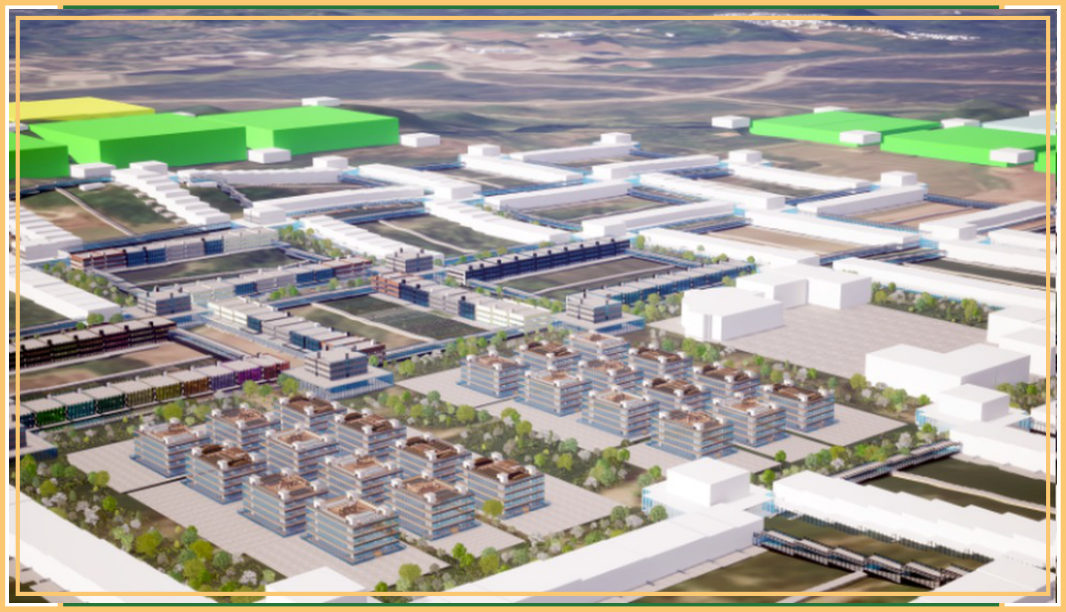
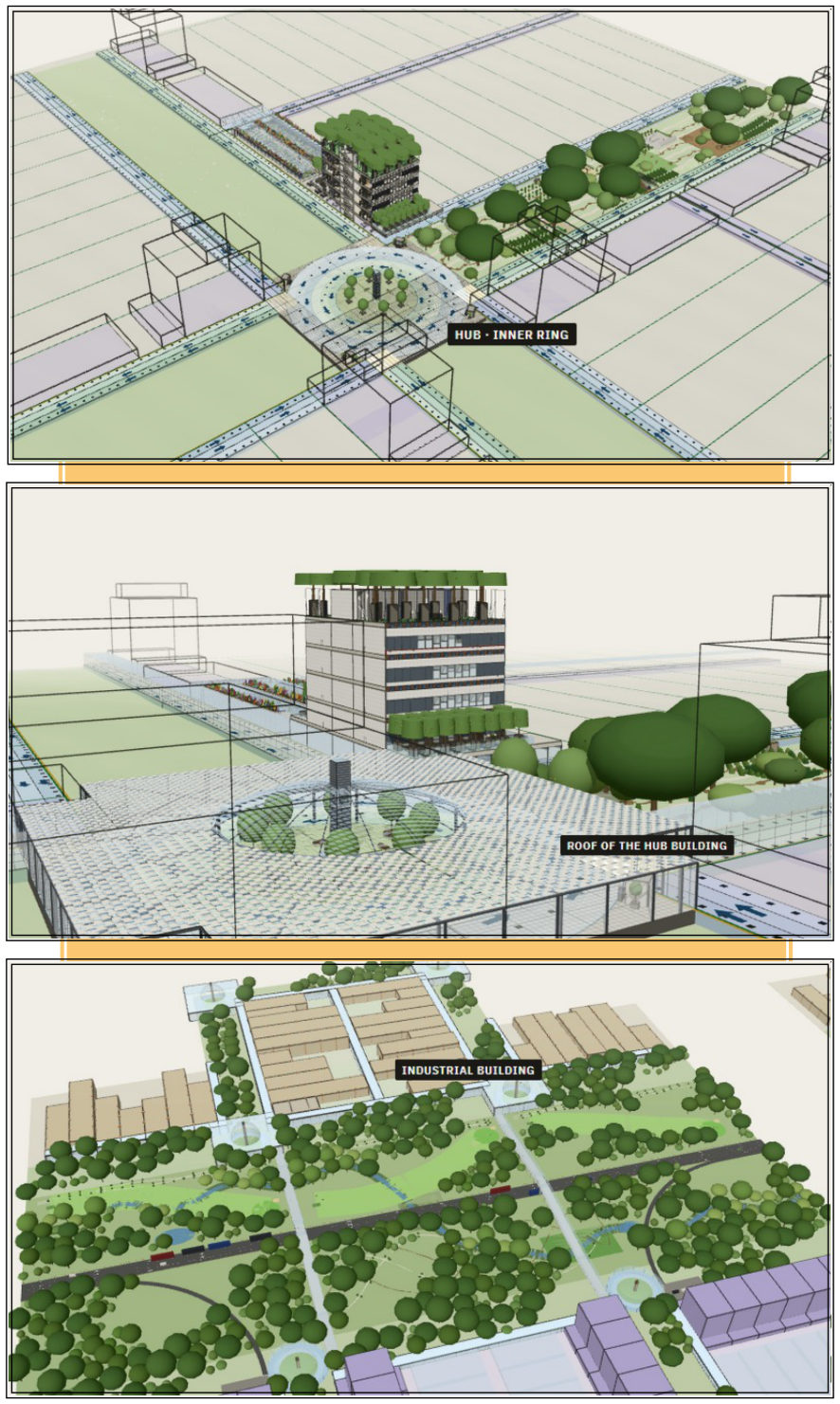
Artist’s interpretation of a NewVistas with its mirrored villages
APPENDIX
The NewVistas Constitution Highlights
The NewVistas Constitution in Brief The NewVistas Constants The Original Documents as One System One Mile (6,336 feet or 1.2 miles) Square Original Terms: NewVistas Equivalents NewVistas Entry by Agreement and Total Conveyance Unified Title “Kept” and “Administer”
The Owner’s Draw Method Capital, Governed Credit, and Succession Credit The Office Corps and the Duty to Teach Cadence of Governing Bodies
Page 196-197
199-202
204-205
The NewVistas Constitution in Brief
The Pattern. One mile (6,336 feet or 1.2 miles) square: 96 villages, 24 districts, 960 residential buildings for 92,160 permanent residents, and 24 public HOUSES of 80 offices.
Economic system. Entry is total conveyance by agreement and Deed; the Community Asset Trust holds title, and each Enterprise Owner, owning 100% of a Business Enterprise run for profit in open competition, holds custody by lease at market rent. Each Business Enterprise first meets its obligations and Owner’s Draw, then the Community 10% Fee and taxes; its residual is kept as productive capital and administered, in sequence, to the have-not, the poor, and the needy by creating, restoring, and preserving Business Enterprises, then to purchasing land and building. Only the three title repositories borrow for the community, each on its own listed assets. No override passes the TOK gate. Every SI agent and robot works under the Enterprise Owner who trains, directs, and verifies it, and what it learns belongs to the owner’s business.
Governance. Four equal Segment courts of 480 seats hold 1,920 presidents: 480 presidencies of four, 640 of three, 184 councils of twelve. Bureaus govern standards only; Enterprise Owners operate. No body stands over another.
Office. Each president stands in one office and teaches its duty. Presiding rotates; random draw fills seats from a narrowed qualified field; terms run four years, one seat released yearly on the departing president’s birthday; service from thirty to seventy-two.
Time. Thirteen-week quarters: twelve operating weeks, one of conference and restoration. Every rented space is used by the hour: forty-five minutes from the hour, the last quarter for the changeover. A four-day week, Monday through Thursday, and every Life Plan and Business Enterprise Plan designed so that the Business Enterprise carries the household’s Owner’s Draw, and significantly more, on no more than twenty hours a week of the Enterprise Owner’s time.
Replication. Each community is laid off again “in the same way”, independent of every other. The Institute licenses buildings. The Council of Fifty coordinates once fifty communities exist.
Startup. A qualified founder; a council of twelve by random draw; a property manager by contract; forty renters on three-year leases; then forty residential buildings and a district public HOUSE; the closing and full operation at eight districts.
Amendment. Originated by a president within the bureau it affects, decided by three of that presidency of four and carried by all four, approved by seven of its council of twelve, presented at conference, approved by the 1,920 presidents and the adult participants, tried, and ratified by a second adult vote.
Entry and exit. Sponsored, reversible tiers precede one irreversible conveyance; conveyed property never returns once the trial year closes; no Enterprise Owner leaves holding a Business Enterprise.
Participation. Self-declared status fixes each A-B-C-D Segment. Nothing is held jointly. Every participant is an Enterprise Owner or the dependent of exactly one, so no one is without housing or a responsible person; most young people form an Enterprise LLC by about age sixteen, and the goal is independence by age eighteen. Only memorabilia passes at death. Each participant holds one Enterprise LLC for life in the community, never sold or transferred; a Business Enterprise passes to a successor only by license and consulting, paid from profit verified each quarter under the profit-first royalty: ordinary income to the licensor, an operating expense to the successor, never a capital purchase.
Civil interface. No civil authority: a nonprofit community foundation holding title through the Community Asset Trust, each Business Enterprise operated by its Enterprise Owner’s Enterprise LLC, owned wholly by that Enterprise Owner and without employees, all under the law of the land and banked by outside banks. It works with its civil area and keeps its law, pays every tax and fee when due, and takes any reduction only on terms the law gives every taxpayer; its participants claim every benefit the law gives them, and home-school their children at their own cost where the law permits.
Food and land. Plants first, grain the staff, meat sparingly, and red meat within the health ceiling. Farm leases run from two to fifteen acres; hinterlands are restored by robot-led mixed herds.
The NewVistas Constants
| Mile (PLOT) | 6,336 ft = 384 rods on each side = 1.2 statute mi; plat 1.44 sq mi to the easement center lines, 2.88 sq mi with the mirrored villages. |
|---|---|
| Rod, perch, pole | 16.5 ft; the perch governs the PLOT. |
| Block; village square | 40 rods = 660 ft; 8 perches = 132 ft, the PLOT’s street; the corner easement 132 ft square. |
| Public HOUSE | Shell 132 × 88 ft = 64 × 43 grids and three 3.07-in frame easements = 40.23 × 26.875 m, long axis East–West; outer band one perch = 8 grids = 5 m. |
| Court | 99 × 55 ft = 48 × 27 grids and three easements = 30.23 × 16.875 m (66 ft + two one-perch end courts); 480 seats, 20 rows × 24. |
| Seat layout | 27 × 48 grids; end court 4 rows of 21 = 84 each end; 84 + 84 + 288 + 12 + 12 = 480; seat 1 grid, row pitch 2; stand seats 24 in a court, 96 in all. |
| Squares and blocks | Central square 60 × 40 perches = 990 × 660 ft, 12 public HOUSEs (4 × 3); two such squares carry the 24. Courts 4 perches interior, 8 perimeter: 3 × 4 + 2 × 8 = 28; 2 × 4 + 2 × 8 = 24. |
| Third square | 660 × 990 ft; 4 corner Centres and 34 warehouses; field 105.8 × 206.4 m inside the breezeway; 612 boxes, 13,464 seats. |
| Seats and courts | 660 × 990 ft; 4 corner Centres and 34 warehouses; field 105.8 × 206.4 m inside the breezeway; 612 boxes, 13,464 seats |
| Office closure | 24 (level 5) + 24 (level 3) + 20 + 12 (level 1) = 80; levels 2 and 4 double-height courts. |
| .Presidencies of three | 160 a court: 152 Segment (608) + 8 department (32); 640 in all. |
| Councils of twelve | 184: 176 cross-Segment (96 village, 24 district, 24 bureau, 24 data and origination, 8 department coordination) + 8 Segment |
| Presidents; floor captains | 1,920 presidents (5.12); 3,840 floor captains, one to each Unit; 960 Branches. |
| Villages and departments | 96 villages; 24 districts, 24 district HOUSEs; 8 departments; 24 bureaus. |
| Calendar | Quarter 13 weeks: 12 operational + 1 conference and restoration; weekly cadence |
| Working week | Monday–Thursday; every Life Plan and Business Enterprise Plan designed for at most 20 hours a week of the Enterprise Owner’s time, at most 960 hours a year over 48 operating weeks; continuous service in shifts of at most 5 hours. |
| Entry age | Youth contracts from about age twelve; own Enterprise LLC from about age sixteen; goal of independence by age eighteen. |
The Original Documents as One System
| DOC | Recorded | Layer it Preserves |
|---|---|---|
| LAW | 9 and 23 February 1831 | Conveyance, title, Business Enterprise, Owner’s Draw, residual, continuance |
| PLOT | May 1833 | Civic scale, public-building placement, replication, the city’s governing arithmetic |
| BUILD | 6 May 1833 | The command to build the community and the two selected HOUSEs, each with lower and higher courts according to the pattern |
| SCHOOL | 1 June 1833 | The 65 × 55 ft inner court and its lower and higher parts |
| HOUSE | 4 June 1833 | Internal architectural anatomy |
| QUORUM | 11 November 1831 | The four group sizes; each president teaches duty |
| STAND | 22-23 September 1832 | “let every man stand in his own office, and labor in his own calling” |
| ROTATE | 27 February 1835 | Rotating presiding and clerking |
| CHOSEN | Acts 1 (KJV Bible) | Narrowing and final selection by random draw |
| ROOM | 19 February 1841 | “prepare rooms for all these offices in my house”: a room for every office, 80 in a building, 1,920 in all |
Other original documents refine finer points (term length; age limits; and related detail); DOCS remain the controlling set.
The reading rule. DOCS are read together, word for word and number for number, as one constrained set.
Measurements, counts, assignments, offices, and repeated patterns are taken literally, and the institutional system is what they disclose when their terms and dependencies are followed exactly. The recurring integers —96 villages; 24 public HOUSEs, eight rows of three, four courts, 80 offices per HOUSE, 1,920 offices — are tolerance-tight: alter one and dependent relations fail.
One Mile (6,336 feet or 1.2 miles) Square
The PLOT contains one mile (6,336 feet or 1.2 miles) square, but its mile is not the 5,280-foot statute mile; it is fixed by the PLOT’s own modules. The PLOT measures in rods and perches: one perch (rod) is 16.5 feet, a forty-rod block is 660 feet; an eight-perch street; the village square, is 132 feet. The completed square closes at 384 rods, or 6,336 feet on each side.
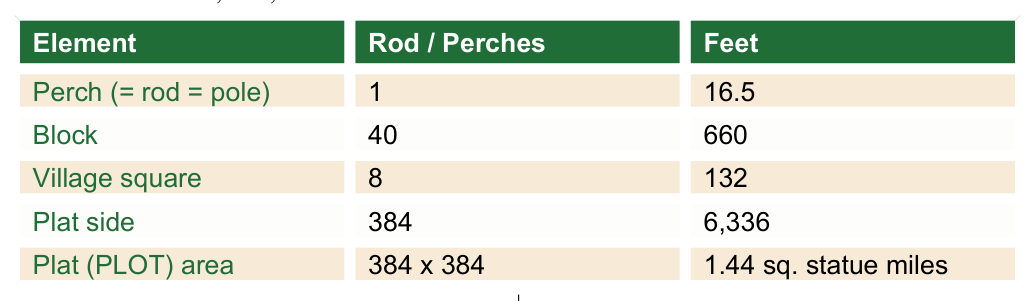
The interior closure. The central band is sixty perches by forty (990 × 660 ft), so the east-west interior is wider than a uniform grid. The north-south interior of seven block rows and eight village squares sums to 5,676 feet; the east-west interior, carrying the 990-foot band, sums to 6,006 feet. Both exceed a statute mile before any edge is added, so the 5,280-foot reading fails on the interior arithmetic alone. The square closes by crediting the boundary strips the text describes: the north and south strips of 660 feet are credited 330 feet to a side, the boundary line running through the strip, and the east and west strips of 330 feet are credited 165 feet to a side on the same rule. Both axes close at 6,336 feet.
The rod-integer test. A rod-based survey’s mile must be a whole number of rods. Only 384 rods satisfies rod integrity and the full grid.
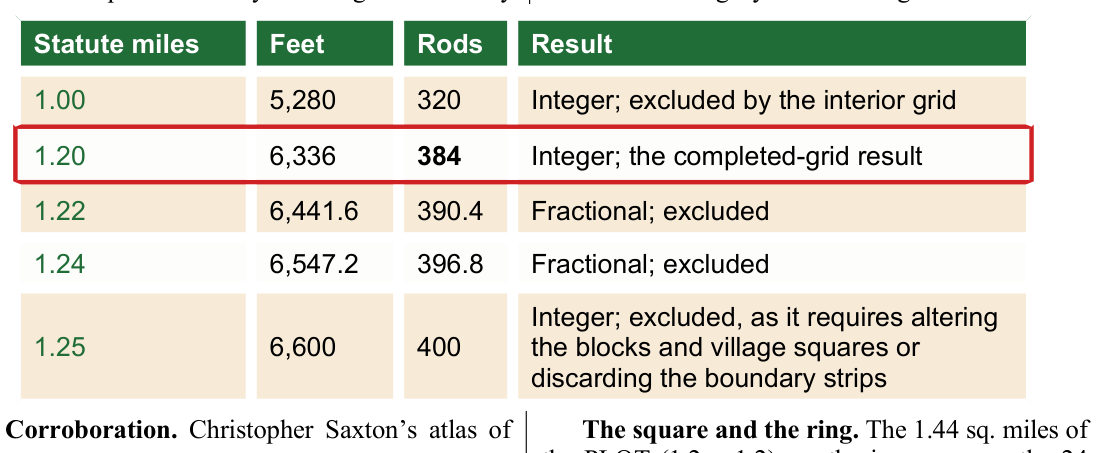
England and Wales (1579) prints its scales as “Scala Miliarium”, and cartometric analysis following Michael J. Ferrar identifies Saxton’s miliarium as about 1.2 statute miles: 1.2 × 5,280 = 6,336. England did not legislate the eight-furlong statute mile until 1593, and customary miles of other lengths persisted beside it. The atlas corroborates the internal proof and does not replace it.
the PLOT (1.2 x 1.2) are the inner square: the 24 districts and their 96 residential villages, measured to the center lines of the four boundary strips, which are the transport and utility easements. Beyond the easements stand the 96 mirrored villages, one numbered for each village of the square; square and ring together are the built community of 2.88 square statute miles. Land is measured in perches and buildings in the grid; the two meet only at the lot line.
Original Terms: NewVistas Equivalents

Office Title
| Bishop | Held title to property and leased it | Department III, Title; title intake and conveyance routing |
|---|---|---|
| Elder | Presiding civil-economic overseer of a local body | Department I, Village; the LAW’s “two of the Elders” at intake |
| High Priest | Senior office of foresight, counsel, oversight | Department II, District |
| Presidency of the high priesthood (Melchizedek) | Governing presidency of the city center | Department IV, Platforms |
| Deacon | Keeper or server; “helps in government” | Department V, Regulatory |
| Teacher | “Messenger to the church”; inward instruction | Department VI, Data |
| Priest (“messenger to the people”) | Carries law and message outward | Department VII, Origination |
| Aaronic (“A standard for the people”) | Supplies a fixed benchmark | Department VIII, Infrastructure |
Economic Term and Procedure
| Agreement / Deed | Binding agreement; conveyance of title | Agreement and Deed |
|---|---|---|
| Enterprise Owner / Business Enterprise | One entrusted with another’s property for productive use; the charge of that trust | Enterprise Owner; Business Enterprise |
| Residue / kept | Surplus remaining; guarded, not consumed | Residual; Kept Residual |
| Administer | Serve the have-not, the poor, and the needy | Administer |
| Sufficient | “sufficient for him self and family” | Owner’s Draw |
| Council | Deliberative governing assembly | Council of twelve |
NewVistas Entry by Agreement and Total Conveyance
“& Behold thou shalt conscrate all thy properties that which thou hast unto me with a covena[n]t and Deed which cannot be broken.” (LAW DOC)
All properties. Conveyance is total: every property a person holds enters the community’s title structure. Deed moves title; the agreement fixes the Enterprise Owner’s protected place in the system after title has moved. The tiers that precede it are stated in pp. 63 and 72; conveyance is the Enterprise Owner tier.
The rent gate. Renting does not begin the economic sequence. To rent, a person opens the permanent account at the community’s external bank into which all wages, income, and revenue flow and from which rent is drawn; the same account becomes the account of the Business Enterprise and the account from which Owner’s Draw is drawn. The agreement-and-Deed sequence begins only at the Enterprise Owner gate.
The personal credit line. A renter may establish a credit line no earlier than six months in; six months is a floor, not a guarantee. The bank also requires net worth of zero or better, measured apart from the excepted debts. The line is personal, extended against the renter’s own still-held title. It consolidates consumer debt and carries the cost of the Life Plan and Business Enterprise Plan, together about ten thousand dollars; the excepted debts stay outside it. The community holds no part of the personal line and assumes no debt.
Title at business launch. Title moves when the Business Enterprise Plan goes into effect and the business is set up, not when the renter decides to proceed. The Enterprise Owner’s Enterprise LLC is formed with the first lease. The community then takes deed and title to all of the person’s property, with full disclosure of its attached liabilities. At the same moment the personal line is retired and its balance absorbed into the Business Enterprise’s credit line, an allocation of the Bureau 7 workingcapital facility. The community neither appraises nor liquidates: the property and its liabilities are held whole in escrow, and the Enterprise Owner continues to manage them.
The trial year. The Enterprise Owner runs the business for a full year of operation, checked at each quarterly review, and at its close elects to continue or to exit.
- Continue. Competing certified liquidation Business Enterprises convert the escrowed property to cash. Proceeds follow the asset class to which Bureau 8 routed each item; they are not residual and never reduce the Business Enterprise’s own credit line, which moves with its plan. The contributed value is the consideration for the Business Enterprise and its leases: it is not carried as a personal stake or a claim against the Trust, and the Enterprise Owner’s return on it is the Business Enterprise, owned outright through the Enterprise LLC.
- Exit. The property is returned exactly as contributed, unappraised and with its liabilities, together with the personal credit line reduced by the principal paid down during the year. That paydown belongs to the Enterprise Owner. The rental agreement runs its normal term; the Enterprise Owner bears only the cost of the plans. The leased assets stay with the community. The Enterprise LLC conveys, without payment, the operating system built during the year to the Community Asset Trust, which licenses it to the next Enterprise Owner after certified Business Enterprise Plan experts rework it.
Death, disability, and business interruption during the trial are carried by the insurance the Business Enterprise Plan requires (4.14). A dispute over the year’s outcome goes to arbitration under the Life Plan and escrow agreement; there is no separate appeal.
Household entry. No Business Enterprise begins before the closing (8.14), and none until the Enterprise Owner and dependents enter together. Before the closing renters keep their personal assets, homes and cars included, under ordinary leases; after it, renting ordinarily lasts a year or two beyond the six-month floor of the credit line (4.24), and nothing but memorabilia is kept outside the structure
Unified Title
“& they Shall be laid before the Bishop … & two of the Elders such as he shall appoint & set apart for that purpose.” (LAW DOC)
Intake. “Laid before” is formal intake: title moves into the community’s repositories. The intake and title routing it names are the function of Property Bureau 8. The two appointed with it are distinct actors already set apart for the incoming process: the entrant’s floor captain at entry, and a village president in the later lease and local path. Bureau 8 receives title, issues receipt of conveyance, and classifies, standardizes, and routes each item by asset class to its repository.
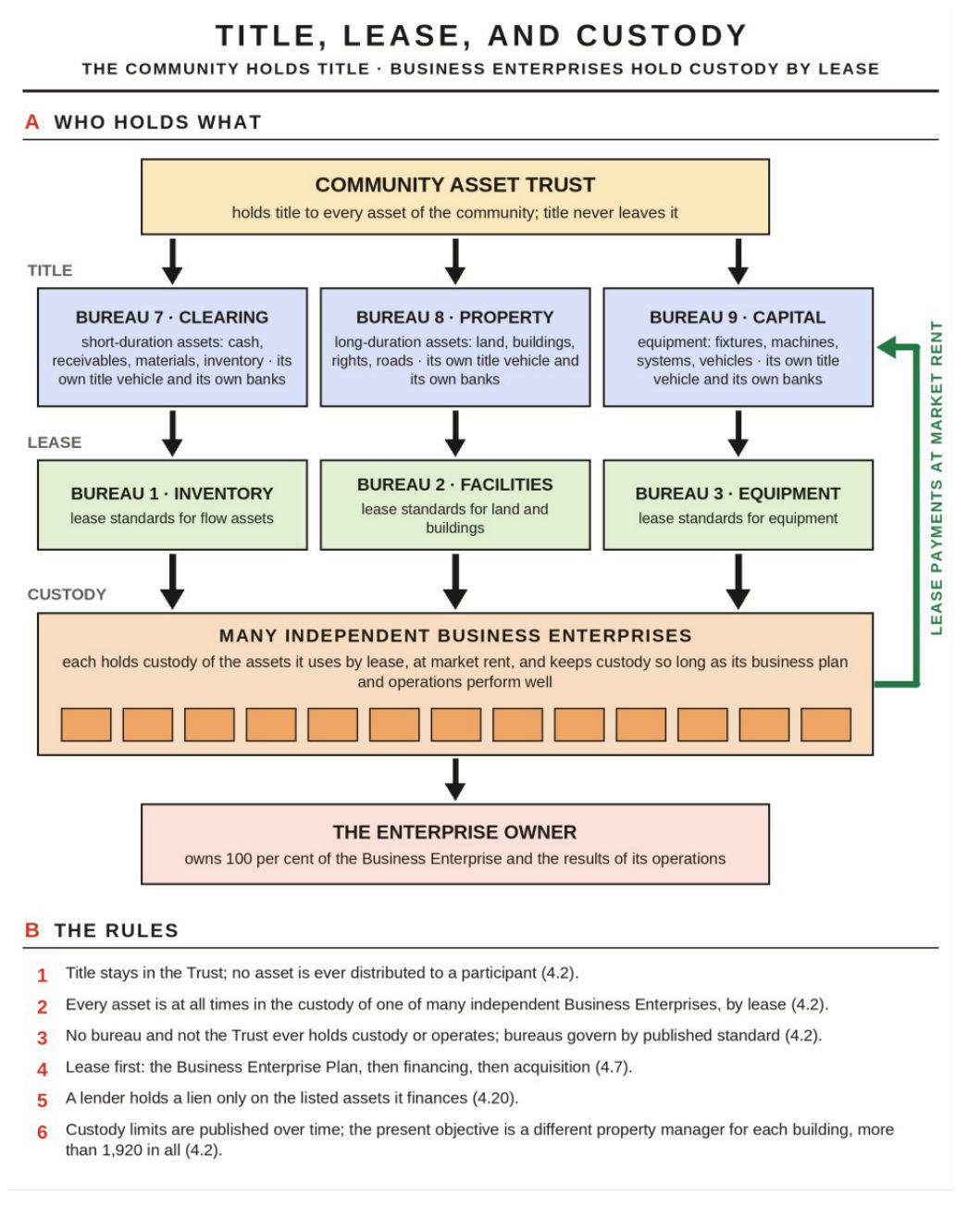
Three repositories. Department III holds title in the three independent repositories, each through its own ring-fenced title vehicle: Clearing Bureau 7, Property Bureau 8 and Capital Bureau 9.
Title in the Trust, custody with Enterprise Owners. The Trust holds title to every asset (see Table on next page), and title never leaves the structure; a lender holds a lien only on the listed assets it finances. No asset is distributed to a participant. Every asset of every class is at all times in the custody of one of many independent Business Enterprises under lease; no bureau and not the Trust ever holds custody or operates.
Use only by fee or subscription. Because every asset is in the custody of a Business Enterprise, nothing in the community is public or ownerless. There is no public bathroom, park, hub, breezeway, lift, stair, deck, or parking. Each Business Enterprise leases its assets from the community and sells their use as a service, and a person uses any of them, a bath and entry unit, a hub park, a breezeway, or a lift alike, only by use fee or subscription, carried in Owner’s Draw. Fees never bars egress or emergency access, which the law of the land requires to stay open at all times.
Custody with many. The Trust leases its assets to many competing Business Enterprises on equal published terms, each keeping custody so long as its business plan and operations perform well. It publishes over time limits on any one Business Enterprise’s share of the custody of each class; until a limit is published where Market Bureau 20 and Underwriting 21 test concentration before a title action places further custody with a large custodian. Beside its property manager, the Business Enterprise holding custody of the building’s structure and envelope and managing it, each public building is in the custody of several Business Enterprises under master leases, for its rooms and courts, units and lifts, storage, water court, and keeping, each sub-leasing by the quarter hour, the hour, the day, or days, or for a longer term signed in advance. The objective is a different property manager with custody of each building: totaling more than 1,920 small propertymanagement Business Enterprises.
The appointment. After Bureau 8 “has received the properties … that it cannot be taken from you,” each is appointed “over his own property or that which he hath received in as much as shall be sufficient for him self and family.” Receipt comes first, protection second, appointment third. In the original, him is struck out and you written in: once title has moved, the Enterprise Owner’s protected relation cannot be taken from the Enterprise Owner. His own property names what was associated with the Enterprise Owner before contribution; that which he hath received names what is received under community title. The Business Enterprise is appointed under community title, never by returning private title.
Modern form. The Enterprise Owner is appointed into a legally recognized Business Enterprise owned 100% by the Enterprise Owner, with protected custody by lease over the assets its plan specifies and governed access to operating credit adequate to carry it. Custody cannot be taken so long as the lease agreements are met; the Enterprise Owner owns the business itself through the Enterprise LLC, the operating system it builds, and the royalties and consulting fees its succession earns.
A real business. The community appoints no nominal Business Enterprise: each is a functioning business with enough leased assets and operating credit to carry its validated Owner’s Draw and leave residual.
“Kept” and “Administer”
“& the residue shall be kept to administer to him that hath not” and “& the residue shall be kept in … store house to administer to the poor and needy as shall be appointed by the Elders … & the Bishop.” (LAW DOC; Those who appoint are the floor captain and the village presidents.)
Control words. “Kept” is repeated each time residual appears and joined each time to “administer”. Both operate at once: administration that consumes principal breaks kept; preservation that produces no action breaks administer. Residual is never a bureau budget, discretionary fund, operating reserve, payroll base, idle liquidity, or spending authority. Kept is preservation in productive motion.
To administer is to operate. Administration is the creation, restoration, preservation, and expansion of Business Enterprise, performed by certified Enterprise Owners, contractors, and subcontractors under published standards, lease-first commitments, the title and finance rails, accounting proof, and due process, while residual remains kept.
Prohibited uses. Residual may not pay salaries or overhead, be redistributed as relief, or fund the startup of new Business Enterprises out of community capital. Those who form packages for entrants and for Enterprise Owners under restoration must add real engineering, industrial, and system value.
Growth without spending residual. The system grows on external credit secured by newly created value. Three sources fund growth without touching what is kept: liquidation proceeds of contributed property; lease profits after taxes, which reduce the debt of their own rail and support that class alone; and, chiefly, value created in formation.
Destination. Residual remaining after the full settlement sequence of the Table shown below is paid to the Community Asset Trust, as each Enterprise Owner contracts at entry, and kept as productive capital. It raises the Trust’s net worth and improves the terms on which each repository finances its own class.
Bonds. As net worth and credit history mature, a repository may refinance with lower-cost bonds in place of bank debt
| Step | Charge | Governing Rule |
|---|---|---|
| 1 | Operating, contractual, lease, license, royalty, consulting, tax-bound and other legally or plan-bound obligations | Recognized through the authorized accounting ontology; royalties computed on accounts verified and recorded under Accounting Bureau 16 each quarter. |
| 2 | Owner’s Draw | The validated constraint produced by the Life Plan and Business Enterprise Plan process, never a participant-proposed number. |
| 3 | Community 10% Fee | One consistently defined base: net profit after Owner’s Draw. |
| 4 | Taxes | Recognized according to the law of the land. |
| 5 | Prior unresolved shortfalls and restricted Bureau 7 loss-treatment | Under their published mathematical rules, on the decision of Clearing Bureau 7 alone. |
| 6 | Final residual | Exists only after the complete sequence, and remains kept. |
The “have-not” is the approved entrant without a viable Business Enterprise. To administer to the “have-not” is to create a Business Enterprise capable of carrying Owner’s Draw and generating residual.
“Poor and needy” name the state of a Business Enterprise—never of a person. A poor Business Enterprise may fail, so that its Owner’s Draw begins to fail, but is restored through a revised Life Plan and Business Enterprise Plan, corrected operations, and practical assistance. It remains viable and can be preserved through temporary governed support and plan correction until profitable operation resumes
The Owner’s Draw Method
What Owner’s Draw is. Owner’s Draw is the participant-specific standard of living for the whole household, established and reviewed quarterly through the Life Plan and Business Enterprise Plan process. It is the validated constraint that process establishes, grounded in both the household’s life requirements and the Business Enterprise’s proven capacity to support them. It is not a wage, salary, average, measure of equality, self-declared preference, entitlement formula, bureau-set figure, or result of any single test or SI model. No participant, contractor, bureau, test, or SI system determines it alone.
The process. The participant provides goals, circumstances, household and dependent needs, abilities, health, preferences, and evidence. A Certified Life Plan Contractor leads the process using validated assessments, demonstrated-work evidence, and SI-assisted analysis. The Life Plan records the household and capability profile; the Business Enterprise Plan tests whether it can be supported sustainably. Origination Department Bureaus 19, 20, and 21 independently test completeness, market evidence, and underwriting. If the resulting draw falls outside the ordinary range, the Contractor’s systems flag it for a defined exception process. An inflated Owner’s Draw fails underwriting; a failing Business Enterprise triggers restoration, never a larger draw.
Bureau 5. Life Plan Bureau 5 governs the method and certifies Contractors; it governs no individual result, writes no one’s plan, and holds no credit or title power.
Certified Life Plan The Contractor. Contractors, each an Enterprise Owner, compete on service, price, reputation, and results. The Enterprise Owner chooses a Contractor—none is assigned—and pays from the personal credit line. The Owner may dismiss a Contractor and hire another, paying for work already completed. The Contractor administers assessments, interprets evidence, challenges goals that exceed demonstrated capability or fail to account for market cost, and integrates each dependent’s Life Plan into the household plan so Owner’s Draw covers everyone.
SI agents monitor Contractors’ work for Bureau 5 against the bylaws and flag unreasonable plans. A Contractor found out of governance loses certification. Monitoring concerns the Contractor’s professional conduct under published rules, not the client; the community keeps no file on any person.
Particular by household. Enterprise Owners with equal ability may have different Owner’s Draws because of children, a disabled dependent, elder care, health, education, or a period of rest or recovery. No ratio or corridor limits a justified difference.
Life first. The Life Plan establishes Owner’s Draw before the Business Enterprise Plan is finalized: the business serves the life. When the Life Plan changes, the Business Enterprise Plan is resized to support the revised draw while preserving residual. Reviews follow the quarterly thirteen-week cycle. A material health or life event—a significant diagnosis, accident, disability, or birth—reopens the process immediately under published Bureau 5 procedures. Care, a dependent’s education already under way, and insurance deductible exposure are never cut to pass underwriting. Instead, the Business Enterprise Plan is revised in order: first scale, asset package, or market; then timing, through a staged path or repayable credit supported by restored operation; and only then elective household lines, which remain the household’s choice.
Raised on proven success. Owner’s Draw also increases with Business Enterprise success. At quarterly review, the Contractor raises it and Bureaus 19, 20, and 21 confirm the revised plan only when three conditions hold: verified profit exceeds the current draw enough to cover the Community 10% Fee and taxes while leaving residual of real community benefit; continuously audited results over enough quarters establish sustained growth rather than a seasonal gain; and the plan supports the higher draw while maintaining residual under a normal downside. A raise must remain in balance with business value: it comes from proven growth, and business value must continue rising alongside it. No ratio, multiple, or formula determines or caps the raise.
Two rewards. Success pays the Enterprise Owner (1) at once in Owner’s Draw and (2) later in business value, realized by license. Each dollar added to Owner’s Draw lowers residual and so business value; with professional advice the Enterprise Owner chooses how much of each quarter’s proven success to take in Owner’s Draw and how much to build into the business.
A raise stands. An earned raise is not reversed for a lean season; the operating line and succession credit carry it. A sustained decline is met by plan revision and, where required, restoration.
A basket of service draws. Apart from memorabilia, household goods are held under community title and bought as services from Enterprise Owners. Owner’s Draw is therefore a flow of recurring and per-use service charges, each separately priced, metered, and visible.
- Housing is drawn by suite: each person has private space, and a household draws the suites it requires. An adapted suite occupies two suite-slots in the building’s inventory but is charged single-suite market rent, the second slot absorbed in the building’s lease economics. Floor spaces, floor captain service, bath and change facilities, guest suites, and Branch-scale facilities, each leased to a Business Enterprise, are service draws.
- Clothing is a weekly clothier delivery for nearly all, with footwear, outerwear, tailoring, repair, student uniforms, sport and ceremonial wear, and presentation consultation varying by household.
- Food is meal subscriptions, drink service, special diets, catering, greenhouse and orchard subscriptions, and recovery meal delivery.
- Education is priced as private service. No bureau pays instructors or funds courses; Learning Mentors and Practice Guides are Enterprise Owners who price each course competitively, with no governed floor fee. The Life Plan provides for each course and the Business Enterprise Plan is sized to carry it; a higher education draw is valid only where the Life Plan and underwriting confirm that it forms future Business Enterprise rather than prestige.
- Per-use access to breezeways, hubs, lifts, bath and entry units, parks, courts, decks, lounges, mobility, clinics, and cultural spaces is metered and charged automatically against Owner’s Draw, for the participant and dependents.
Owner’s Draw and residual. Owner’s Draw is the floor the Business Enterprise must clear; residual exists only above it and is kept.
Market prices. Prices are market-formed; signed leases and verified market evidence are inputs to financing, never outputs of a formula.
Meal/Restaurant Services
Food service. Ordinary breakfast, lunch, and dinner are supplied by Enterprise Owner food-service businesses under Food/Health Bureau 4 standards, not by household cooking. A suite carries a kitchenette, not a kitchen: a small refrigerator for snacks, preference items, and a few fresh prepared meals
delivered during sickness, recovery, caregiving, schedule disruption, or a guest’s visit, and no freezer.
- Restaurants. Each restaurant facility is a professional kitchen and dining room leased in meal-period blocks to separate breakfast, lunch, and dinner Business Enterprises, each with its own service period and preparation, cleaning, and turnover window. There is about one facility to each residential building, roughly 960 at full scale. Each meal-period Business Enterprise serves about 100 subscribers a meal, drawn from the whole community, whose covers turn over the building’s 80 dining seats within the service window.
- Subscription. Customers subscribe through a digital application that records meal commitments, guests, and menu selections ordinarily at least three days before service, so menus are set before raw materials are bought, just in time. The mature community has no walk-in restaurants; guests are added through the same application. A Life Plan may carry a buffer for café and bar requests, placed through the application and never at the café or pub.
- Dual competition. A food Business Enterprise competes first for the facility lease and then continuously for clients, who choose where to take each meal. The Life Plan sets each person’s menu wherever the meal is taken. The facility count is fixed; each meal-period Business Enterprise contracts toward 50 or grows toward 150 subscribers as clients follow the best Enterprise Owners.
- Kitchenette service. One robotics-assisted kitchenette-service Business Enterprise serves ten apartment buildings, 960 long-term and 220 guest suites, 1,180 in all.
The Twenty-Hour Objective
The objective. Every Life Plan and every Business Enterprise Plan carries one shared objective: that the Business Enterprise earn the household’s
validated Owner’s Draw, and significantly more, on no more than twenty hours a week of the Enterprise Owner’s own time, worked within the four-day week and the twelve operating weeks of each quarter. Twenty hours over forty-eight operating weeks is at most 960 hours a year. The objective is a critical principle of the economic system: the time it releases carries the household, education, recreation, the arts, and the governance and service on which the community runs.
The Enterprise Owner sets the schedule. Each Business Enterprise is privately held, owned 100 per cent by its Enterprise Owner. The Enterprise Owner sets its fees, its rates, and its schedule, and may work more or fewer hours in any week. No bureau, president, floor captain, or contractor sets, records, or polices any person’s hours, and no file of hours is kept on any person. The objective governs the design of the plans, never the conduct of the owner.
The community promotes it by design. The community advances the objective through the plans it helps form. Each Business Enterprise Plan is designed, and its asset package compiled, so that its productivity yields the objective: the plan specifies the leased equipment, robotics, and access to SI agents that carry the work beyond the Enterprise Owner’s twenty hours, sized so that at twenty hours the business carries its Owner’s Draw, leases, the Community 10% Fee, and taxes, and leaves residual well above that floor under a normal downside. Robots and SI agents may work the whole week; the Enterprise Owner’s twenty hours carry direction, skill, judgment, and the client.
Long-term value for owner and community. The margin above Owner’s Draw is the purpose of the objective, not a remainder. The Business Enterprise builds business value for its Enterprise Owner, realized by license, and its residual is kept as productive capital in the Community Asset Trust, raising the community’s net worth and financing its growth. A plan that carries Owner’s Draw at twenty hours but builds no long-term value for the Enterprise Owner and the community does not meet the objective.
Tested at origination. Bureau 19 confirms that every Business Enterprise Plan states the Enterprise Owner’s planned weekly hours and the equipment, robotics, and SI access that carry the rest; Bureau 20 verifies the demand behind it; Bureau 21 underwrites its viability at those hours. A plan viable only on thirty, forty, or sixty hours of the owner’s week is redesigned before it originates — by added leased equipment, robotics, or SI access, a different asset package, scale, or market, or a shared facility —never by lengthening the owner’s week. Where a service must run longer than one owner’s twenty hours, the plan shares the facility among several Business Enterprises by meal period, by day block, or by alternating week.
In the Life Plan. The Life Plan carries the objective for the Enterprise Owner and for each dependent who holds a Business Enterprise of his or her own, and plans the time it releases: the long weekends, the thirteenth weeks, Leap Week, and the pursuits each member chooses, under Bureau 6 standards.
Reviewed each quarter. Where the Enterprise Owner finds that the business requires well beyond twenty hours a week to carry its Owner’s Draw, the quarterly review treats it as a defect of the plan —under-equipped, under-priced, or wrongly sized —and revises the Business Enterprise Plan where the draw itself begins to fail, restoration follows. The community’s answer is better equipment and a better plan, never a longer week.
Not a wage. The twenty hours do not measure pay. Owner’s Draw is not a wage, no Business Enterprise is paid by the hour, and the objective sets no ratio, multiple, or cap on Owner’s Draw or business value.
The Owner as Trainer
Trained, not installed. SI agents and robots raise output only as far as a capable person trains, directs, and checks them. A robot learns a task from the person who shows it, watches it, and corrects it; an SI agent learns a practice from the professional who verifies its work and teaches it what the practice requires. Adding agents or robots without such a person does not by itself raise output. The Enterprise Owner is that person for every SI agent and robotic platform in the custody of his or her Business Enterprise. That every working adult is an Enterprise Owner is therefore the arrangement by which the community carries the SI and robotics age.
At every level of capability. SI agents and robots will grow far more capable over the life of every plan. As they do, the Enterprise Owner’s part shifts from doing the work and correcting the machines to directing the work, supplying its context, setting the standard of good work for each client, designing how the work is verified, and answering for it. The principle holds at every level of capability: the more the machines produce, the more depends on the person who directs, verifies, and answers for what they produce, and the more that person’s stake in the result matters.
Why the owner, not the employee or the machine alone. The machine learns best from the person who knows the particular work, stays with it, answers for its output, and keeps what the training earns. An employee is paid for time rather than for training, may be training a replacement, and takes what he or she knows on leaving; machines left without an accountable trainer repeat their errors at scale. The Enterprise Owner is paid for results and never by the hour, holds the equipment in custody by lease, keeps what the trained system earns in the six-step settlement sequence shown in the Table on p. 198, and builds its value into the business.
The training belongs to the business. What the Enterprise Owner teaches SI agents and robots (demonstrations, corrections, checks, methods, data, and the behavior they acquire) is part of the operating system the Enterprise LLC builds and owns, and passes to a successor only by license. The leased platform remains community-titled; what it learns in the owner’s custody is the owner’s. Records of the training follow the privacy rules.
The owner answers for the output. Work done by an SI agent or a robot is the Enterprise Owner’s work. Nothing leaves the Business Enterprise on SI or robotic output that the Enterprise Owner has not verified, or placed under a verification method the owner has proven on that work.
Verification by design. Verification is designed, not left to vigilance, since a person who merely re-reads the work of a capable machine adds little and grows careless as the machine improves. Each bureau’s standards for its domain state when SI or robotic output may be accepted, when an independent second analysis, a sampling audit, or a provenance record is required, and how failures are reported; Metrics Bureau 18 measures outcomes, not only hours saved. The Enterprise Owner chooses the method within those standards and answers for its result.
Planned within the twenty hours. Each Business Enterprise Plan allots part of the Enterprise Owner’s twenty hours to training, correction, and verification, heaviest when a system is new and falling as it learns. Bureau 21 underwrites the plan on that learning path, not on the rated output of the equipment. Learning Mentors and Practice Guides teach the training and checking of SI and robotics as a core skill of every Enterprise Owner under Life Plan Bureau 5 and Publication Bureau 17 standards, and
consolidators deliver each system commissioned to the owner’s plan.
SI agents and robots will become much more capable over each plan’s lifetime. The Enterprise Owner’s role will shift from performing tasks and correcting machines to directing work, providing context, defining quality for each client, designing verification, and remaining accountable for the results.
Capital, Governed Credit, and Succession Credit
Four categories. (1) Owner’s Draw, (2) Business
Enterprise residual, (3)
governed succession credit, and (4) community-side capital are distinct. Residual is kept. Contributed property and community-side profit from leasing assets to Enterprise Owners are community-side capital: they may pay certified contractors for legitimate operating and transition work and may stand as listed collateral in financing of their own class. Each repository finances its own class on its own collateral, and lease profits earned on a class support that class alone. No category is bureau budget or spending authority.
The operating line. The certified Business Enterprise Plan sets the business credit line after the Life Plan defines Owner’s Draw for the Enterprise Owner and dependents. Life Planning is continuous and formally updated quarterly; dependents over twelve update their own elements each quarter within one integrated household plan. The same Owner’s- Draw-first discipline carries into every successor Business Enterprise. The line is reviewed at least quarterly; in the mature system SI agents read the transaction stream against published rules far more often, and a Business Enterprise on plan has its credit widened in time. Operating credit and the nightly sweep follow.
The continuity file. Each quarterly review is the deliberation point after continuous machine-readable evidence has accumulated — health indicators, service draws, education, Business Enterprise performance, household burden. It is a continuity profile, never a transferable identity; Bureau 5 governs the standards by which it is assembled, interpreted, and routed. The certified Life Plan Contractor receives it with the prior quarter’s actions and outcomes and performs triage and redesign.
Accounted apart. Royalties and consulting fees an Enterprise LLC receives as licensor are succession receipts. Bureau 16 accounts them apart from the profit of the Business Enterprise that Enterprise LLC operates. They are never residual of that Business Enterprise and never the Owner’s Draw.
Their own sequence. Succession receipts bear the Community 10% Fee and then taxes. A royalty paid by one Enterprise LLC lowers its own Community 10% Fee base and enters the licensor’s base in turn, so the community’s base across the two is unchanged. What remains after fee and taxes is the Enterprise Owner’s own, credited to his or her succession credit. While the Enterprise Owner remains in the community, that cash follows the no-positive-balance rule. It is deposited into the Enterprise LLC’s credit structure and swept nightly against the Bureau 7 facility, and the succession credit rises by the same amount plus interest at the applicable community rate.
What it buys. The Enterprise Owner draws on succession credit when current production falls short of a valid Owner’s Draw, for example during:
- Community or external service;
- A sabbatical or retirement;
- A slow-maturing or low-revenue Business Enterprise;
- A lean season.
It buys time only: never a larger Owner’s Draw, never an inheritance, or an office. It satisfies the full-time service qualification on the record of verified quarters Accounting Bureau 16 holds.
Exit and death. On leaving the community the Enterprise Owner first passes the Business Enterprise to a successor and succession credit passes into the exit stream. Succession credit lasts for the Enterprise Owner’s life; on death unused credit reverts under the community-side capital rule.
Continuing dependent care. Reversion does not extinguish a validated responsibility for a dependent who cannot reasonably become independent. The plans provide for it by an instrument that is durable beyond the Enterprise Owner, purpose-bound to the named dependent’s care, funded to its validated cost, and certified before it is relied upon. Any lawful structure with all four properties may be used —insurance, trust, fiduciary, or credit. The continuingcare bylaw publishes the standards within the Life Plan standards of Bureau 5; Bureau 21 underwrites and Schema Bureau 19 certifies.
The Office Corps and the Duty to Teach
The source. QUORUM DOC (11 November 1831) states one formula four times, varying only the number: “the duty of a president over the office of a Deacon is to preside over twelve Deacons to set in council with them & to teach them their duty”, and repeats it for twenty-four “Teachers”, forty-eight “priests”, and ninety-six “Elders”. In modern terms, a president presides over twelve regulatory presidents, twenty-four data presidents, forty-eight origination
presidents, or ninety-six village presidents. It closes with the rule: “let every man learn his duty & to act in the office in which he is appointed in all diligence.” Three rules follow:
1. Twelve, twenty-four, forty-eight, and ninetysix are constitutional capacities, the integers by which the court closes.
2. The duty is threefold: (i) to preside, (ii) to sit in council, and (iii) to teach.
3. The duty is laid on a president, never on a presidency: an individual president discharges it before the presidents they teach, and a presidency of three meeting them only as a body leaves it undone.
Purpose and size. An office corps carries its department’s system to every village, district, and district building. Every seat of a court belongs to an office corps, to one of the two Segment councils of twelve, or to a department presidency of three.
| Organization | Department / Bureaus | Corps x Size | Seats | Each Covers | Presidencies |
|---|---|---|---|---|---|
| Village Presidents | I-Village / Bureaus 1,2,3 | 3 x 96 | 288 | one village, one bureau | 96 × 3 = 288 |
| District Presidents | II-District / Bureaus 4,5,6 | 3 x 24 | 72 | one district, one bureau | 24 x 3 = 72 |
| Origination Presidents | VII-Origination Bureaus 19,20,21 | 1 x 48 | 48 | one district building, all three bureaus | 24 x 2 = 48 |
| Data Presidents | VI-Data / Bureaus 16,17,18 | 1 x 24 | 24 | one district building, all three bureaus | 24 x 1 = 24 |
| Regulatory Presidents | V-Regulatory / Bureaus 13,14,15 | 1 x 12 | 12 | bureaus n and n + 12; all three bureaus of Department V | 12 |
| Trustee Council | — | 1 x 12 | 12 | bureaus n and n + 12 | 12 |
| Department presidencies of three | One per department | 8 x 3 | 24 | one bureau each | 24 |
| TOTAL | 480 | 480 |
Note: Because every seat is mirrored across the four courts, the seat allocation of one court and the roster of the 480 presidencies of four are the same list.
The Office Corps and the Duty to Teach
Regulators and trustees. Twelve regulatory presidents cannot reach twenty-four buildings, so regulatory seat n covers bureaus n and n + 12; trustee seat n of the Trustee council covers the same pair.
The pairing closes the bureau councils. Twentyfour bureau councils call for seventy-two presidency places. The twenty-four stand presidencies supply twenty-four, the twelve regulatory presidencies twenty-four, and the twelve Trustee council presidencies the remaining twenty-four. The pairing of bureau n with bureau n + 12 is required by this arithmetic, and it is why a trustee or regulator keeps a desk in buildings 1 & 13; 2 & 14, 3 & 15, etc., and holds them on different days.
Trustee, Regulatory, Operating. Each bureau council draws its Trustee presidency from the Trustee council at the west end, its Regulatory presidency from the Regulatory council at the east end (which is why the Regulatory council is taught the duties of Bureaus 13, 14, and 15), and its Operating presidency from the stand, so no bureau governs itself out of one body. These three names govern every council of twelve, including the founding council, the village and district councils, and the Institute council.
Seats of accumulated experience. Neither council of twelve is an entry position. A trustee carries the oversight of title and financial standing across two bureaus, and a Regulatory council member carries innovation, legal, and audit regulation across two. Qualification is tested at application. Both councils sit in two bureau councils per member, so once bureau presidencies become full-time their seats are full-time and the succession qualification applies+
The teaching day. The three presidents of Department V teach the Regulatory council on the Saturday in turn, as every office corps is taught. The Trustee council is not taught, and no president stands over it: its members were taught in every office corps they passed through.
Departments without office corps. Departments III, IV, and VIII have no presidents to teach, because nothing they hold is distributed by village or district:
- Department III: title is kept for the whole community in the three repositories.
- Department IV: the platform is one platform beneath every bureau.
- Department VIII: materials, utilities, and transportation are single physical networks.
Each carries its duty for the whole community from its stand presidency of three, its three bureau presidencies of four, its places in the bureau councils, and its Sunday report.
Two teaching patterns, one rule. Each president teaches the duties of his or her own bureau to those who carry that bureau.
- Distributed corps (village presidents, district presidents). The organization splits into three corps, and each member carries one bureau. Each president teaches one corps and no other: the Bureau 1 president the Bureau 1 village-president corps of ninety-six, and so through Bureau 6.
- Shared corps (origination, data, and regulatory presidents). The corps is too small to split, so each member carries all three bureaus and is taught three times, separately, by the three presidents of the department. No corps receives a combined presentation.
What a member is taught is exactly what they carry into the village, district, or building served.
Stations, not rungs. The responsibilities stand side by side as stations, never as rungs of advancement, and every office corps is taught by name in its numerical form.
Stand in the office: Every person stands in the office appointed and labors in the work assigned (STAND DOC, 22–23 September 1832). An office is a constitutional coordinate: one room, one seat, one presidency relation, one council relation, and one bounded domain of duty. A president learns the work of that office, acts within it, and does not absorb the work of another office on any plea of zeal or capacity. Trustee, Regulatory, Operating, village, district, bureau, floor captain, and service roles remain distinct, and encroachment is visible to peers. A president originates amendments only within the bureau of that office.
Cadence of Governing Bodies
Meeting cadence: every meeting 9:00–9:45 a.m., weeks 1–12
| Governing Body | Day of the week | Meetings a quarter | Presiding Council |
|---|---|---|---|
| Presidencies of four — village, district, bureau, origination, data, Branch | Every Monday | 12 | Each of 4 presides, 3 times a quarter |
| Segment councils of twelve — Trustee council and Regulatory council, four of each | 1st, 2nd and 3rd Tuesday; not the 4th | 9 | Each of 12 presides, 3 times a year |
| Departments I-VIII coordination councils | 2nd Tuesday of the month | 3 | Each of 12 presides once a year |
| Presidencies of three — 152 Segment and 8 department in each court, 640 in all | 4th Tuesday of the month | 3 | Each of 3 presides once a quarter |
| Councils of twelve — village, district, data and origination | Every Thursday | 12 | Each of 12 presides once a quarter |
| Bureau councils of twelve, Bureaus 1–12 | 1st and 3rd Thursdays | 6 | Closes over two quarters |
| Bureau councils of twelve, Bureaus 13–24 | 2nd and 4th Thursdays | 6 | Closes over two quarters |
One presiding closure. The presiding turn of every body runs in office sequence, read off the floor plan, and continues unbroken from quarter to quarter; the clerk is always the member who presided at the meeting before. Where a body meets as many times a quarter as it has members, the cycle closes each quarter; otherwise it closes over as many quarters as it takes, and no member loses a turn. Neither duty can be assigned, withheld, or retained.
Placement. Bureau councils alternate Thursdays because their memberships overlap. Department coordination and Segment councils sit on Tuesday because their members sit in bureau councils on Thursday; on the 4th Tuesday the Segment council seats sit in their presidencies of three.
Branch presidencies — the floor captains of one apartment building — meet on Monday with the presidencies of four, but serve residents rather than govern and never combine into a council of twelve.
← Part Nine: NewVistas Governance — One Integrated SystemBack to the NewVistas Book