Chapter 2: The Economic Engine in Operation
“The residue shall be kept … to administer.”
The LAW, 9 February 1831
Part Two turns the recovered specification into an operating economy. The sequence is deliberate: first, the enterprise lifecycle shows how businesses are created, restored, and preserved without spending kept “residue”; second, “sufficient” and “residue” are defined in operation; third, growth finance explains how new capacity is funded through Enterprise Owner–created value and external credit; fourth, the accounting section shows how the capital base is protected once the Business Enterprise economy is running.
A System of Its Own
An economist will want one answer first: what kind of economy is this? It adopts nothing from any economic system of the modern world, and it is distinct from any known economic principle that has been proposed. The LAW’s economic system begins from a single unit: one person who both performs the work and holds custody of the capital the work needs, multiplied across a bounded community that owns the productive base and governs itself.
The LAW builds its economy on one unit: the individual Enterprise Owner. Each adult holds a single enterprise — a business they own outright, joined to leased custody of the exact capital the work requires: rooms, equipment, inventory, software, and systems. The person who does the work also governs it and holds responsible custody of the tools it needs, so knowledge of the work, control of the means, and the reward for excellence stay together in one accountable hand.
Ownership of the productive base rests with the community. The community holds title to the land, the buildings, the equipment, and the infrastructure, and leases their custody to the Enterprise Owner who puts them to work. The Enterprise Owner owns the business itself — the value created by running it well after the Life Plan Owner’s Draw, loss recovery, community 10% fee, and taxes have been met. That value is real and can be transferred, but only through a governed sale to another qualified Enterprise Owner, paid from the business’s future earnings; the underlying assets stay with the community and are never cashed out.
No one outside hires the Enterprise Owner, and they hire no wage labor. Competition runs at every scale: every adult is an independent Enterprise Owner competing directly for customers, which drives prices toward the lowest level a viable Business Enterprise can sustain. Villages compete with villages, districts with districts, and whole communities with one another for residents, participants, and trade.
Each community is bounded from the start. At full scale it holds no more than 92,160 permanent residents in 960 apartment buildings within a defined footprint. When a community fills, it does not expand into a larger body; a new Council of 12 begins the pattern again as a separate, independent community. Were the pattern to spread across the earth, it would form thousands of communities — up to 130,000 NewVistas — each holding its own title, each governing itself, and each competing with the rest.
What a NewVistas Community Is
Each NewVistas is a private gated community under the civil law of the place where it is located. It is not a city government. It does not tax, police, or claim public authority. With guests and visitors included, the total population is about one hundred thousand. Because every adult has an enterprise and every dependent belongs to a household, the community contains roughly forty thousand individually owned businesses. No one is unattached and no one is unsheltered, because every resident belongs within a household, a captain’s unit, a village, and a district.
The inner community follows a defined 1.44-square-mile pattern, with surrounding farms bringing the full land system to about twenty-five square miles. Those limits matter: a NewVistas cannot keep expanding into a giant centralized body. When it fills, it stops growing. A new Council of 12 starts the same pattern again as a separate community, beginning with one apartment building and growing under the same rules.
This is the key: the LAW caps ownership, multiplies the communities, and keeps competition without creating employees. Ownership is bounded, replicated, and competitive — first, capital is held by a bounded nonprofit community that does not govern like a state, operate businesses, or employ workers; second, that community is capped and then repeated rather than expanded without limit.
The Enterprise Owner’s Business
An Enterprise Owner owns one legally recognized business. That business leases the rooms, equipment, inventory, and other assets it needs through a lease from the proper community rail, but the community keeps title to those assets. The rule is simple and strict: one owner, one enterprise. One owner is responsible for the lease, the custody of the assets, the credit line, and the enterprise. The business does not run on stored cash — it runs on approved credit and lease terms after the required origination checks have cleared.
Part One showed that administer in the LAW is an action word, and that the actor is always a private Enterprise Owner, not a governing body. Residual is administered to three groups in sequence, and in practice these name three ongoing tasks in a working economy:
Create — helping a new entrant become an owner
A “have not” is a new entrant who has been recruited and approved but does not yet have a working Business Enterprise. To administer in this case means to create a real business. Imagine a food-service enterprise: a neighborhood kitchen serving one cluster of ten buildings. When the entrant joins, all property is conveyed into the community system. Certified liquidation enterprises compete to turn those assets into cash, and that cash is used to reduce community debt rather than becoming kept residual. Then an existing owner, acting as a consolidator, helps assemble the kitchen into a complete business: build-out, equipment, supply links, software, certification, and operating systems. The goal is a business package worth more than it cost to assemble — that added value allows the kitchen to be financed, while the new owner leases it at a rate high enough to cover financing, repair, maintenance, and updating.
Restore and Preserve
The “poor,” in this operating sense, are existing Enterprise Owners whose businesses have weakened and no longer reliably produce residual. Their captain of ten identifies the problem. To administer here means to restore the business: revise the plan, correct the operation, and bring in practical help from stronger Enterprise Owners who are paid for their work.
The “needy” are different — Enterprise Owners whose businesses are basically sound but threatened by a temporary shock: illness, accident, cash-flow timing, family disruption. To administer here means to preserve the business through the disruption so it can keep operating.
Create, restore, and preserve are three different cases with a single purpose: increase the number and strength of owners while keeping the residual intact. Each successful new Enterprise Owner makes it possible to help another entrant later, so the work has no natural endpoint — which is why the principal may not be spent directly.
Land and Buildings
Land and buildings follow the same rule: value must be created rather than paid for by spending kept residual. Before land is bought or construction debt is taken on, the property manager must first secure enough leases from other Enterprise Owners to fill the building at market-lease coverage of rent, plus lifecycle, plus financing on market terms. Only then may the owner get an outside construction loan, secured only by that specific asset, large enough to buy the land and build the project — and the project must cost less than both its appraised value and the value supported by the lease payments.
For each new building, the community receives a building-specific license from the NewVistas Institute. The license may have a stated value of $3 million but is granted at no cost; it allows the community to use a design meant to cut building costs roughly in half based on the Institute’s current cost modeling, and gives access to certified vendors who supply containerized parts, assembled on-site by enterprise contractors chosen through competition.
An Enterprise Owner’s Lifecycle
Two words matter most here: Owner’s Draw and residue. A Business Enterprise is not successful just because it is open, serves customers, or pays its lease. It must support the Owner’s household at the level set in their Life Plan and still produce a residual that can be kept as community capital.
Owner’s Draw Is Set by the Life Plan
Modern readers may think of the Owner’s Draw as a bare minimum, like the amount needed to survive. The LAW uses “sufficient” differently: it is the amount an Owner’s business must provide for them and their household under a personal Life Plan — not assigned as a flat number by the community. Each household is different, so each definition of Owner’s Draw is unique. A Certified Life Plan Contractor discovers it through a governed process, taking account of housing, food, clothing, health care, dependent care, mobility, education, recreation, and similar needs. Both Bureau 5 (Life Plan) and Bureau 19 (Business Enterprise Plan) govern the process together.
An Owner’s Draw is earned and spent by the household — the community does not hand it out as an allowance. The household uses its Owner’s Draw to buy what it needs from other Owners’ businesses: housing, meals, clothing, care, education, transportation, recreation. Those payments become revenue for other enterprises, which also must meet their own Owner’s Draw and produce residual. Household spending supports the whole economy.
Residual Must Be Produced and Kept
Every enterprise must do two things: provide enough for the Owner’s household, and produce extra money beyond that amount — this extra is “residue.” If a business produces no residual, it does not meet the LAW’s requirement; the community may appoint only businesses that can support the owner and still leave extra money. After residual is produced, it must be saved as community capital. It cannot be used as a bureau budget, a discretionary fund, a payroll fund, or a hidden spending account — only to help start, repair, protect, and grow productive enterprises.
The residual also sets the value of the business: transferable business value is the market value another qualified Enterprise Owner will pay, weighed against comparable sales, and it goes up only when residual goes up. The value comes from contributed growing residual — not from land, buildings, or equipment, which stay under community title.
A Worked Example
A food-service enterprise earns $300,000 a year before the Owner’s Draw and taxes are handled under the approved plan. The Owner’s Life Plan requires $180,000 as their draw. After the plan is completed: $120,000, less $12,000 (community 10% fee), less roughly $32,000 in taxes, leaves $76,000 kept residual. That $76,000 is not extra personal spending money and not a bureau budget — it is kept as community capital, and the business’s transferable value depends on that after-tax residual continuing to grow.
A different owner running a similar business, but whose Life Plan requires $220,000, leaves only $80,000 in after-tax residual — a lower-value business. The main question is never whether a draw is high or low, but whether the enterprise can provide it and still produce growing after-tax residual.
Note: tax rates cited throughout this chapter are illustrative and jurisdiction-dependent in each NewVistas community’s actual location.
Selling a Business
When an enterprise is sold, the two owners negotiate three linked terms: the price, the share of after-tax profit above the buyer’s draw that pays it, and the term over which payment runs. The buyer does not pay the full amount at once — payment comes as a negotiated share of after-tax profit above the buyer’s draw, until the price is paid. If the business produces $120,000, the seller receives a negotiated share of $30,000 a year; if it produces $180,000, roughly $45,000. If the business weakens, the payment goes down with it. After the sale, the selling owner remains subject to the same discipline: a new draw is established, and any income above it is held as governed credit — not spendable wealth, and not inheritable estate. At death, no further draw is owed, and unused credit reverts to the community capital base.
An Enterprise Owner Economy
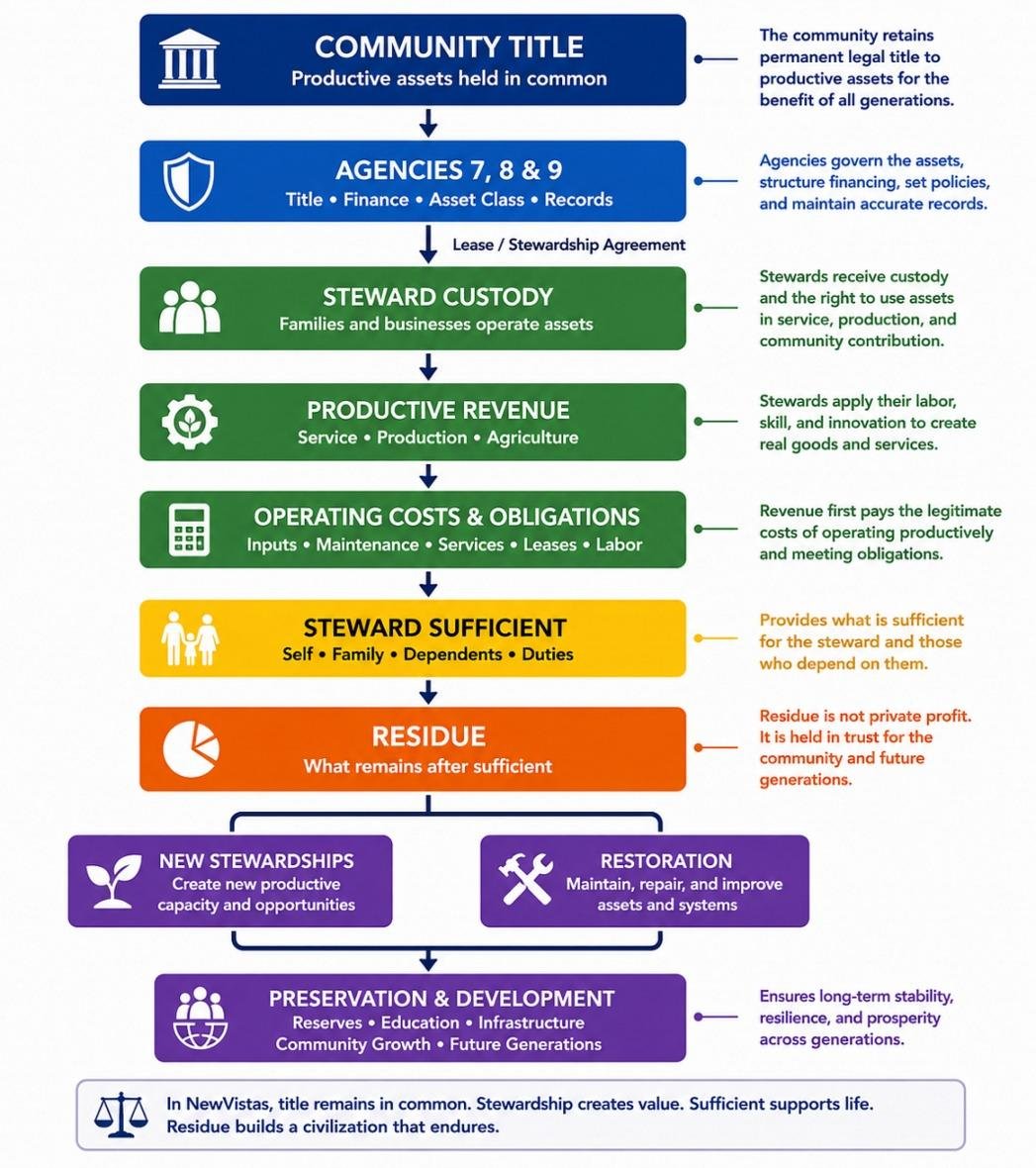
A NewVistas owns the civilization substrate — land, buildings, equipment, infrastructure — but does not operate it. Enterprise Owners hold productive custody by lease, own their businesses 100%, and compete on a level platform. No private monopoly on assets; no central operator. Three principles hold this together, and each is necessary for the others to function:
- The community owns the platform; Enterprise Owners hold custody. All long-term assets are held in community title through the appropriate governance channels. No owner, investor, or private company can gain monopoly control over the physical foundation productive life depends on. Custody is real and protected — not a tenancy-at-will revocable at a landlord’s discretion, but a constitutionally governed productive right secured by an unbreakable agreement.
- Enterprise Owners compete through their businesses. Each participant owns the enterprise built on leased assets in full: its goodwill, subscribers, customer relationships, operating knowledge, reputation, and future transfer value. Two clothier enterprises in one village compete for the same residents; two restaurant enterprises compete for the same dinner subscriptions.
- Bureaus set standards; they do not run businesses. The twenty-four bureaus define standards, certifications, and constitutional rules — they do not manage budgets, hire workers, run businesses, build reserves, or allocate capital. No bureau may gain a hidden operating arm through retained staff, software control, AI automation, or nominally independent entities. The ban is absolute and has no emergency exception.
Bureaus govern — Enterprise Owners operate.
This separation is NewVistas’ firewall against the concentration of power.
Property Is Business Value, Not Assets
The most important conceptual shift in the enterprise economy is what constitutes property. An Enterprise Owner does not own money, equipment, buildings, land, or profit in the conventional sense — their property is the enterprise they own and the future business value they created by competent operation. This is not a lesser form of property; it is distinct, and in several ways superior. A capable owner who starts with little and builds a productive, residual-generating business over a working lifetime creates real transferable value, priced through market analysis of the business’s probable future residual, without accumulating private asset wealth.
A Business Value in Practice
An Enterprise Owner runs a subscription restaurant earning $1 million in annual profit above the household draw. The community fee (10% of the $1M net above Owner’s Draw = $100,000) leaves $900,000; after an illustrative ~30% blended tax, roughly $630,000 remains as residual. When the owner is ready for a new enterprise, they choose and test a successor through a subcontractor apprenticeship, complete a two-quarter proving period, and sell the business at a valuation set by comparable sales. The successor pays through a negotiated share of future after-tax profit above their own draw, until the full price is paid — no lump sum, no buyer savings requirement, and the community’s title to the underlying equipment and premises remains unchanged throughout.
The Settlement Sequence
Every Business Enterprise settles its accounts in a fixed six-step constitutional sequence:
- Owner’s Draw — the owner and household take their plan-defined draw before any other claim on revenue. This is the protected floor; it cannot be reached by residual obligations, credit-line pressure, or bureau claims.
- Loss carry-forward — prior-period losses are absorbed before residual is recognized. An enterprise that ran a deficit in an earlier quarter settles that before declaring residual in the current one.
- Community 10% fee — used constitutionally for bad-debt protection for failing enterprises, not as a welfare transfer. It is the last rung of a remediation ladder, reached only after Life Plan revision, expert help, and further repayable credit have been exhausted.
- Taxes — local, state, and federal taxes on profit above the Owner’s Draw, met before any constitutional claim on residual.
- Purchase annuity (if applicable) — Enterprise Owners who received their business by purchase rather than the consolidator process settle the purchase annuity here, from after-tax profit above their draw.
- Kept residual — what remains is residual, and it is kept: not distributed, not spent, not converted to private savings. It is community capital, administered to create, restore, and preserve productive business enterprises.
Note: the exact final ordering of this sequence is still being finalized.
Accounting: Protecting the Capital
A capital-preserving economy cannot merely promise to leave principal untouched — it must show that the principal remains intact, that it covers ordinary business losses without using residual, and that it can trade outside the community without draining its capital base. Four disciplines do that work:
1. Accounting Truth Without Surveillance
Every transaction, authorization, lease, and title action must be digitally provable, but proof does not require a surveillance society. The accounting system records what happened in verifiable form, while raw personal data remains owned by the individual, limited to its purpose, and visible only through authorized workflows. The community keeps aggregate and statistical information, not personal dossiers — the books can be reconciled and audited without giving any bureau access to a person’s financial, health, household, or Life Plan history.
2. Community 10% Bad-Debt Protection Fee
Each Enterprise Owner pays a pre-residual community 10% fee, assessed on net operating profit after the plan-defined Owner’s Draw and recovery of any prior-period loss, that retires bad debt from failed business enterprises after reasonable reorganization efforts have been exhausted. It is intended to operate as a no-filing reorganization mechanism, not a bankruptcy proceeding. Sustained claims against the fee point to an underlying deficiency — mispriced plans, thin underwriting, inadequate insurance — and are to be corrected rather than absorbed.
3. Catastrophic-Only Insurance
Conventional and state health-insurance systems often grow costly because they route ordinary, predictable care through third-party payment, separating routine choices from the person receiving care. A NewVistas community uses catastrophic-only insurance instead: ordinary and foreseeable costs are paid directly by the owner at transparent prices, and outside carriers absorb only true catastrophes. This returns ordinary medical decisions to the individual and keeps routine care outside the insurance mechanism.
4. Import-Export Balance
A NewVistas trades, and it imports what it cannot efficiently produce — specialty components, chips, medicines, raw inputs — but every import must be balanced by exports of equivalent value over the proper accounting horizon. A continuing deficit would consume kept capital, which is exactly what the LAW forbids; balance is a constraint, not an aspiration. Coordination across the communities that comprise the Council of 50 supports the specialization required for balanced trade at scale.
Questions People Ask
Q. If participants don’t own assets, why work hard?
A. Participants own the business value they create: goodwill, customer relationships, operating knowledge, and future transfer value. A strong enterprise can be sold at a negotiated value grounded in market analysis of its probable future net — the incentive to build value remains strong, while entry depends less on personal wealth.
Q. Can Enterprise Owners set prices and choose customers?
A. Yes. Within published bureau standards, they set prices, design services, choose business models, and compete for customers. Bureaus govern safety and standards; Enterprise Owners govern the businesses themselves.
Q. What if an Enterprise Owner’s business fails?
A. A clear remediation sequence: revise the Life Plan and Business Enterprise Plan; bring in expert help; address health issues if needed; provide further repayable credit. If all else fails, the community 10% fee retires the shortfall. The owner keeps a draw while the goal remains restoration, not liquidation.
Q. Who decides how community assets are used?
A. Published constitutional rules govern asset use, not any single manager’s discretion. The twenty-four bureaus publish rules, and the rotating 1,920-seat governance structure amends them through super-majority approval and full publication. Rotating authority, term limits, and no bureau budgets are designed to prevent capture.
Q. Can a design this integrated actually be built at scale?
A. The design starts small: one apartment building and one Council of 12. Each subsequent step requires proven performance before scaling further. Full Enterprise Owner mechanisms activate only when the scale can support them, and a renter stage lets early participants test the model first. This is a purposeful deployment design, not an untested utopian leap.
The Parable of the Entrusted Talents
Source: Matthew 25:14–30 (earliest complete witnesses: Codex Sinaiticus and Codex Vaticanus, 4th century; imaged at collections.csntm.org). Quoted here in the 1611 King James translation for accessibility.
The original 9 February 1831 LAW states: “Behold thou shalt consecrate all thy properties… unto me with a covenant and Deed which cannot be broken… he shall appoint every man a Steward… in as much as shall be sufficient for himself and family.”
From this text we learn that those who voluntarily convey their properties become Enterprise Owners in the community, with responsibility to become a business owner who can multiply their “all” for the benefit of themselves, their dependents, and the entire community. The LAW enables the principles recorded in the Parable of the Entrusted Talents to be implemented in a NewVistas community:
“For the kingdom of heaven is as a man travelling into a far country, who called his own servants, and delivered unto them his goods. And unto one he gave five talents, to another two, and to another one; to every man according to his several ability; and straightway took his journey. Then he that had received the five talents went and traded with the same, and made them other five talents. And likewise he that had received two, he also gained other two. But he that had received one went and digged in the earth, and hid his lord’s money.
“After a long time the lord of those servants cometh, and reckoneth with them. And so he that had received five talents came and brought other five talents, saying, ‘Lord, thou deliveredst unto me five talents: behold, I have gained beside them five talents more.’ His lord said unto him, ‘Well done, thou good and faithful servant: thou hast been faithful over a few things, I will make thee ruler over many things: enter thou into the joy of thy lord.’…
“Then he which had received the one talent came and said, ‘Lord, I knew thee that thou art an hard man, reaping where thou hast not sown… and I was afraid, and went and hid thy talent in the earth: lo, there thou hast that is thine.’ His lord answered… ‘Thou wicked and slothful servant… Take, therefore, the talent from him, and give it unto him which hath ten talents.’”
In the parable, the master entrusts his wealth to servants who hold it for their lord. An Enterprise Owner’s economy in a NewVistas community is designed on a related but distinct principle: although the servants in the parable belonged to their lord, a NewVistas “servant” is an independent Enterprise Owner, not someone serving another person. In a NewVistas community, the trust holds title to productive assets on behalf of the community and remains responsible for their long-term stability and growth; individual participants act as owners operating enterprises with trust-owned property.
The parable shows stewardship measured according to capacity rather than absolute amount — the servants entrusted with five talents and two talents were both commended because each doubled what he had received. Greater returns are expected from owners entrusted with greater property to convey; yet even a one-talent owner can still use the opportunity to hold title to an enterprise and generate growth from a modest beginning. The contrast with the unprofitable servant underscores the danger of leaving entrusted capital idle: NewVistas applies this lesson by keeping productive capital active, stable, and available for enterprise use, transforming the participant from a “servant” into an enterprise operator, while surplus productivity continually strengthens the community as a whole.
Enterprise Owners: Providing What Is Sufficient
Housing Designed for Everyone
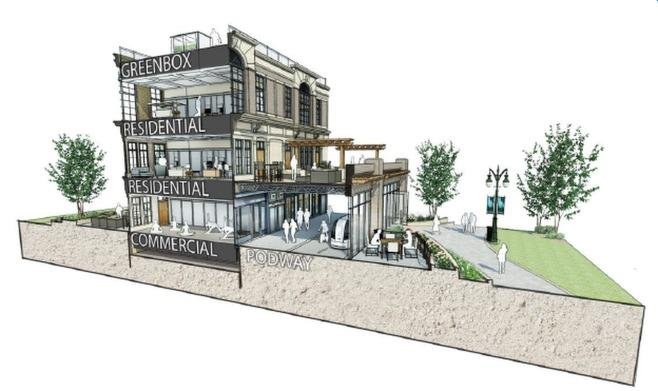
NewVistas apartments use modular 4-by-16-foot suites. Each apartment includes at least two suites: one for the resident, one for guests. A family of five — two parents and three children — receives a six-suite apartment. This policy applies to everyone; someone with greater financial means cannot rent an entire floor for privacy or security, because the community’s infrastructure addresses those needs without requiring special control of space. Because all suites are modular, they can be joined or separated as needed, with sound-, light-, and odor-proof partitions that allow residents privacy and comfort. The goal is not uniformity, but adequate space for all without congestion or overcrowding.
Apartment Suites Are Modular, Compact and Luxurious. Each module is 16 feet long by 4 feet wide, with 10-foot ceiling height. All suites are equipped with a convertible bed, kitchenette, shower, office desk, personal wardrobe space, toilet, and integrated smart controls for temperature, humidity, air flow, and lighting. Furniture systems and mobility platforms can serve multiple purposes — transportation, storage, seating, or sleeping — allowing participants to enjoy the functionality of much larger living environments.


Service-Based Economy
A NewVistas community, with at least 40,000 enterprise-owned businesses, owns all assets, including inventory, commercial and residential space, and equipment. Businesses own no assets; they must use leased assets productively, and are highly specialized, managing the processes that move products from stage to stage. Because the economy is service-based, modern barriers to entry disappear — success depends on business acumen, expertise, and a strong plan, not on capital brought from outside.
Walkable Access — No Cars
A built-up NewVistas is 1.2 miles across each side of the PLOT, making it walkable for able-bodied people. Because NewVistas campuses are planned according to the 1833 PLOT, they have no motorways or roads — streets are green spaces with gardens and fruit trees, while most pedestrian traffic uses breezeways beside apartment buildings. For those who need mobility help or must move luggage, the mule provides support: with interchangeable apps for seating, beds, trolleys, and more, mules move through breezeways, apartments, and elevators. Cars, rail, and air transport connect communities with hinterlands and pastures; mules can reach mirrored industrial zones, though specialized vehicles are typical there.
Recreation, Health, and Food
The community values leisure and recreation because they improve productivity, creativity, and overall work quality — rest helps the brain reset, while fatigue increases errors. NewVistas offers extensive facilities on campus and in the hinterlands and aims for a four-day workweek so participants can rest regularly.
Nutrition is one of the primary determinants of health. Today, over 70% of Americans are overweight, with half of these being obese — rates that suggest the condition is systemic, tied to diet, lifestyle, and environment, not just individual choice. The community governs food production and processing to provide healthier food with less processing, fewer food miles, and better access; combined with recreation, walkability, and reduced car dependence, this supports better health outcomes. NewVistas uses advanced early-diagnosis tools, with personal health data owned and controlled by the individual.
Owner’s Draw Is Individual
Each owner receives a community-assigned credit line, funded by an external commercial bank and based on contributed net worth and past business residual. Business revenue pays down the credit line; any excess is transferred to Bureau 8, where the community holds title and issues the Enterprise Owner an unbreakable deed and agreement outlining contributions, benefits, and responsibilities. Community algorithms may assist by estimating needs and tracking business value, but the Owner’s Draw remains plan-defined in the Enterprise Owner’s own Life Plan — never a self-declared or automated number.
A NewVistas Economic Cycle
At the end of each quarter, a Business Enterprise settlement is enacted. The sequence is strict and non-discretionary — no bureau can alter it, and no one can delay it. This discipline ensures the Owner’s Draw is protected, the community 10% fee is accurately charged, and any residual left is genuinely accumulated as community capital. The cycle follows eight steps:
- Gross Revenue — all income from the Enterprise Owner’s productive activity
- Minus Operating Expenses — supplies, labor, utilities, and business costs
- Minus Lease Payment — the Owner’s obligation to the community
- Owner’s Draw — paid for family support: food, housing, health, education
- Minus Prior Losses — any previous period’s shortfalls are recovered
- Community 10% Fee — charged on net profit, funding community bad-debt relief
- Minus Taxes — required obligations to civil authority
- Final Residue — what remains is kept as permanent community capital
| Component | Purpose | Who controls it |
|---|---|---|
| Owner’s Draw | Guarantees the Enterprise Owner can support their household (food, family, health, education, etc.) | The Enterprise Owner, defined in their Life Plan, protected by the community |
| Community 10% bad-debt protection fee | Funds bad-debt write-offs for failing enterprises, restoring them to productivity | Automatically calculated; funds a restricted Bureau 7 mechanism |
| Residual | What remains beyond the Owner’s Draw, the 10% fee, and obligations; preserved as permanent capital | Moved to the Storehouse; never consumed for bureau operations |
| Kept capital | Accumulating community wealth used to create new enterprises and support those in need | Administered by existing Enterprise Owners through formal processes |
The community 10% bad-debt protection fee restores failing enterprises internally, so the community’s balance sheet never weakens. Kept residual accumulates without consumption — meaning the community’s credit standing continuously strengthens, enabling long-horizon expansion, infrastructure building, and intergenerational stability.
NewVistas: A System That Preserves Capital and Expands Opportunity
NewVistas addresses a central challenge by preserving community capital while allowing individuals to prosper. Its approach is straightforward:
- Community title is separated from Enterprise Owner custody;
- Business operations are separated from ownership of the underlying assets;
- Profits support mutual aid through a community 10% bad-debt protection fee;
- Remaining capital is retained rather than being consumed;
- Capital is managed through productive enterprises rather than by a bureaucracy;
- Rotating, unpaid leadership prevents authority from becoming hierarchical.
The result is a community in which participating Enterprise Owners compete effectively and keep the profits they earn; their basic needs are protected; their failures are addressed internally; their capital grows without being consumed; and their future generations inherit a stronger, functioning system instead of unresolved obligations.