The Large-Animal Blocks
Large animals never live in a suite: every larger animal lives on a large-animal block and is walked to. The constitution places fourteen such blocks on the inner row of the ring, across the easement from the square and in every arm, nearest the people: six dog blocks of ten acres, the two horse grounds of the middle row and four horse blocks, and two city farms of 150 acres, stocked first with 960 dogs and 140 horses. They are sized for roaming, not grazing; feed comes from the farms and the hinterland. Small animals of 25 pounds or less live in suites of the Pets Allowed villages: every district begins with two Pets Allowed and two No Pet villages, 48 of each in all, and a village changes kind only whole and slowly, as leases turn. Outside its own building a pet travels closed in a carrier, never on a leash; a trained service animal at work walks beside its partner where the law requires (Constitution 7.10). This plate shows an earlier study of four blocks; the figures above are the constitution’s.
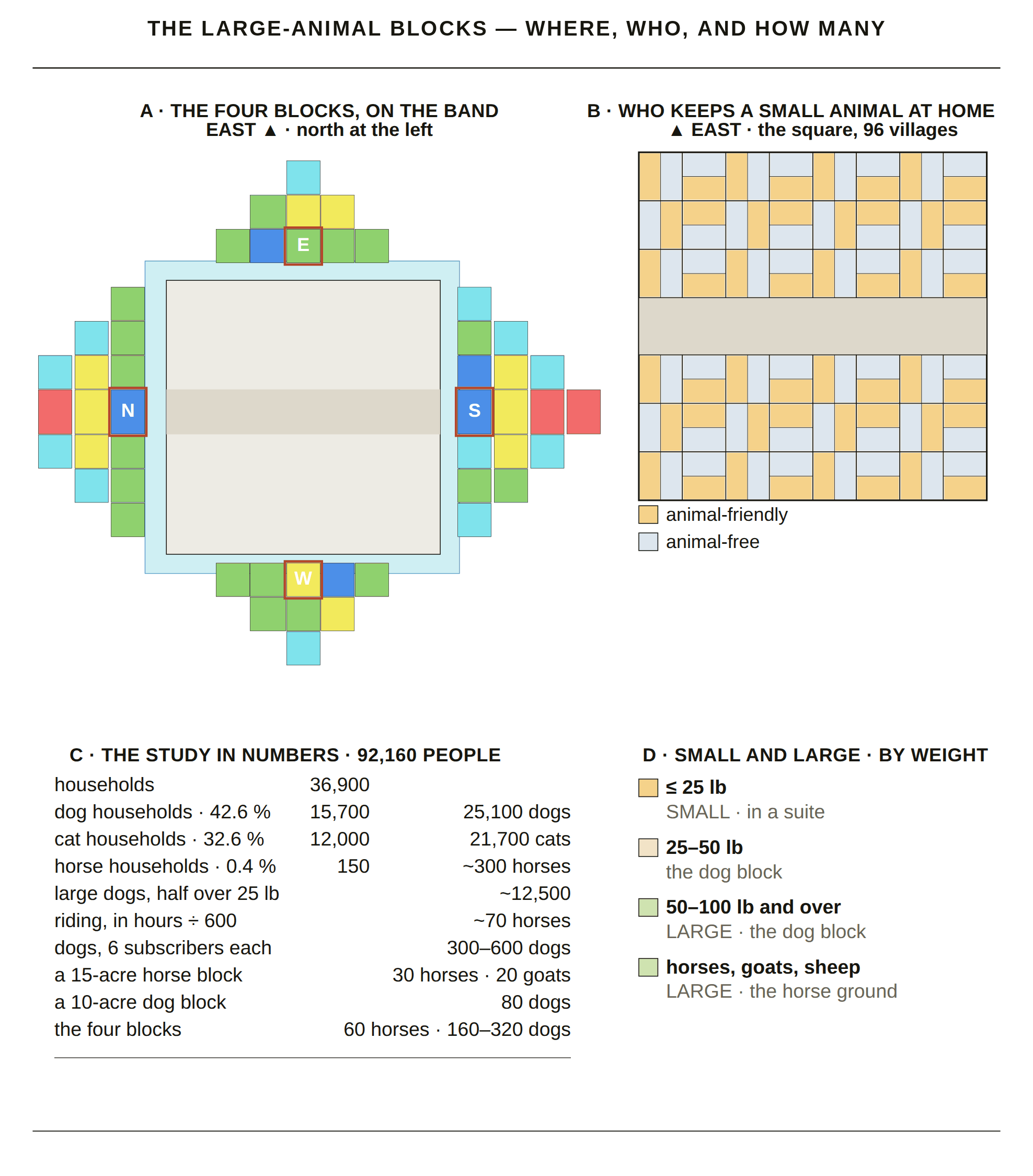
The rule is simple: an animal too large for a suite lives on a block of its own and is visited there, not kept at home. Setting the fourteen blocks on the inner row of the ring puts them just across the easement from the square, the nearest ground to where people live. Pets Allowed villages are kept together, most of them on the edges that face these blocks. The two most-used kinds of block are drawn in detail on The Horse Block and the Dog Block.