
The MULE as a motorized mobility unit
Modern society is filled with highly specialized equipment. We have separate devices for transportation, cargo movement, mobility assistance, lifting, maintenance, deliveries, and countless other tasks. Most of these assets spend much of their lives sitting idle, consuming resources, occupying storage space, requiring maintenance, and eventually needing replacement.
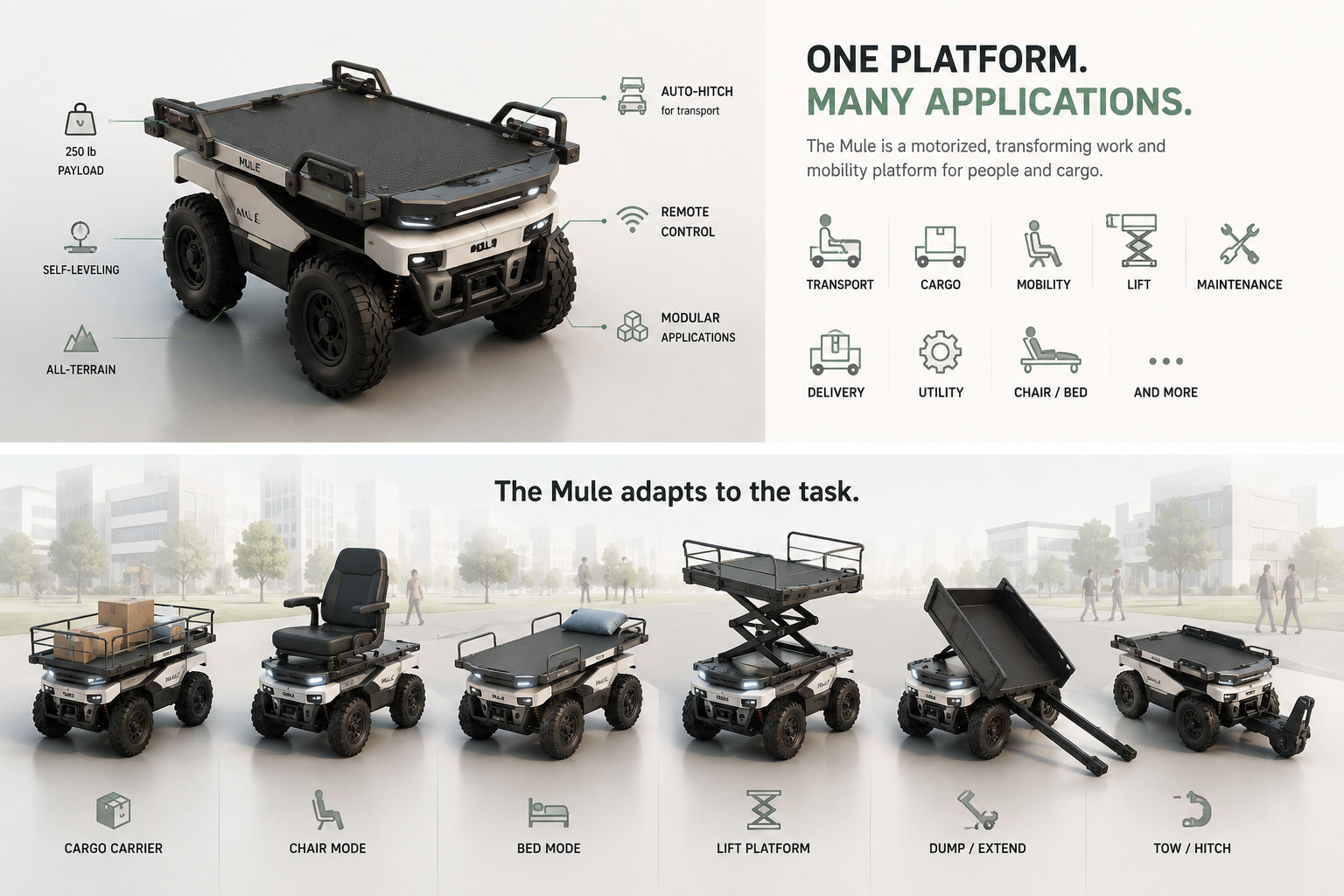
The NewVistas Motorized Transforming Mule was developed from a different idea.
The mule is best understood as the physical equivalent of a smartphone. A smartphone is a common platform capable of performing many different functions through applications. It serves as a telephone, camera, computer, navigator, communication device, payment system, and much more.
The mule applies the same principle to the physical world.
Rather than creating a separate machine for every task, NewVistas utilizes a common mobility platform capable of accepting a wide variety of applications, attachments, and configurations. The same platform can carry supplies, transport materials, provide mobility assistance, serve as a chair, transform into a bed, function as a lifting platform, support maintenance activities, and perform numerous other roles throughout the community.
The result is a system that achieves greater utility from fewer resources while remaining flexible enough to adapt to changing needs.
A Platform Rather Than a Vehicle
Although the mule can transport people and materials, it is not simply a vehicle.
At its core, the mule is a modular work and mobility platform. Different attachments allow it to perform different functions without changing the underlying system.
One configuration may function as a cargo carrier capable of moving substantial loads throughout the community. Another may support mobility assistance for individuals who require help moving between destinations. Another may operate as a maintenance platform or lifting device. Others may serve entirely different purposes.
This flexibility allows a single piece of equipment to replace multiple specialized machines while maintaining high utilization throughout its operational life.
Transforming Infrastructure
The mule reflects a broader design philosophy that appears throughout NewVistas.
Apartment suites transform. Furniture transforms. Community spaces transform. Equipment transforms.
Rather than building a different system for every activity, NewVistas seeks to create infrastructure capable of adapting to multiple uses over time.
The mule embodies this principle directly. Depending upon the application installed, the platform may function as a transport device, a cargo carrier, a mobility aid, a work platform, a lift system, or a temporary resting space. Some configurations allow the platform to transition from chair mode into a fully reclined bed, providing additional flexibility for users who require rest, recovery, or mobility assistance.
Transformation allows a smaller number of assets to serve a larger number of needs.
Mobility and Accessibility
One of the mule’s most important roles is supporting accessibility.
Children, older adults, individuals recovering from injury, and persons with disabilities all benefit from reliable mobility assistance that allows them to participate fully in community life.
Rather than creating separate transportation systems for different categories of users, the mule platform provides a common solution capable of adapting to individual needs.
This approach helps preserve personal independence while reducing the complexity and cost of specialized transportation infrastructure.
Accessibility is therefore not treated as an afterthought. It is incorporated directly into the design of the platform itself.
Productive Work and Community Operations
The mule is equally valuable as a work platform.
Communities require the continual movement of supplies, tools, equipment, food, maintenance materials, and countless other resources. The mule provides a practical means of performing these tasks without relying exclusively on larger vehicles.
Its load-carrying capabilities allow it to transport substantial quantities of materials throughout the community. Configurations can support irregular loads, long materials, flat sheets, maintenance equipment, agricultural supplies, and other work-related functions.
This makes the mule an important component of community logistics, maintenance operations, construction support activities, groundskeeping, agriculture, and local delivery systems.
The same platform that serves a resident in the morning may support maintenance work later in the day, dramatically increasing asset utilization.
Automation and Assisted Operation
The mule is designed to operate within a highly automated environment.
Advanced control systems can support remote operation, automated positioning, self-leveling on uneven surfaces, and intelligent interaction with other infrastructure systems. Future implementations may include increasingly sophisticated navigation and task-management capabilities that further reduce operational complexity.
Automation is not intended to remove human involvement entirely. Rather, it assists users by reducing physical effort, increasing safety, improving reliability, and simplifying operation.
Importantly, the platform is designed around resilience. Core operational functions can continue through local systems even when external communications or internet connectivity are unavailable.
This reflects the broader NewVistas commitment to reliability, redundancy, and layered certainty.
Integration with Community Transportation
Within the NewVistas transportation system, the mule occupies a unique position between personal mobility, community logistics, and productive work.
Large-scale transportation needs are addressed through walking networks, shared vehicle fleets, roads, rail systems, and aviation infrastructure. The mule serves a different purpose. It addresses the countless small transportation tasks that occur every day within buildings and throughout the community itself.
By moving people, supplies, equipment, and materials efficiently across short distances, the mule reduces dependence upon larger vehicles while improving accessibility and convenience.
It becomes part of the invisible infrastructure that allows the community to function smoothly.
Stewardship of Mule Platforms
Like other productive assets within NewVistas, mule platforms operate within a stewardship framework.
The platforms are generally treated as equipment-capital assets and form part of the community’s broader equipment portfolio. Ownership remains within the trust structure while custody, maintenance, and operational responsibilities may be assigned through stewardship agreements and contractor relationships.
Specialized custodians may oversee maintenance programs, inspections, repairs, software updates, charging systems, replacement schedules, and fleet management.
These custodians do not own the assets. Their responsibility is to ensure that the equipment remains safe, reliable, and available for community use.
This arrangement promotes professional maintenance, higher utilization, longer service life, and more efficient use of resources.
The Physical Smartphone
The mule ultimately represents more than a single piece of equipment.
It demonstrates how intelligent design can replace many specialized systems with one adaptable platform. Just as a smartphone performs dozens of functions through software applications, the mule performs numerous physical functions through interchangeable hardware applications.
The platform can transport people, move materials, assist mobility, support maintenance, provide lifting capability, serve as temporary furniture, and adapt to needs that may not yet exist.
In this sense, the mule is not merely a machine. It is a foundational piece of NewVistas infrastructure—a flexible platform that allows the community to achieve more with fewer resources while supporting accessibility, productivity, resilience, and human flourishing.