
Transforming Spaces
Modern buildings are often designed around a simple assumption: every activity requires its own dedicated room.
Bedrooms are used primarily for sleeping. Bathrooms serve a single purpose. Offices sit empty when work is finished. Dining rooms are occupied for only a small portion of each day. As a result, large amounts of space remain unused much of the time while construction costs, energy consumption, maintenance requirements, and environmental impacts continue to increase.
NewVistas approaches space differently.
Rather than assigning a separate room to every activity, NewVistas uses transforming spaces that allow a single area to support multiple functions throughout the day. The objective is not to make people live in smaller spaces. The objective is to provide the functionality of much larger environments while using resources more efficiently.
By increasing the usefulness of every square foot, the community can devote more land and resources to parks, recreation, agriculture, education, public facilities, and productive activity while maintaining a high quality of life.

The Apartment as a Flexible Environment
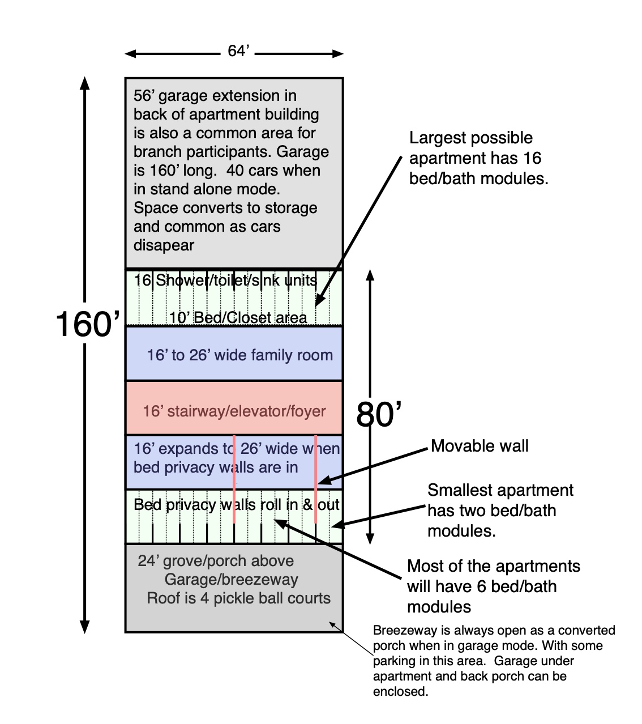
NewVistas apartments are built from a series of integrated modules designed to support daily living.
Each suite consists of three primary environments:
- A family module for living, socializing, dining, and daily activities.
- A bed module for sleeping, relaxation, and personal space.
- A bath module capable of supporting multiple personal-care functions.
Together, these modules create a living environment that adapts to changing needs throughout the day rather than remaining fixed in a single configuration.
The result is an apartment that provides substantially more functionality than conventional housing occupying a similar footprint.
Transforming Personal-Care Spaces
One of the most distinctive features of the NewVistas apartment is the transforming bath module.
Rather than dedicating separate rooms to showers, toilets, changing areas, sinks, workspaces, and seating, the bath module is designed to support multiple functions within a single adaptable environment.
Depending on current needs, the space can function as a shower, toilet room, sink area, changing space, seating area, or personal workspace.
These transformations are managed through integrated mechanical systems, sensors, interlocks, and verification processes designed to ensure safety, reliability, and ease of use.
The objective is not novelty. It is to provide greater functionality while reducing the amount of physical infrastructure required to support daily life.
Intelligent Space Management
Transforming spaces require a higher level of coordination than conventional rooms.
For this reason, NewVistas incorporates layered control systems that monitor operating conditions and verify that spaces are ready for transformation before transitions occur.
Sensors may monitor conditions such as moisture, drainage, position, load, humidity, obstructions, and system status. Verification systems confirm that environmental and safety conditions are appropriate before a space changes configuration.
These systems are intended to improve safety, reliability, and user confidence while reducing maintenance requirements over time.
The goal is not automation for its own sake, but dependable operation that remains largely invisible to the participant.
The MULE Platform
Transforming spaces extend beyond the apartment itself.
The NewVistas MULE platform serves as a flexible mobility and utility system capable of supporting multiple functions.
A MULE may provide personal transportation, cargo movement, storage, seating, or support for transforming furniture systems depending on current requirements.
Because the platform can serve multiple purposes, fewer specialized devices are required throughout the community.
This flexibility reduces material consumption while increasing overall functionality.
Localized Environmental Systems
Traditional buildings often rely upon large centralized systems that condition entire structures regardless of how individual spaces are being used.
NewVistas instead moves environmental control closer to the point of use.
Individual living spaces can maintain independent control of temperature, humidity, ventilation, and air quality. Fresh air delivery, energy recovery systems, and localized conditioning allow environmental resources to be directed where they are needed most.
This improves comfort while reducing overall energy consumption.
Transforming spaces therefore operate not only as physical environments, but as intelligent environmental systems capable of adapting to changing conditions throughout the day.
Accessibility and Adaptability
Transforming spaces are also designed to support changing physical needs over time.
Participants may experience different requirements as they age, recover from injury, accommodate family members, or respond to changing life circumstances.
Because the environment itself can adapt, housing remains useful across a much wider range of situations than conventional fixed designs.
This flexibility reduces the need for costly relocations, renovations, or specialized facilities.
A More Efficient Use of Resources
The ultimate purpose of transforming spaces is stewardship.
Every square foot of construction requires materials, energy, maintenance, financing, and ongoing environmental resources. When buildings contain large amounts of underutilized space, those resources are consumed without providing corresponding value.
By allowing spaces to serve multiple functions, NewVistas increases the usefulness of physical infrastructure while reducing the amount of infrastructure required.
The result is a community that can provide greater functionality, more open space, more productive land, lower resource consumption, and higher quality of life simultaneously.
Building for the Future
Transforming spaces represent one example of a broader principle that appears throughout the NewVistas physical campus.
Infrastructure should be adaptable rather than rigid.
Buildings should evolve with changing needs rather than requiring continual replacement.
Technology should simplify daily life rather than complicate it.
And physical environments should support long-term human flourishing while using resources responsibly.
Within NewVistas, transforming spaces are not simply an architectural feature. They are part of a larger effort to create a physical framework capable of supporting sustainable prosperity across generations.