Part Nine: NewVistas Governance — One Integrated System
NewVistas Governance
THE NewVistas Constitution is not a single rulebook. It is an integrated system that appears when the founding documents are read together, not separately, and it functions as a working system for forming and limiting distributed public servants. These documents reveal that system in layers:
- An economic system of title and residual;
- A spatial and governance system of buildings, courts, seats, and offices;
- An office system of bounded, rotating duty and a temporal system of patterned time;
- A replication system that allows the same community to be established elsewhere. One control principle runs through the whole system and should be stated first: Bureaus govern; Enterprise Owners and certified contractors carry out all real operations.
This claim is structural, not symbolic. Because the constitution remains fixed while operations beneath it stay competitive, the system can adapt in practice without drifting from its principles.
A Plan Measured to the Seat
The spatial plan is precise: a one-mile-square PLOT layout contains ninety-six villages and twentyfour public buildings arranged in eight rows of three. At the center, a governing hall with 480 seats is repeated four times in HOUSES 5 & 17, creating four courts with 1,920 seats total, matched by 1,920 offices across the twenty-four HOUSES.
HOUSE 5 HOUSE 17
| Higher Court | Lower Court | Higher Court | Lower Court | TOTAL |
|---|---|---|---|---|
| 480 | 480 | 480 | 480 | 1,920 |
480 seats is not only exact; it is structurally fertile — it divides cleanly by 3, 4, 12, and 24, which is precisely what later lets presidencies of 3 and 4 and councils of 12 arise from the same seat field. Read from the governing bodies rather than from row-andaisle packing, the same total appears independently:
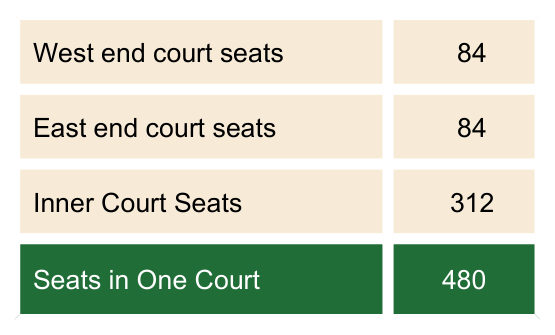
Geometry and governance converge on the same number. Alter the integers and the repeated closures begin to collapse.
Governing Bodies are Embedded in the Architecture
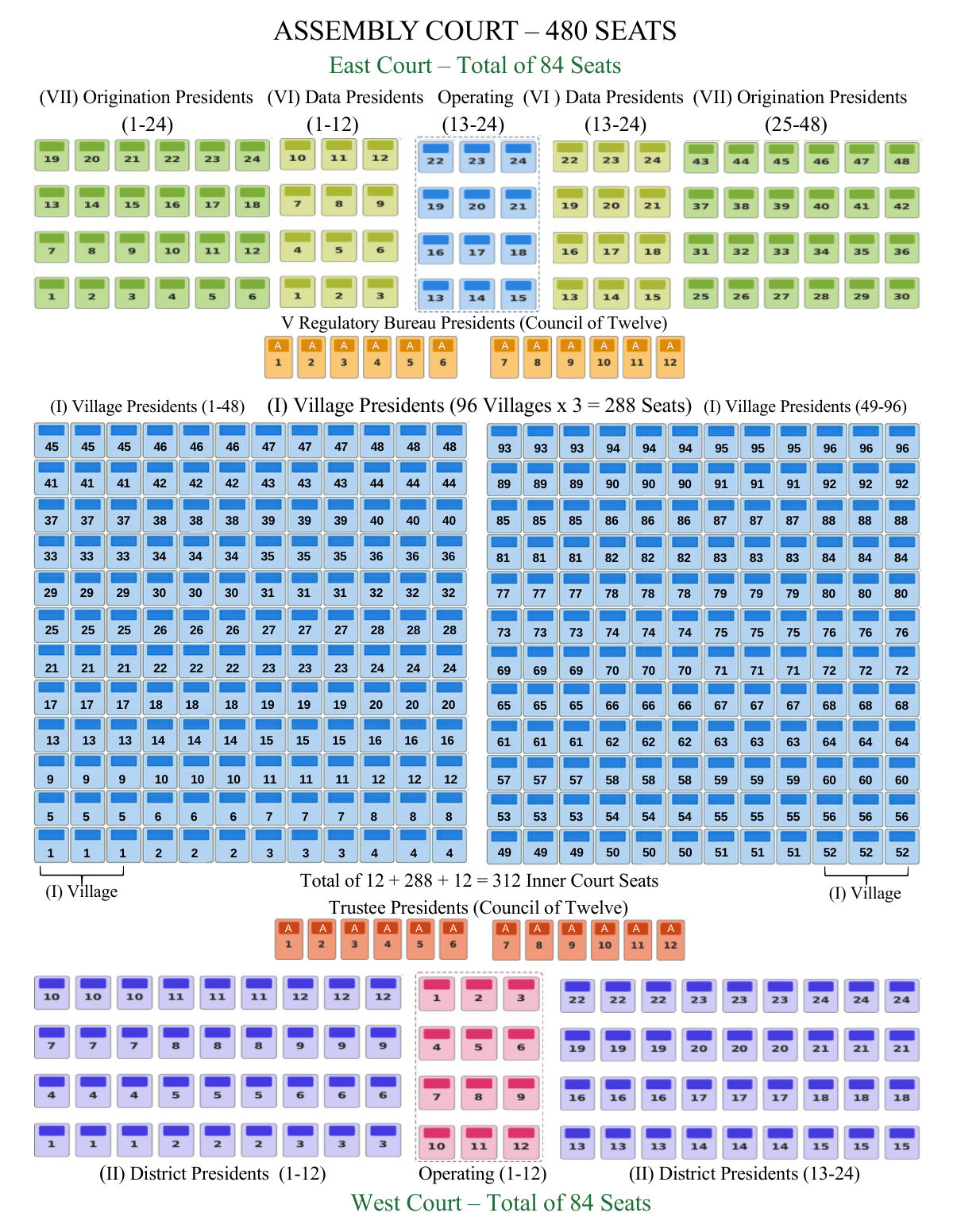
Because the seat field is highly divisible and rich in adjacencies, governing bodies are built into the architecture rather than assigned later by committee.
- Three contiguous seats form a three-person presidency for Segment advocacy;
- Each numbered coordinate, repeated across the four courts, creates a four-person presidency with representation from every ABCD Segment;
- Ordered runs of these presidencies of four form 176 cross-Segment councils of twelve, and the trustee and regulator seats of each court form eight Segment councils, 184 in all.
Two consequences follow. (1) Each president belongs to a presidency of three, a presidency of four, and a council of twelve. (2) The councils also function as distinct domains, not as levels in a hierarchy. The resulting system is dense and interconnected, not pyramidal.
Where the Whole is Joined to its Operative Parts
The same geometry drives its presidents through eight defined mission rows—the eight departments—binding number to purpose instead of leaving it generic. These departments force the constitution out of abstraction and into operation: their twenty-four bureaus impose the same fixed rules on supplies, buildings, health, records, approvals, and the NewVistas infrastructure.
This governing principle appears most sharply in the economic layer. The community holds unified title; participants hold custody only through leases. Title is held through the three title repositories of Department III: Clearing Bureau 7, Property Bureau 8, and Capital Bureau 9. These bureaus govern the title but they never run the businesses that use it. This structure of govern title, lease custody, and retain the residual, turns the constitution into an enforceable system.
The two center blocks of twelve multipurpose buildings each were not to be ornamental. They were to be the city’s constitutional core: the mechanism designed to:
- Produce distributed public servants;
- Place those servants in offices with precision;
- Embed them among peer witnesses;
- Route them through distinct councils;
- Differentiate them by mission;
- Block the usual upward concentration of power through geometry, being office-bounded, and by rotation.
The NewVistas Constitution is one integrated system set out across several documents, not a single statute.
Its mile-square plan establishes ninety-six villages, twenty-four buildings, and four recurring courts of 480 seats for a total of 1,920 seats and offices in total. These engineered, highly divisible numbers produce presidencies of three and four, along with 176 twelve-member councils, directly from the geometry. Authority is always rooted in place, office, and body; each president is surrounded by peer witnesses; the system is interconnected rather than hierarchical; and bureaus govern while Enterprise Owners carry out operations
Presidencies & Councils
Governance runs through three recurring shapes, each drawn straight from the seat and office geometry of the NewVistas Constitution: (1) Advocacy, (2) Witness, and (3) Harmonization — and none of them form a chain of command.
The presidency of three gives immediate Segment Advocacy (AAA, BBB, etc.) within one court.
The presidency of four gathers one president from each matching court coordinate to supply complete cross-Segment (ABCD) Witness.
And Councils of Twelve Harmonize several presidencies within a bounded domain. Together they form a 3 × 4 (ABCD, ABCD, ABCD) matrix that preserves (1) Advocacy, (2) full Witness, and (3) Harmonization without creating hierarchy among the individual bodies.
Advocacy, 640 times over
The 480 seats of a court sit in uninterrupted horizontal bands, and every three contiguous seats of the same Segment (AAA, BBB, etc.) form a presidency of three. 480 divided by three gives 160 presidencies of three per court, 640 in all: 152 Segment presidencies per court (608 in all), whose whole task is to advocate for their Segment, and 8 department presidencies on the stands (32 in all)..
A government ordered by coordinates, offices, and councils, designed to prevent concentration of power through repeated peer witness and bounded place.
Councils that Arise from the Geometry
| Council | Count | Basis |
|---|---|---|
| Village | 96 | Served by the Presidents of the Village department |
| District | 24 | District-scale coordination — the Presidents of the District department |
| Bureau | 24 | One for each Bureau |
| Data & Origination | 24 | One Data and two Origination presidencies in each district HOUSE |
| Department | 8 | Coordination only |
| Segment | 8 | Trustee & Regulatory |
| TOTAL | 184 | Councils |
Village presidents serve the ninety-six villages; District presidents serve the twenty-four districts —not higher government, but governance at a different scale under identical constitutional limits. And these are not 176 sets of separate people: Trustee and Regulatory presidents each serve on two councils, so council seats exceed the 1,920 unique presidents. The councils are distinct domains, not forming a higher-and-lower chain.
Meshed, not Hierarchical
Every president belongs to at least one triad and one quad; none acts as an isolated authority. From the start, each president is embedded among immediate peer witnesses, so the structure is designed to resist hierarchical leadership.
The councils function as distinct domains, not as higher and lower chambers, so the system is deliberately meshed rather than vertical. They are highly structured, but not pyramidal. Each president is repeatedly held accountable laterally through several bodies before any distant superior could be imagined. Constitutional review arises from repeated councils with distinct roles, not from rank.
All council seats come from the community’s 1,920 governing presidents. These presidents serve across 480 presidencies: village presidencies (288 × 4), district presidencies (72 × 4), trustee presidencies (12 × 4), regulatory presidencies (12 × 4), operating presidencies (24 × 4), origination department presidencies (48 × 4), and data department presidencies (24 × 4). A presidency may participate in more than one council relation – for example, an Operating presidency sits in both its bureau council and its department coordination council. In that way, a president may serve in one council under one relation and in another council under a different relation, carrying the same bounded office into each.
Each council’s constitutional role is to provide harmonization. A presidency of three from one Segment gives a concern its first local voice, and a presidency of four tests it through full cross- Segment witness. The council then places that concern alongside other intersecting enterprises within the same bounded relation: one village burden beside other village burdens, or one bureau concern beside other bureau concerns. No council outranks another or reports upward; the structure is lateral rather than hierarchical. The meeting cadence below supports this layer by giving each council a recurring place in the weekly and monthly rhythm, ensuring every member’s turn to preside is real rather than crowded out.
| Body | Presidencies | Cadence | Day | Time | Recurrence |
|---|---|---|---|---|---|
| AAA, BBB, etc. | Three of each Segment | Monthly | 4th Tuesday | 9-9:45 a.m. | Once per quarter for each member |
| ABCD | Village � District Department � Data Origination � Branch | Weekly | Every Monday | 9-9:45 a.m. | All 12 operational weeks |
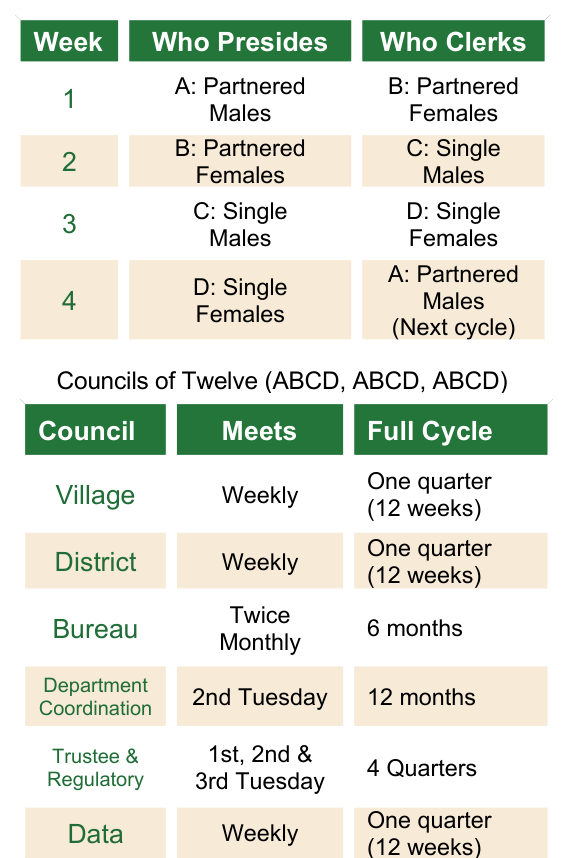
| Councils of Twelve | 96 Village 24 District 24 Data/Origination | Weekly | Every Thursday | 9-9:45 a.m. | All 12 operational weeks; each of 12 members presides once per quarter |
| Bureau Councils 1–12 | 12 Bureau Councils | Weeks 1&3 | 1st / 3rd Thursday | 9-9:45 a.m. | Shares its Trustee and Regulatory presidencies with its paired bureau (13-24) |
| Bureau Councils 13–24 | 12 Bureau Councils | Weeks 2&4 | 2nd / 4th Thursday | 9-9:45 a.m. | Shares its Trustee & Constitutional presidencies with its paired bureau (1–12) |
| Dept’s I-VIII Coordination Councils | The three Operating presidencies of a department | 3 per quarter | 2nd Tuesday. | 9-9:45 a.m. | Each of 12 presides once a year |
Why Each Body Is Scheduled Where It Is Presidencies of Four: Weekly, Monday, 9:00-9:45 A.M.
Presidencies of four carry the most immediate governing and service responsibilities, so they meet weekly during all twelve operational weeks of the quarter. This cadence ensures each of the four members presides exactly three times per quarter (four members × three turns = twelve operational weeks). Holding these meetings on Monday anchors the operational week from the outset.
Councils of Twelve: Thursday, 9:00-9:45 A.M.
Village, district, and Data/Origination Councils of Twelve meet weekly during the twelve operational weeks, but on Thursday instead of Monday. Because each council has twelve members, this cadence allows every member to preside once per quarter (twelve members times one turn each equals twelve operational weeks). Thursday keeps these meetings separate from Monday presidency meetings while completing the week’s governing work before the protected Friday. The twenty-four bureau councils meet only twice monthly: councils 1-12 on the first and third Thursdays, and councils 13-24 on the second and fourth. This split is necessary because each matched bureau pair (1 with 13, 2 with 14, 3 with 15, and so on) shares one Trustee presidency and one Regulatory presidency. Placing paired councils on opposite weeks prevents those jointly held presidencies from being scheduled in two councils at the same time.
Presidencies of Three: Monthly, Fourth Tuesday, 9:00-9:45 A.M.
Segment presidencies of three meet monthly, on the fourth Tuesday, so each of the three members presides once per quarter. Because their role is advocacy for their Segment rather than ongoing operational management, a slower monthly tempo is appropriate: they identify and articulate concerns without disrupting the weekly rhythm of the more operational bodies.
Department Coordination Councils: Monthly, Second Tuesday, 9:00-9:45 A.M.
Department coordination councils meet on the second Tuesday, mirroring the cadence of the presidencies of three while shifting it by one weekday. Their work crosses the three bureaus of one department and carry them back to the bureau councils, which decide them; they govern nothing. Placing that work in a weekly slot would repeatedly interrupt the weekly bodies, so the monthly rhythm preserves room for strategic coordination without disrupting operational tempo.
The Logic of Weekly and Monthly Cadences
Weekly meetings belong to bodies with immediate operational and service responsibilities, including presidencies of four and Councils of Twelve.
Monthly meetings belong to bodies focused on broader coordination or advocacy, such as presidencies of three and bureau councils.
Together, these tempos support frequent operational contact and slower harmonizing review without forcing every body into the same rhythm.
The Fixed Morning Window
All four bodies meet in the same fixed window, 9:00-9:45 A.M. This is a constitutional rule, not a local preference, and it works because the meetings are separated by day.
Each body has its own day — Monday, Tuesday, or Thursday — and Wednesday carries no ordinary governing meeting so a single start time creates no conflict. The rule is simple: one morning slot on four different days.
Fixing the hour also prevents capture. Because the presiding officer cannot shift start times, schedule access cannot be quietly shaped by personal availability. The 45-minute limit keeps meetings bounded rather than open-ended.
What is Explicitly Protected
Two protections override the weekly schedule: (1) Fridays remain free of ordinary meetings, and (2) week thirteen suspends the ordinary governance cadence except for general gatherings. Together, fixed days, fixed hours, protected Fridays, and restoration weeks keep every NewVistas calendar authority bounded by its constitution.
Implementation Note
Because each day, every time and their cadence are fixed, scheduling tools have no discretion to exercise changes. A NewVistas community creates the literal recurring events — weekly Monday presidencies and Thursday councils, presidencies of three
on the fourth Tuesday, department
OFFICES in DISTRICT BUILDINGS 1-24
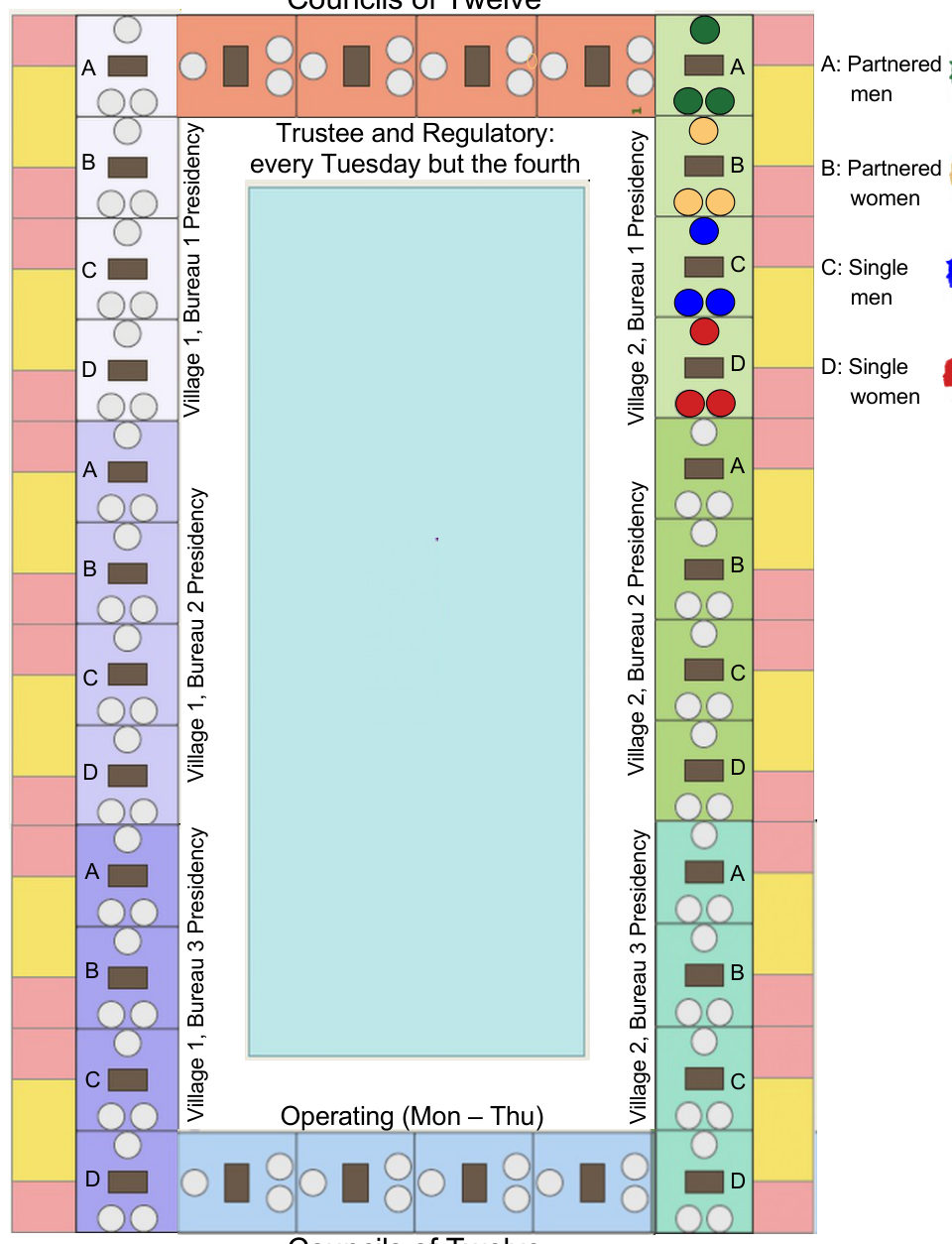
Councils of Twelve
Councils of Twelve
Two chamber levels are the higher part of the two inner courts on the 3rd and 5th levels in each of the NewVistas #1-12 and #13-24 central buildings. The arrangement of the offices follows this format:
HOUSE 1 – District 1: The lower court – Villages 1 & 2; the higher court – Villages 3 & 4. HOUSE 2 – District 2: The lower court – Villages 5 & 6; the higher court – Villages 7 & 8; etc.
coordination councils on the second, trustee and regulator councils every other Tuesday, and bureau councils on alternate Thursdays, all from 9:00-9:45 A.M. — while keeping Fridays and the four yearly week thirteen’s clear of any community work.
Presiding and Clerk Rotation: Who Leads and Who Records
Every governing body follows the same two rules, so the rotation is the same whether the group has three members or twelve.
Rule 1: Presiding is fixed by seat. Presiding moves through the body in a set sequence based on where members sit in the assembly hall. It does not depend on availability or volunteers.
Rule 2: Preside, then clerk. The clerk for each meeting is the member who presided at the meeting before. Each member chairs one meeting and records the next, so the record of every meeting is kept by the member who has just handed on the chair. The chair advances one seat at a time and returns to the first seat at the end of the cycle.
Why are the roles paired? Because the presider served as clerk at the previous meeting, the minutes read and approved at the start of each meeting are the ones the presider wrote. The first act in the chair is to read back that record for approval, so the person who created the record accounts for it and continuity carries smoothly from one meeting to the next.
The Seating that Sets the Sequence
The four Segment categories ABCD are the four courts of the two assembly halls of HOUSES 5 and 17, and that gives the fixed sequence used by every presidency of four and every council built from them:
A – Partnered Males: HOUSE 5 lower court B – Partnered Females: HOUSE 5 higher court C – Single Males: HOUSE 17 higher court D – Single Females: HOUSE 17 lower court
Three-Person Presidency: Segment Grouping (Monthly, One Quarter)
A three-person presidency represents one Segment cross-section of a council. Each forms four such presidencies—one for each Segment—by grouping the three members from that Segment, with one member drawn from each of the council’s three presidencies. For example, in a village council, the partnered male members of the three bureau presidencies form one three-person presidency;
partnered females form another; and single males and single females form the remaining two. The group meets monthly, completing a full cycle over one quarter, or three meetings. Each member presides once and serves once as clerk.
| Meeting | Who Presides | Who Clerks |
|---|---|---|
| Month 1 | President 1 Left seat | President 2 Center seat |
| Month 2 | President 2 Middle seat | President 3 Right seat |
| Month 3 | President 3 Right seat | President 1 Left seat – next cycle |
Presidency of Four (Weekly, one 4-week rotation × 3 per quarter)
Meets weekly across the twelve operational weeks, so the four-week rotation below runs three times a quarter. Each member presides three times and clerks three times.
Why Bureau Councils Alternate Weeks.
Each bureau is paired with a counterpart in the other department: bureau 1 in the Provision Division with 13 in the Assurance Division, bureau 2 with 14, and so on. The pair shares the same Trustee and Regulatory presidencies — the same eight members serve on both councils — while only the Operating presidency differs. Because those overlapping presidencies cannot meet in two places at once, paired councils meet on alternate weeks: the Provision Division (Bureaus 1-12) on the 1st and 3rd Thursday, and the Assurance Division (Bureaus 13-24) on the 2nd and 4th weeks.
Example: The Trustee and Regulatory presidencies that meet as the Inventory Bureau 1 council (Village Department I) in weeks 1 and 3 meet again in weeks 2 and 4 with Operating presidency (Regulatory Department V) as the Innovation Bureau 13 council. Each council keeps its own twelve-seat rotation, so a dual-seat member holds a seat in both councils but never chairs two councils in the same week. To keep the records clear, the dual-seat member is treated as two separate seats—one for each council—so each council’s presiding rotation, clerking rotation, and minutes remain fully independent.
Standing Rules
- Initial sequence. At the body’s first meeting, the first seat (left / A / Trustee-A) presides and the next seat clerks; the sequence continues from there.
- Restoration weeks. Because week thirteen and the leap week have no regular meetings, the rotation counts only meetings actually held. A restoration week pauses the cycle, which then resumes with the next seat rather than skipping one.
- Seats, not people, rotate. Under birthday release and annual single-seat replacement, an incoming member takes the departing member’s seat and place in the rota, so turnover does not disrupt the cadence.
- Minutes loop. Each meeting begins with the presider reading the minutes they recorded as clerk at the previous meeting, for approval by the body, before new business begins.
Office, Rotation, & Succession
A president occupies an office but never owns it. Office and Business Enterprise are parallel, bounded appointments: each person stands in place rather than gaining authority through accumulation.
A president does not own an office or become an executive above others. A president stands in one coordinate, teaches its duties, serves within its proper domain, and remains subject to the same rules of release and renewal as everyone else. Standing in one’s own office—and not another’s—is the first discipline of the whole sequence.
Standing in place is the constitutional antidote to ambition through accumulation.
Four Years, One Seat at a Time
Each seat has a four-year term: long enough to learn and serve, short enough to prevent entrenchment. When a four-person presidency is first formed, the opening stagger is set by lot. Each seat is assigned to one of four annual classes, so one seat turns over in each of the first four years. After that, the senior seat is released each year, leaving three presidents in place as one new president enters.
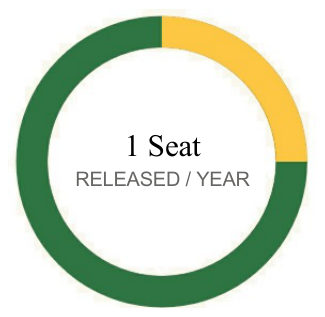
The opening lot matters because it removes human contrivance from the initial sequence and prevents the founding group from assigning favorable or unfavorable terms by preference or faction.
The Anti-capture Trigger
The senior seat is released on the departing president’s birthday at the end of the four-year term. Linking annual rotation to a birthday trigger has a powerful effect: because birthdays are spread across the calendar, there is no election season, synchronized advocacy cycle, or single moment when organized pressure can capture multiple offices at once. The presidency of four remains a continuing body—never entrenched, purged, or captured by turnover.
Six Ordered Steps
Refilling a seat follows six steps, each with a distinct constitutional purpose. Qualification comes first; campaigning never does. Candidates are considered because they are qualified to stand, not because they have organized support.
1. Notice. The succession process begins three months before the departing president’s birthday, preserving time for review..
2. Qualification. Ten candidates must meet the office’s published qualifications, protecting competence.
3. Narrowing. The field is narrowed to four then to two qualified candidates, protecting seriousness.
4. Witnessed Random Draw. The departing president conducts the draw between the two before the other three presidents; only the one drawn is recorded and published. The draw acts only after qualification.
5. Sustaining confirmation. Those served confirm by secret ballot—fifty percent plus one—protecting the governed.
6. Birthday installation. Installation occurs on the outgoing president’s birthday, preserving the distributed temporal sequence.
Recall remains in the hands of the governed. In addition to removal within councils, the voters served by a president may remove that president through a 66% negative vote, held by secret ballot, with participation required from all who are served. This provides real recourse while preserving a demanding qualification standard.
Summary
Office is a bounded duty temporarily held, never possessed. Four-year terms begin with a stagger set by lot, then release one senior seat each year on the holder’s birthday, so scattered birthdays prevent synchronized control and three presidents remain while one enters. Refilling follows six steps: (1) notice, (2) qualification, (3) narrowing to two candidates, (4) to a witnessed random draw, (5) sustaining confirmation, and (6) birthday installation, with campaigning excluded throughout. Presiding rotates without a seniority ladder, service is unpaid, and discipline remains within councils, supported by a 66% recall.
Temporal Constitution
The NewVistas calendar is not merely a scheduling tool; it is a governing structure, because office rotation and non-overlapping meetings require a patterned, constitutional approach to time.
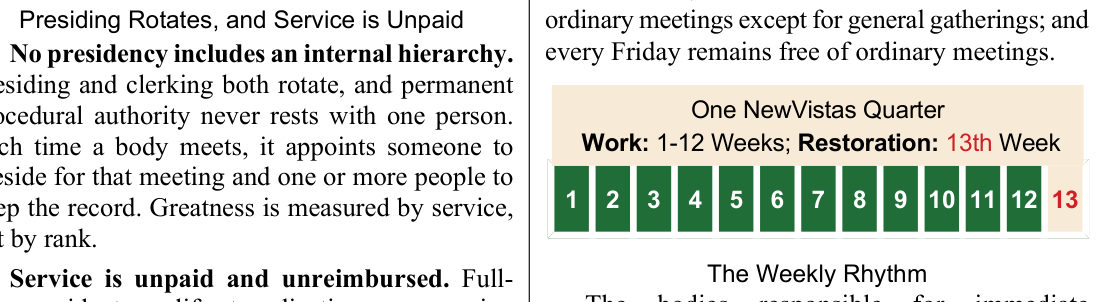
The year is divided into four 13-week quarters. Ordinary governance and labor occur during the first twelve weeks; the thirteenth week is set aside from
time presidents qualify at application on succession credit and receipts, a matured Business Enterprise, or insured income replacement sufficient for the four-year term, while part-time presidents cover ordinary costs from their own business life. Public service is honored, but it is never salaried or used as a path to enrichment.
The bodies responsible for immediate governance and service meet weekly on fixed days, so none competes with another. A guaranteed day makes presiding meaningful: someone with a regular place in the calendar can truly preside, while irregular or overlapping schedules may include them formally but displace them in practice.
Fixed Places in the Week
| Day | Who Meets | Cadence |
|---|---|---|
| Monday | Presidencies of 4 | Weekly |
| Tuesday | Segment Presidencies of 3; Department Coordination | 4th Tuesday — 2nd Tuesday |
| Wednesday | No ordinary governing meetings | Always |
| Thursday | Councils of Twelve | Weekly |
| Friday | No meetings | Always |
The Monthly Rhythm: Deliberately Slower Coordination
Bodies focused on broader coordination, rather than constant contact, meet monthly. This slows cross-domain coordination enough to keep it from intruding on the weekly rhythm. Segment presidencies of three meet on the fourth Tuesday, and department coordination councils on the second Tuesday. This cadence also determines how often each member presides in a quarter—three times in a presidency of four, once in a presidency of three, and once in a council of twelve—so the turns to preside are distributed by the calendar itself, not by individual discretion. Department coordination councils meet on the second Tuesday
Week Thirteen and Leap Week:
Rest Built into the Structure
Week thirteen completes the pattern by suspending the ordinary cadence except for general gatherings. Restoration becomes community-wide rather than merely private: the whole organism rests and gathers together instead of carrying committee work forward without pause.
When the community pauses its ordinary cadence together, a collection of individuals becomes a culture with one rhythm.
During week thirteen, ordinary meetings pause so the community can gather, rest, and renew its quarterly rhythm before the next quarter begins.
Leap Week keeps the pattern aligned with the real calendar. Whenever the ISO week-year includes a Week 53, that week is observed as Leap Week between Quarter 4 of one year and Quarter 1 of the next. The community follows the fixed ISO rule rather than creating its own correction, and because the quarter structure remains intact, the leap adjustment never distorts office rotation.
The Calendar Against Capture: Returning the Cycle to the Whole
In ordinary institutions, control of the calendar often becomes control of the body. The patterned week and quarter resist that capture: meetings occupy fixed, non-competing places; presiding rotates; Friday remains free; and week thirteen suspends the cadence. No single body can consume the whole calendar. Time itself becomes bounded office space.
This is one of the system’s hidden anti-hierarchy devices: it prevents schedule capture, protects each turn to preside, and makes the non-monarchic design livable in practice-the point where the cycle returns to the Constitution that began it.
Summary
The temporal constitution divides the year into four 13-week quarters: twelve operational weeks and a thirteenth week for community-wide restoration, with Fridays always free. Weekly bodies meet on fixed days-presidencies on Monday and Councils of Twelve on Thursday—while monthly bodies meet on the fourth Tuesday and Wednesday. This prevents overlap and fixes each member’s turn to preside by the calendar. Leap Week absorbs ISO Week 53 without disrupting rotation. Above all, the patterned calendar serves as an anti-hierarchy device: by preventing schedule capture and protecting every turn to preside, it makes the non-hierarchical system workable and returns the cycle to the whole.

← Part Eight: Timeless Principles — The Rules that Hold Every CommunityPart Ten: The Environment — The Thousand Year Standard →