
Captains and the Branch Presidency
Captains serve the community at unit, group, and branch levels. A captain primarily serves a unit – which is a grouping of approximately 10 limited partnes plus their descendants, and who all live on the same floor of an apartment building.
Captains are also captains of 50 and captains of 100. As captains of 50, they serve 50 people, in coordination with another captain. Groups, as explained here, can either be formed by partnered males and partnered females (1 group), single males and single females (second group), all males (third group), and all females (fourth group).
As captains of 100, captains are branch presidents. In this capacity, they serve the 100 occupants of an apartment building, which houses a branch. A branch comprises of 4 units, each having approximately 25 members – 10 limited partners and their dependents.

A limited partner is the basic unit in a community. A limited partner is an individual who resides within, has a business in the community, and has deposited their net worth, at least US $20,000, in the community. Limited partners are usually above 18 years old and are mentally, physically, financially, and legally responsible.
Children under 18 and adults who have another limited partner or partners as their legal “guardians” are “dependents” (dependents have granted power of attorney to their guardians, who must be limited partners). They are counted in the community’s overall population. Together, limited partners and dependents are referred to as participants.
The participants who occupy one floor in an apartment building form a unit, and are served by a captain. Each unit comprises of limited partners, from all the four demographic groups, and their dependents. With four apartment floors, each building forms a branch with four units. The four captains from each unit form a branch presidency. A branch presidency serves a whole apartment of around 40 limited partners and their legal dependents. On average, each limited partner is responsible for 1.5 legal dependents. Therefore, a branch is composed of approximately 100 individuals.
Ten branches form a village comprising around 1000 individuals. The village is served by three village presidencies, each representing one agency in the Village Bureau – agencies 1, 2, and 3. Each presidency has four presidents, adding up to 12 presidents. the 12 form a village council that collectively serves the village in instances where decisions significantly affect the community.
Four villages form a district. Each district is served by three district presidencies, each from an agency in the District Bureau – Health and Nutrition, Life Planning, and Recreation and the Arts. The three presidencies, of 12 presidents each, form a district council. Twenty-four districts form a NewVistas community, with a population of around 100,000 people. Going by this description, the community is served by 3,840 captains – 24 districts = 96 villages = 960 branches, so there are 960*4 = 3,840 captains). .
Who is a captain?
A captain are the first point of contact between limited partners and the community. Captains recruit, select, and integrate limited partners into the community so that they can be comfortable and productive. Besides this, captains serve as an interface between the community and participants. In this role, they help participants in most basic issues they have concerning any of the 24 agencies, and not just agency 1, for which they are a service extension.
When recruiting, captains aim to have at least 70% representation of the demographic composition of the region where the community is located. Collectively, the branch presidency monitors the recruitment by individual captains, so that the branch is at 80% in terms of representation oof the region’s demographic groups. This is further monitored by the village council, which guides captains’ recruitment initiatives to help the village achieve at least 90% representation.
The district council monitors recruitment as well, which, with 40 branches, is expected to further narrow the gap, such that the district has at least 95% representation. Trustees too have a role to play, working with district coucils so that the community has more than 98% representation, and is therefore a very close reflection of the society within which it operates.
How captains work
The captain works for 45 minutes from 8AM, Monday to Thursday. Their engagement is on voluntary, part-time basis. Captains have offices on the floor that houses the unit that they serve. The office is located in the 20-foot hallway, and measures 8 by 8 feet.They are easily accessible to limited partners.
The office is reserved for community business for one hour from 8AM on Mondays, Tuesdays, and Wednesdays, and 2 hours on Thursday. During other hours, it is rented out to other limited partners as office space. The captain, however, has the first right to rent it for their own business.
The branch presidency meets weekly on Thursdays, at 9AM for 45 minutes. The meetings are held in the office of the captain whose turn it is to preside. During these meetings, presiding and clerking are rotated, so that each captain has an opportunity to clerk and preside in a month.
How captains are chosen
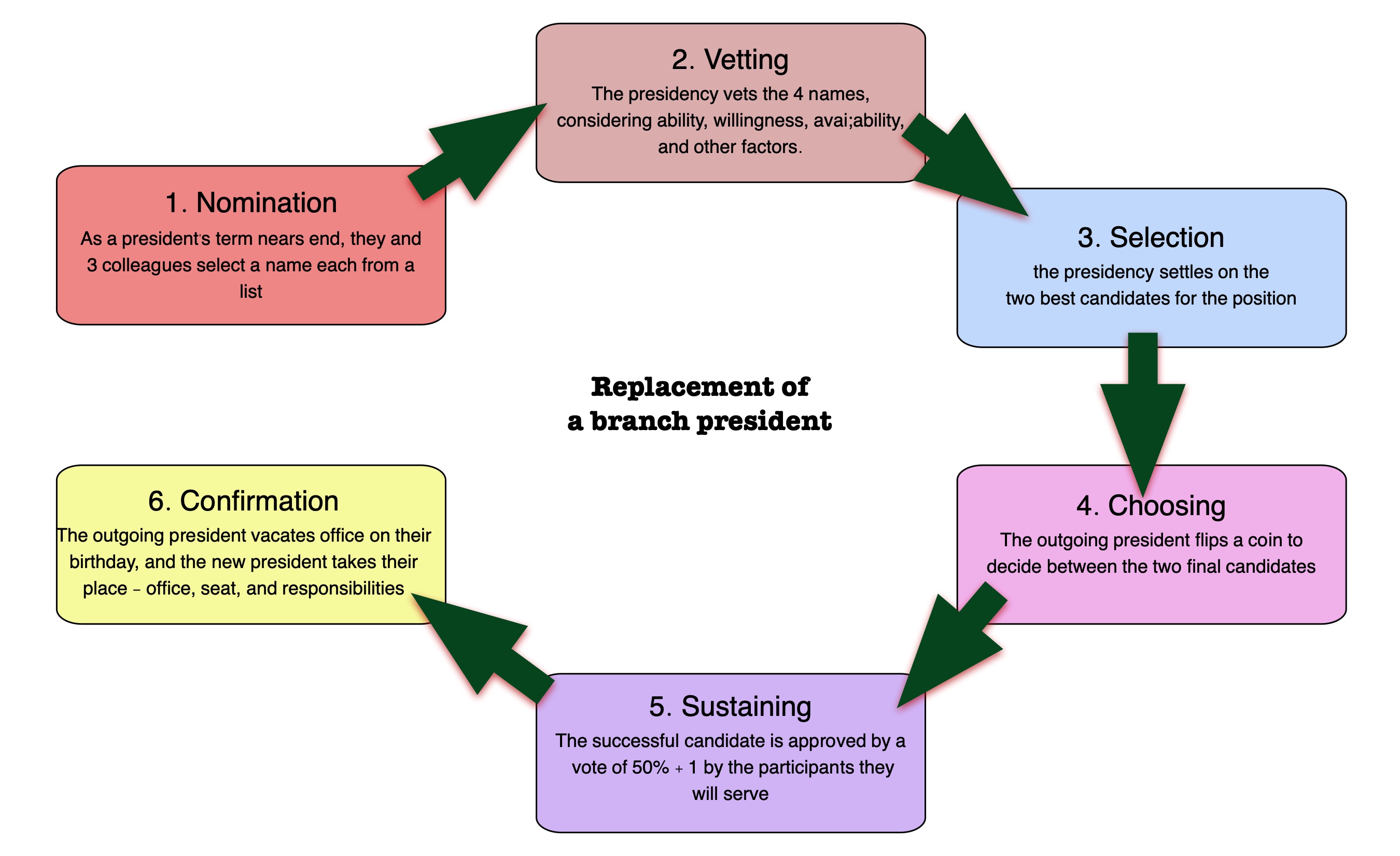
A captain serves for 4 years. Each year, a member of the branch presidency is replaced, and vacates office on their birthday. This enables the presidency to seamlessly self-replicate, while ensuring that the beginning and end dates of service are random, and therefore, unlikely to cause any vacuum.
Two months before when they are due to vacate office, the outgoing captain and other members of the branch presidency consult agency 1’s automated system, for a list of suitable candidates to replace the outgoing captain. Suitability foccuses on avaialbility to serve, willingness, and knowledge of the requirements of the position.
From the list, the four captains cchoose one unique candidate each. They then discuss the four names, and settle on two names. In selecting the two names, the presidency considers the candidate’s suitability as a model community member, demographic balance, and past service to the community.
To choose between the two candidates, the outgoing captain flips a coin to select the next captain. The final selection is therefore an act of providence, rather than a subjective, process driven by human bias or considerations.
Once a candidate has been selected through the coin toss, they must receive the support of a majority of the limited partners they are to serve. The limited partners give their approval or rejection through an online voting app, making the process transparent and hassle-free.
Ultimately, captains are answerable to the limited partners that they serve. If, in the performance of their duties, the captain loses the confidence of the limited partners and dependents in their group, they can notify the village council, which deliberates on the merits of any accusations against the captain. If the allegations are substantive, they can replace the captain.
Duties and responsibilities of the captain
Captains serve the community much more locally than any other community public servant. This makes them the best-suited to perform the duties that require direct and even personal interaction with limited partners. this is also another reason why they are not part of the 480-presidency community public service, whose members’ focus is much wider in terms of responsibilities and clientele.
Recruitment and selection of limited partners
Captains, are the primary recruiters of limited partners. In recruiting limited partners, are guided by the specific community needs as various agencies may determine, as well as demographics – this refers not only to the four demographic divisions (partnered males, partnered females, single females, and single males), but also ethnicity,culture, and age, among other societal and natural categories.
Captains are guided by agency 1’s automated system and other public servants who serve the agency. For instance, the agency’s council may determine, on the advice of its automated system and other data, that some new recruits are needed, to establish businesses as butchers, doctors, barbers, and other professions. They can assign a captain a specific set of people who they will recruit, and integrate in their unit.
In other instances, an existing participant can request that they subcontract a person with a certain skill-set. They may have the person already in mind, in which case the captain merely vets the potential participant, or the existing participant may ask the captain to look for someone from the general public.
Orientation and integration
Once the selected limited partners have joined the community formally, they need to be fully integrated into the system. For this, they need training. The training involves basic things such as the community’s physical layout, where the hubs, breezeways, and amenities are, for instance. It also includes practical knowledge of how the community system works, including the ecosystem, the physical campus layout, transport, and how to look for work, grow, and prosper. Training also involves learning about the community’s ethos, approach to community, and social organization, among other aspects of community life.1
Training
While training is mostly automated, captains may need to involve themselves personally and engage other members of the community public service to make training effective. In addition, the innovation in training and wide-ranging interaction with other departments, agencies, and bureaus give the necessary platform for captains to conduct regular check-ins and appraisals to see how well the limited partners are getting on.
A captain needs to be a model limited partner so that, beyond training, they can also show the way by example. They need to be models of how to succeed and what not to do to thrive. They must also use their own experiences to measure expectations for existing and upcoming limited partners. While this is so, every adult community member who has clearly expressed their will to serve can be called upon to work as a community public servant, including as a captain.
To enhance the chances of success, the captain liaises with limited partners to form and sustain an effective support system, which new entrants turn to as they navigate the initial days since joining. Captains can undertake this function with other captains within or beyond their branch.
Skills development, training, and mentorship
Upcoming limited partners, at the time dependent on limited partners, start the process of becoming limited partners when they turn 12. This means they have to start a business, find some gainful work, and enhance their skills. Captains are vital in helping dependents succeed in their quest in conjunction with guardians.
For a school-going teenager to work for money, the captain who serves their guardian will need to sit down with the child and guardians, explore options, and use the community system to find the most appropriate opportunity. The captain either handles this or facilitates and ensures that it has done so that a new limited partner at 18 can fully exploit the community’s facilities and opportunities to prosper.
Conflict resolution and arbitration
Once two parties have failed to resolve their conflict amicably, they turn to their captain to help resolve the dispute. The captain can make a few decisions to resolve the conflict based on their knowledge and experience handling such situations. In addition, their personal touch with the involved parties in conflict will help create the necessary trust and confidence.

Troubleshooting system issues and feedback
Captains interact with limited partners and their dependents at a personal level, often because the partners cannot navigate the system efficiently. This gives the captain a chance to train the limited partners and dependents on how to handle the system better. In other instances, the problem might be the system. The captain relays the issues they have observed to the relevant agencies for them to be fixed.
Duties and responsibilities of the branch presidency
The branch presidency has a few unique roles that it performs collectively. Many of the functions are based on the general oversight role the presidency has over individual captains.
Arbitration and conflict resolution
When a captain cannot resolve a conflict, the matter goes to the branch presidency. Sitting together virtually or in person, the branch presidency works with the parties to resolve the dispute. Where need be, they may ask for the input of the Legal Affairs Agency (agency 14) and the village council as need be. In many cases, this is expected to be the last stage of the arbitration process. In exceptional circumstances, the issue may go to the village council and, thereafter, be referred to law courts under whose jurisdiction a community geographically falls.
Advising the village council
The branch presidency forms a crucial link between the community system and limited partners. The presidency keeps the village presidency informed on the branch’s affairs. It also recommends actions only the village council or presidencies can sort out. Such matters may include training modules. For instance, some limited partners or dependents may lag and need additional help, interventions, and stewardship. The council may also assist the individual captains through training, mentorship, and integration during the entry process. The presidency collaborates with the village council to maintain social cohesion and foster a strong community spirit.
Review of branch performance
The branch presidency regularly appraises the branch’s performance in various aspects. It reviews the performance and progress of limited partners and their dependents as they work their way in the community and recommends any relevant action. The branch presidency is responsible for examining the apartment’s status, physically and otherwise, and advising agencies, bureaus, and presidencies where it feels improvements can be beneficial.
Conclusion
Captains are the primary physical contact between limited partners, dependents, and the system. Often, many of the duties that captains perform are automated, with their role being mainly to monitor the system and ensure that it is working well. Where the circumstances demand, they can get personally involved with the person involved, working them through the system, mentoring and coaching them, and identifying issues with the system that could improve it.
References and further reading
Von Der Heydt, Andreas. An In-House Coaching Model & Implementation Plan to Onboard and Integrate New Employees More Successfully with Managers as Coaches. Diss. Northeastern University, 2021.
- In modern organizations, immediate managers and supervisors are given the task of integrating new employees into organizations by teaching them the culture, specifics of their roles, and how to maneuver the organization. The community also appreciates the importance of having limited partners learn the ropes early from the person they will mostly be in contact with from then on. In this setting, however, the orientation is more thorough, covering everything from securing work, and improving qualifications, to mentoring them in their personal lives as well.[↩]
