
Artificial Intelligence and the Constitutional Reconstruction of Education
Introduction: How modern education is inspired by the industrial economy
Why does the NewVistas Educational Structure replace the Industrial School System? Read on for answers.
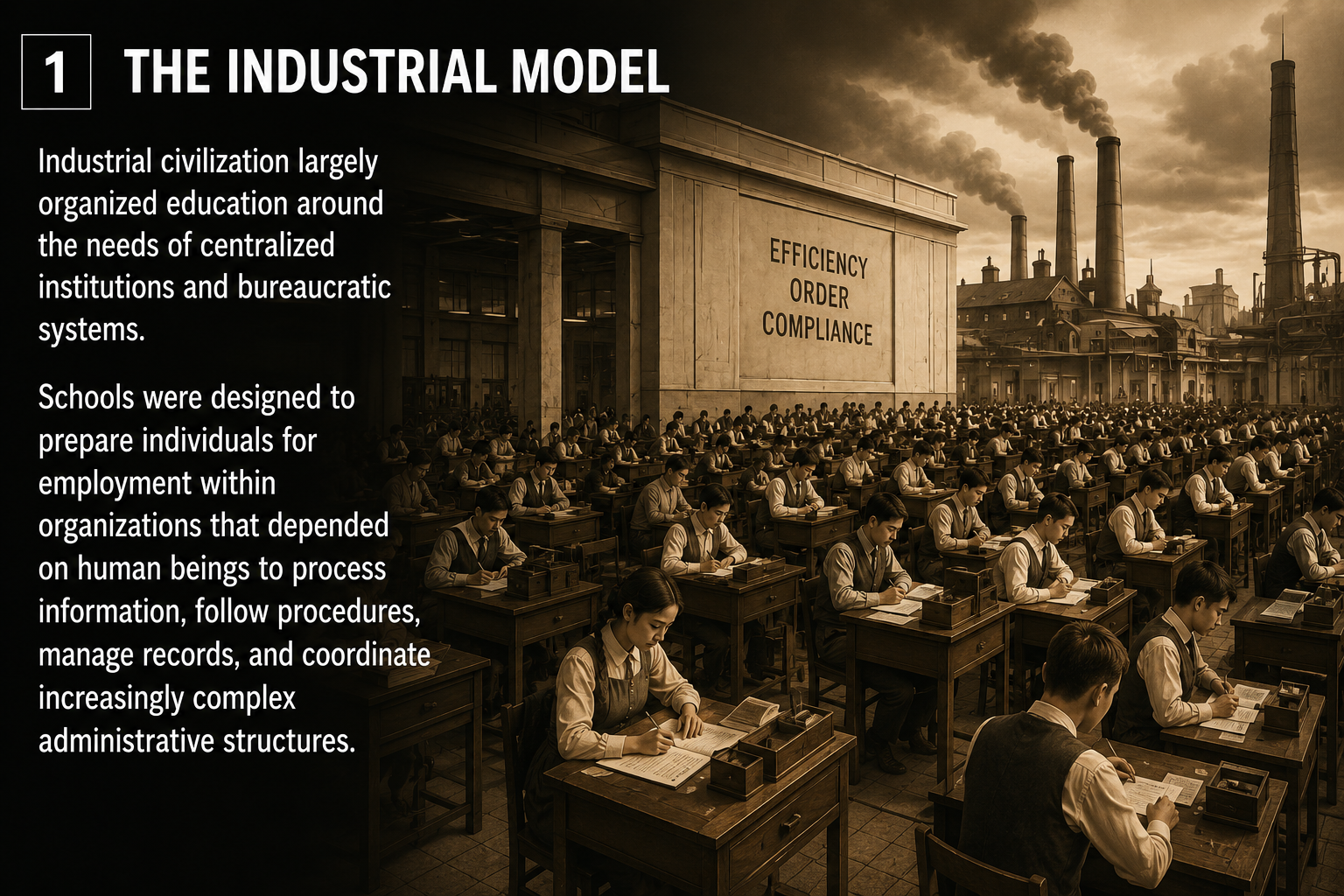
The modern industrial school system was created to serve industrial civilization. Its architecture emerged during an age of factories, railroads, centralized bureaucracies, mass armies, large employers, and information scarcity. The education system was not meant to cultivate stewardship, entrepreneurship, creativity, or wisdom. The purpose was the production of disciplined participants who could reasonably function inside industrial organizational systems.
Parallels with industrial systems
That the objective was to create a body of disciplined workers is revealed in the structure of this eduation system. Bells regulate movement, informing students when to go to class, break for breaks go for lunch, and leave the school. In factories, bells signalled the end of shifts, meal times, and emergencies. Workers could organiize their entire days around bells, much the same way students do with bells in schools.
Before industrialization, people were grouped either as apprentices, journeymen, or masters. When the industrial age came, tasks became repetitive, segmented, and standard. People were now grouped by age, gender, and physical capabilities. This grouping is firmly entrenched in school. In many cases, students proceed through the grades based on the turn of the calendar, rather than mastery of coursework.
Industrial complexes arose, where giant buildings housed all aspects of production. They allowed centralized supervision and production. This too was adopted in the school system, with giant campuses which served the same functions as industrial complexes.
Other similarities include standardized tests to sort populations, grades that rank participants comparativelt, and credential access (e.g., college degrees) into employer hierarchies. Taking work home – and homeworkfor students ensures that institutiona authority extends to the home.
When the school system is organized this way, it assumes that information is scarce, and onnly possessed by teachers. It also assumes that these experts are scarce, and the institutions of which they are a part must control knowledge. computation is scarce, with maximum effort being spent not on improving student’s reasoning and judgement skills, but on moulding them into future employees.
Enter artificial intelligence…
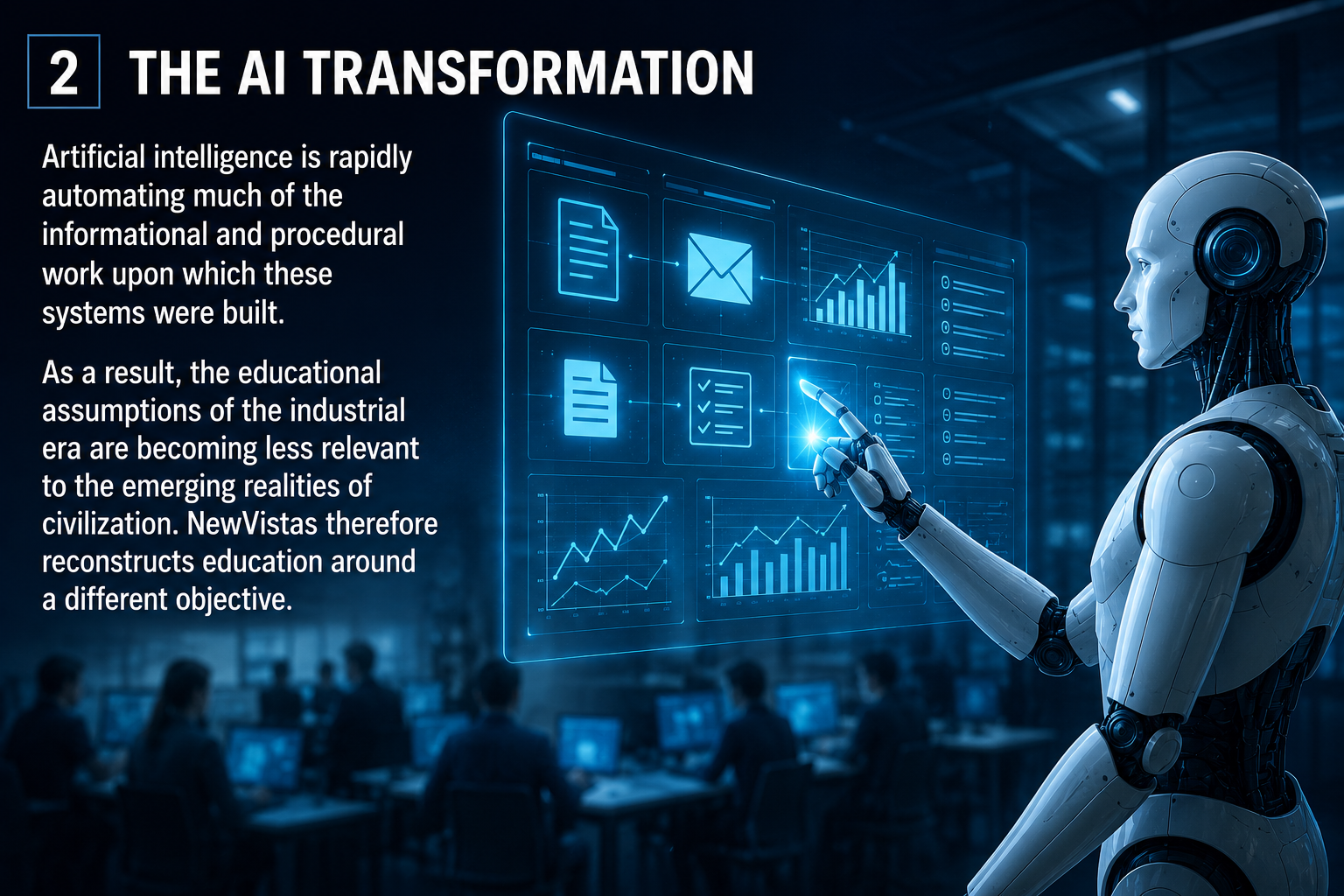
Artificial intelligence simultaneously breaks all of these assumptions. AI systems already outperform average humans in factual retrieval, symbolic computation, and summarization. They are better at tutoring, coding assistance, language translation, and information synthesis.
This means that the monopoly over knowledge and its control is no longer a sustainable model. Once information becomes universally accessible, the educational problem fundamentally changes. The problem is no longer about having students memorize scarce information. It is how people can be taught to reason, judge, collaborate, and communicate. It is about building their capacity to govern themselves and wisely direct intelligent tools.
AI: Eliminating Industrial Information Delivery While Elevating Human Formation
The industrial teacher primarily functioned as an information conveyor. AI makes this role economically obsolete. The roles for which teachers were crucial are already being done better by AI systems, which can explain mathematics, summarize literature, retrieve history instantly, generate practice exercises, and write essays. These systems have also been deployed to diagram scientific systems, tutor interactively, and solve symbolic problems.
Despite these extraordinary capabilities, AI does not eliminate the value of human interactions and impact in education. It instead changes where this value is focused. Human educational value is essential in judgment, ethics, and disciplined cognition. Interpreting, synthesizing, and communicating information also needs human insights, as does stewardship, creativity, collaboration, and supervised practice.
AI makes information cheap and easily accessible while elevating the value of disciplined human formation. To reflect these changes, NewVistas has new terminologies meant to communicate the evolved role of human expertise in education. For instance, Agency 5 full-time educational professionals are called Learning Mentors. Agency 17 operational practitioners are called Practice Guides.
Exactly one-half of youth foundational courses originate from Agency 5 full-time professional Learning Mentors. The other half originates from Agency 17 part-time business-owner Practice Guides actively operating inside productive civilization. This constitutional balance prevents educational monopolization by either detached academic bureaucracy or purely narrow vocationalism.
By structuring education this way, the NewVistas system intentionally forces continual integration between theory and practice, abstraction and application, and cognition and production. Ultimately, it ensures the continual integration between scholarship and stewardship.
Artificial intelligence increasingly reduces the amount of human labor required to sustain civilization. As a result, NewVistas is not organized around the industrial assumption that most people must spend the majority of their lives performing repetitive labor inside large bureaucratic institutions.
Instead, NewVistas develops a highly productive service-oriented civilization in which automation carries much of the informational and procedural burden. The resulting productivity makes possible shorter work weeks, reduced working hours, continuous education, expanded artistic and cultural participation, recreation, family life, and lifelong stewardship development. Economic progress is therefore measured not merely by output, but by the extent to which human beings gain greater capacity for learning, creativity, community participation, and self-governance.
Why NewVistas Rejects Fully Remote Foundational Education
NewVistas aggressively embraces AI while simultaneously rejecting fully remote foundational childhood education. Large-scale remote educational experiments have demonstrated major weaknesses in accountability, discipline, and social maturity. Lack of iin-person instrucctions negatively affects communication, hinders team work, and prevents cultural transmmission as is the case in a classroom.
Because the AI-powered NewVistas system ensures that educational problems do not revolve around information, the new challenges are the formation of children as they mature, supervision and correction, accountability, socialization, and motivation. This shift demands physical educational practice, which NewVistas constitutionally requires. Students, Learning Mentors, and Practice Guides must physically participate together on site for all forty-eight sessions of every course each quarter.
While remote systems may supplement some functions, such as tutoring, simulations, review, personalized pacing, and AI assistance, they cannot replace mentorship, apprenticeship, accountability, observation, and embodied information. Therefore, despite the transformative impact of AI on education, human formation is environmental, social, physical, and supervised.
The Quarterly Educational Structure
Between the ages of 4 and 18, all participants take three courses each quarter. Each course consists of forty-eight supervised on-site sessions. The educational structure intentionally rejects industrial uniformity. Different disciplines require different rhythms. Courses may be organized as four weekly sessions, concentrated weekly blocks, or laboratory intensives. They can also be arranged as fabrication clusters, agricultural cycles, or immersive field environments.
In some instances, a course may be compressed into four consecutive sessions in one day, or four consecutive immersive days containing twelve sessions per day during wilderness instruction, fabrication projects, robotics intensives, transportation studies, agricultural harvests, or musical workshops.
The industrial school system standardized time for administrative convenience. The NewVistas is a departure from this, instead organizing time around mastery, apprenticeship, productive reality, and operational experience. Because there is no centralized school building, courses occur throughout the community, turning it into a campus by itself. Classes can be held in greenhouse systems, fabrication labs, restaurants, clinics, studios, and business offices.
V. Competitive Market-Driven Course Publishing
The NewVistas educational system is constitutionally decentralized. There is no centralized curriculum office determining daily lesson plans, ideological conformity, and ensuring identical intellectual pathways. Instead, Learning Mentors and Practice Guides independently create and publish courses.
All courses are published exactly one quarter in advance. In publishing a course, the mentor or guide gives their identity, relevant details, and includes a description of the subject. The mentor or guide sets out participation standards, session structure and schedule, location, class limits, materials, and the direct cost. Armed with these details, students and guardians then voluntarily evaluate and select courses after reviewing the information shared by the mentor or guide. Adults also voluntarily select continuing education courses.
Agency 5 governs standards for Learning Mentors. Agency 17 governs standards for Practice Guides. Neither agency centrally plans the actual details of the education offered, including exact educational ideology, or seeking to shape identical intellectual conclusions, lecture scripts, or standardized thought. Instead, their focus is on standards, safety, disclosure, and certification. The agencies also govern the competency of mentors and guides, and enforce structural integrity.
Because of this freedom, educational offerings emerge competitively from productive civilization itself. Weak courses lose enrollment, while more valuable mentors gain demand. New educational offerings emerge continuously. Because AI transforms civilization rapidly, decentralized educational markets adapt far faster than centralized bureaucratic curriculum systems.
Youth Formation, Uniforms, and Visible Educational Identity
When in session, participants aged 4 – 18 wear fitted community uniforms. These uniforms are supplied through professional clothiers. The uniform system creates an immediate, visible educational identity. Community participants instantly recognize who is currently participating in the foundational educational structure.
In addition, students have to agree to grooming, hygiene, attendance, and participation standards. Participants ages four through eighteen wear fitted community uniforms supplied through professional clothiers. These standards are today common in elite preparatory academies and professional institutions.
Status signalling is discouraged in NewVistas, a stance that is also enforced in the classroom. Tattoos, nose rings, and other similar adornments are prohibited during the foundational years of up to 18. The focus is on professionalism, seriousness, and mutual respect. These measures are also taken to reduce distraction, status competition, and gang signalling. These standards are not only limited to students, but also to Learning Mentors and Practice Guides, who agree to dress and grooming standards.
Adult Continuing Stewardship Education
Education never ends in NewVistas. Even after clearing the foundational education system, adults continue taking at least one course every quarter throughout life. Adults directly select courses and pay from their own “sufficient.” The adult educational structure alternates quarterly. During one qarter, an adult participant takes a course offered by Learning Mentors offering professional courses (and governed by aAgency 5). The next quarter, they take a course offered by practice guides, who offer operational courses (and are governed by agency 17).
The alternating structure integrates theory and practice, strengthening conceptual systems while benefiting from lived judgement. The phenomenon of credential monopolies, which fuel detached academic absorption, is suppressed in this structure.
Operational practitioners transmit forms of knowledge difficult for AI systems to fully encode, such as pattern recognition, tacit judgment, failure experience, and adaptive decision-making.
Adults are not subjected to universal dress and grooming standards because adulthood carries a presumption of mature self-governance.
Voluntary Participation and Informed Covenant
The NewVistas educational structure operates through informed voluntary participation rather than concealed coercion. For instance, before entering the community, guardians and participants receive a detailed explanation of standards related to uniform, grooming, mentor and guide structure, and participation bylaws. They are also fully informed about continuing education standards, as well as course systems. During every course registration exercise, these standards are repeated.
Educational Ownership, Privacy, and the End of Comparative Ranking
Industrial educational systems depend on comparative ranking because industrial civilization sorted populations into employer hierarchies, bureaucratic ladders, institutional scarcity systems, and centralized labor structures. This approach is decisively eliminated by the NewVistas education systems because, since it is powered by AI, it increasingly dominates informational optimization.
NewVistas, therefore, constitutionally prohibits common practices in industrial-inspired educational systems such as GPA systems and honor rolls, class ranking, and percentile systems. The system, therefore, eliminates permanent comparative educational identity.
In further pursuance of privacy, educational evaluations belong to the student. Institutions, agencies, mentors, guides, employers, or centralized databases do not own permanent educational identity records. The system rejects centralized educational surveillance, predictive profiling, behavioral scoring, and permanent institutional ownership of educational identity.
Participants instead receive competency feedback, observed mastery comments, certifications, and individualized guidance. The objective is not defeating peers, but to increase stewardship capability. By doing so, the structure substantially reduces status anxiety, academic caste formation, and peer rivalry. NewVistas shifts educational psychology from competitive positional warfare to individual stewardship development.
Homework Collapse in an AI Civilization
Artificial intelligence has fundamentally undermined the traditional purpose of homework. Modern AI systems can already write essays, solve equations, summarize books, generate reports, and produce polished assignments across a wide range of subjects. As a result, work completed outside a supervised learning environment increasingly reflects a student’s access to AI tools, their ability to optimize prompts, their skill in concealing external assistance, or the level of support available from parents and others, rather than their actual mastery of the material.
For this reason, NewVistas constitutionally prohibits homework. Educational work is conducted only within supervised learning environments where reasoning can be observed, AI usage remains transparent, collaboration rules are clearly defined, and mastery can be directly demonstrated. The responsibility for education is therefore not transferred to families during evenings and weekends, but remains within the educational system itself, where learning can be accurately guided, evaluated, and verified.
The Walkable Community as Educational Infrastructure
Here’s a prose version that maintains the intent while reading more naturally:
In NewVistas, the community itself functions as educational infrastructure. Rather than separating learning from daily life, the physical and social environment is designed to support continuous education through participation in a functioning civilization. The community is walkable, mixed-use, continuously populated, and governed through invitation-based membership and due-process systems that create a safe and stable environment for residents of all ages.
Within this setting, children are able to move independently between courses, music instruction, gardens, fabrication spaces, restaurants, mentorship opportunities, recreational activities, and productive workplaces. Because these destinations exist within an integrated community, education is no longer dependent upon buses, large institutional campuses, or constant parental chauffeuring.
As children navigate the community, they progressively develop independence, confidence, social competence, responsibility, practical awareness, and the ability to orient themselves within a complex environment. These skills emerge naturally through participation in everyday community life rather than through artificial exercises detached from reality.
The objective of education in NewVistas is not to maximize institutional custody over a child’s time. Instead, the goal is to integrate learning with real life, allowing education to occur within the context of productive, intergenerational community living.
Education for Decentralized AI Civilization
Industrial civilization largely organized education around the needs of centralized institutions and bureaucratic systems. Schools were designed to prepare individuals for employment within organizations that depended on human beings to process information, follow procedures, manage records, and coordinate increasingly complex administrative structures.
Artificial intelligence is rapidly automating much of the informational and procedural work upon which these systems were built. As a result, the educational assumptions of the industrial era are becoming less relevant to the emerging realities of civilization. NewVistas therefore reconstructs education around a different objective.
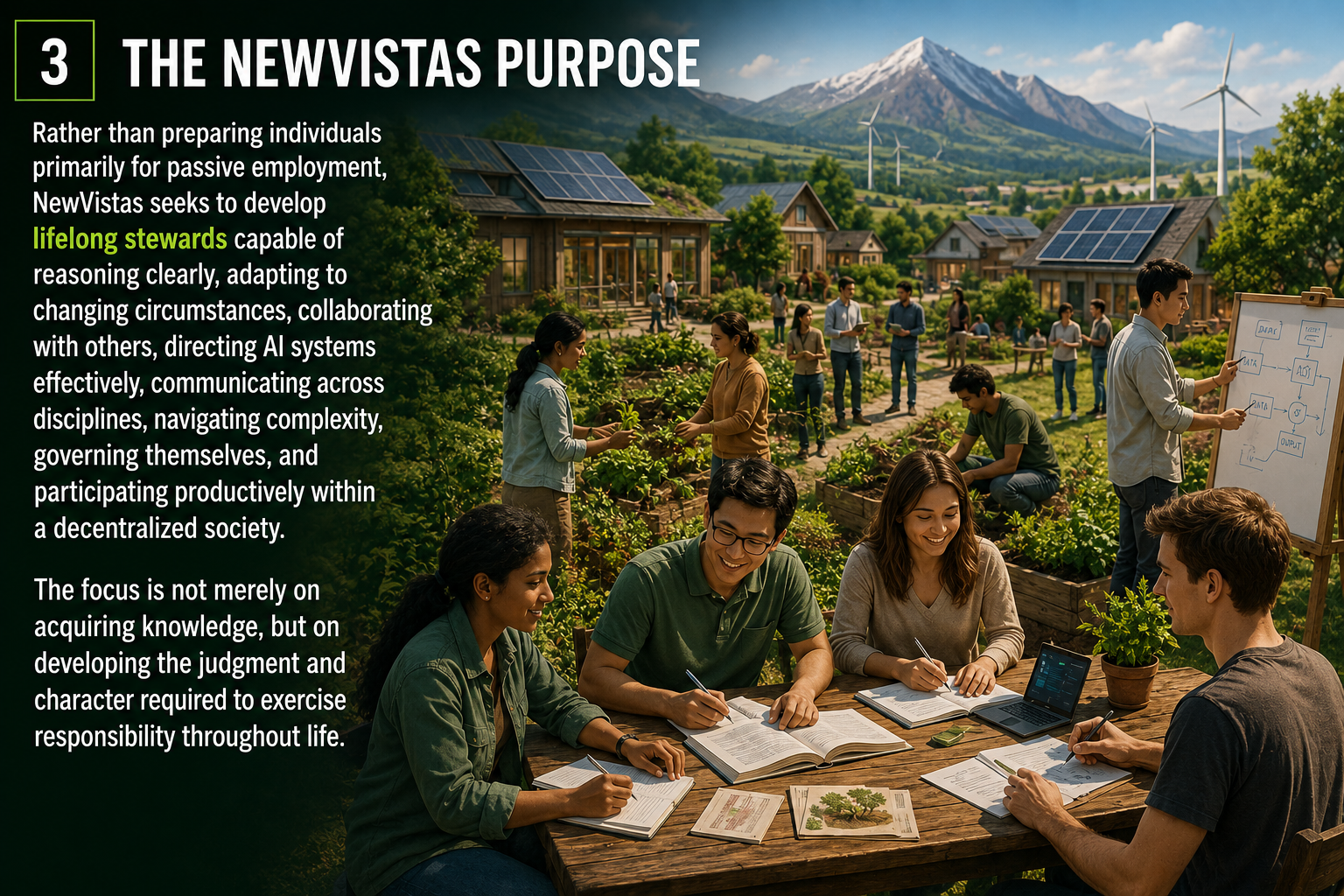
Rather than preparing individuals primarily for passive employment, NewVistas seeks to develop lifelong stewards capable of reasoning clearly, adapting to changing circumstances, collaborating with others, directing AI systems effectively, communicating across disciplines, navigating complexity, governing themselves, and participating productively within a decentralized society. The focus is not merely on acquiring knowledge, but on developing the judgment and character required to exercise responsibility throughout life.
Within this framework, the distinction between “school” and “real life” largely disappears. Learning is not confined to classrooms or limited to specific hours of the day. Instead, the entire community functions continuously as a campus, an apprenticeship network, a reasoning environment, and a productive civilization. Education occurs through participation in the life of the community itself, where learning, work, governance, culture, and social responsibility are integrated rather than separated.
The industrial school system was a product of nineteenth- and twentieth-century industrial civilization. As artificial intelligence transforms the nature of work and knowledge, civilization is increasingly compelled to develop a new educational model—one designed not for bureaucratic employment, but for capable, self-governing individuals who can steward themselves, their communities, and the tools they create.