
Councils of 50
A council of 50 is formed by agency presidencies serving 24 agencies in 50 communities. this group of communities is known as a NewVista.Councils of 50 form several ways through which communities in a NewVista can collaborate, harnessing extensive social, economic, and geographical might for individual communities’ benefit.
With approximately 5 million participants, a NewVista offers a big market for individual communities, an opportunity for heightened social interaction and exchange in a diverse society, and more ambition in the achievement of capital-intensive infrastructure projects. A council of 50 also plays an important role as liaison between communities and the authorities, especially since most communities in a NewVista submit to the same jurisdiction.
Each agency is served by three agency presidencies – trustee, operational, and regulatory. Since there are 24 agencies in every community, there are 72 councils of 50. 24 are trustee councils, another 24 are operational, and the rest are regulatory. Each council consists of 200 members – since every presidency in the plat-based system comprises of four presidents.
While communities are autonomous in their operations, and are up to 90% self-sufficient, it is nonetheless important for them to collaborate on a range of issues. Such collaboration is structured, designed to generate positive incomes without the possibility of domination of one community by another, or an overlapping of responsibilities, a factor that breeds confusion and affects productivity.
NewVista in a plat-based concept
The communities that form a NewVista share several common interests and challenges. They might be in the same political environment, face similar economic, security, or infrastructural challenges, or have especially strong cultural ties.
The NewVistas system is organized as detailed in the table below:
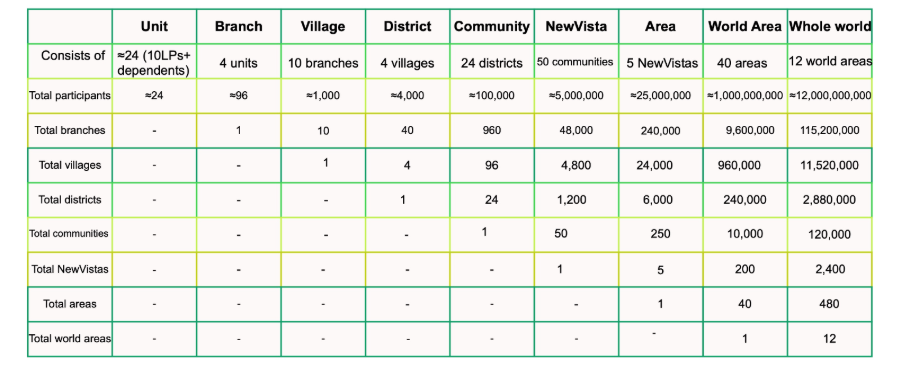
Notes on table:
- The figures for participants above are approximate. Every apartment floor holds a maximum of 30 people. In many cases, some limited partners will have more or less than 2 dependents, meaning that a unit may have as few as 15 members, and sometimes approach 30.
- Visitors and guests in apartments are not counted officially. However, since they will be a regular feature, a branch will easily have more than 100 people in some instances, and in others, less.
The collaboration that these ties demand is channeled through councils of 50. A council is formed by the 50 communities’ agency presidencies. Trustee agency presidencies form their own fifty councils of 50, as do operational and regulatory presidencies. Therefore, each community, which has 72 agency presidencies (three for each of the 24 agencies) belongs to 72 councils of 50.
For instance, all operational agency presidencies serving agency 1 form an operational Residential and Mediation Operational Council of 50. The trustee agency presidencies likewise form a Residential and Mediation Trustee Council of 50, while regulatory agency presidencies form a Residential and Mediation Regulatory Council of 50.
Each NewVista has 72 councils of 50. There are 24 operational councils, 24 trustee councils, and 24 regulatory councils. Each council consists of 50 presidencies of four and therefore has 200 members.
| type of council | Formed by | Number of councils |
| Trustee council of 50 | trustee agency presidencies | 24 |
| Operational council of 50 | Operational agency presidencies | 24 |
| Regulatory council of 50 | Regulatory agency presidencies | 24 |
Historical background councils of 50
In 1844, the first leader of the LDS movement, Joseph Smith established a council in 1844, shortly before his death, to govern the movement’s civil matters. The council, though consisting of many senior members of the church, also included other people who were not members. It was a separate entity from the general church’s organizational structure.
The early church operated in a challenging political and social environment. For instance, the saints were on the receiving end of brutal persecution in many of the areas where they had established communities – in fact, Joseph Smith was murdered by a mob 4 months after establishing the council.
Early church leadership led by Smith sought to engage more positively with political and local leadership in the areas where they lived. The council of 50 would be a valuable tool for this. LDS communities had been established in geographically diverse locations in the United States. There needed to be a mechanism through which these communities could collaborate on social matters, outside the formal administrative structures of the church, which would be provided by the Council of 50.
While early LDS communities were established in areas that already had inhabitants from other faiths, saints felt that there needed to be a civil system that, while complementing existing laws and regulations, would assist saints to live more harmoniously with fellow saints and to more fully live the word of the Lord.
The council of 50 would set up the systems through which saints would resolve civil issues without the need to resort to legal suits. Early leaders, notably Sidney Rigdon, taught that there should be no division between church and state, in effect advocating for a theocratic government. This was deeply unpopular in the country and led to many problems that the early Saints encountered.
The early church also needed to have a mechanism through which it could address its issues with the authorities, which had led to widespread persecution and expulsions. The Council of 50 would have helped with this. Purposefully, it included people who were not members of the LDS, as Joseph Smith taught that all people of all religions and denominations would form part of the Kingdom, though Jesus himself would be king.
Types of councils of 50
There are three types of councils of 50 – trustee, operational, and regulatory. Trustee councils of 50, formed by the trustee agency presidencies serving each agency, are focused on aligning strategies within their agencies and community with those of other communities in a NewVista with whom they share similar challenges or circumstances.
Operational councils of 50 work to share information across the NewVista on implementation of strategy and general agency operations. Councils of 50 therefore help to streamline operations through sharing of information on new and better ways of doing things, including changes to optimize the automated system’s performance.
Regulatory councils of 50 work as an umbrella conference for a NewVista’s regulation and compliance activities. In an environment where legal hurdles may often crop up to impede communities’ progress, regulatory councils offer much needed legal advice and lobbying to clear the way.
Every community agency is therefore, based on the above, represented in three different councils of 50. This gives agency presidencies and their council an extensive range of information, advice, and collaboration avenues in the course of their service.
General duties of Councils of 50
In its modern form inspired by this early council as attempted by the saints, councils of 50 coordinate issues that, due to geographic, climatic, political, or legal circumstances, prevent the optimal operation of an individual agency. It may also be done to reap from the economies of scale, creating the sort of operational and financial muscle that can push through major infrastructural developments, form powerful lobby groups to pursue the interests of the NewVista, among other things.
Each community in a NewVista is surrounded by farmland, pastures, wilderness, and areas for raw material extraction. Different communities’ farmland and wilderness areas are next to each other, even though their physical campuses are wider apart, sometimes several miles. With the communities being geographically close to each other, there is a high exchange of trade and culture, as well as a need to collaborate on a few infrastructural undertakings.
Some NewVistas may be within a whole country, in other cases a state or province, or other legal entities. It is important, for the sake of streamlined interactions with legal authorities, for such NewVistas to have a unified approach. NewVistas coordinate such matters through councils of 50 to present a unified approach and carry greater weight.
While each community’s agency councils independently adopt and implement strategy, it is sometimes important to align some plans and operations with other communities for added weight.
For instance, a particular community’s Transport Agency’s council may identify, based on data, the need to significantly upgrade the air transport within the community’s crop and pastureland, providing new airstrips and helipads. Some of these lands may be near other communities, necessitating a collaboration to minimize costs and optimize benefits. The agency’s operational presidency will put these proposals to the council of 50 to secure and guide collaboration in this regard.
Councils of 50 offer a powerful avenue for cultural transfer. The community, when viewed as a densely populated town of 100,000 people, may betray some small-town characteristics, where people are known to or familiar with each other, have a high degree of cultural homogeneity, and have over time developed a community dynamic unique to them. Matters are not helped by geographical isolation, though small, between different communities.
These characteristics, while in some cases adorable, can also have negative consequences, such as when people do not want to embrace newcomers, or are too set in their ways to accept changes to their way of life. Councils of 50 offer a system of 24 arteries through which ideas, information, and changes are communicated across 50 communities – the size of Houston or Philadelphia. Each community, though independent, is simultaneously part of a larger community, maximizing the NewVistas system’s economic and social opportunities.
How a council of 50 works
Presiding presidency
For the purposes of coordination and facilitating the workings of a council, a presiding presidency is chosen to preside over meetings and coordinate committees’ operations. The selection is done through a lottery.
All presiding presidencies across all 72 councils come from the same community. The selection, which happens through lottery, and takes place at the end of a four-day quarterly council convention, is automated, with all communities eligible, besides those who have presided or clerked in the last one year.
The selection of a new presiding presidency takes place at the end of one quarterly meeting. 15 minutes before the convention ends. all coouncils proceedings are paused, while the presiding community deploys a software to randomly select the next community from the eligible parties.
The selection happens six months before they are due to preside. In the first three months, they act as the clerk of the presiding presidency which will preside the next meeting. This gives them an opportunity to shadow the incoming president. get acquainted with current programs, and therefore be well prepared for their tenure in three months’ time.
Roles of the presiding presidency
Within each council, the presiding presidency is responsible for facilitating quarterly council conventions, which are held in their community, in the building of the agency the presiding presidency serves.
In the lead up to the convention, different agency presidencies come up with projects and subjects to discuss and advance within the council. they submit them to an A-powered system which advises them whether such an idea has already been submitted. All these ideas are fine-tuned by the system and sent to the presiding presidency, who collates them and informs other members of the council.
Presidencies have to submit their ideas at least a month before the convention. submissions received after the deadline are considered in the next convention. All presidencies have ample time – one month – to go through suggested ideas, and decide which committees they will join at the convention.
Presiding presidencies are responsible for organizing council conventions at which they will preside. Through their agency, they rent the required space, and any equipment that the meeting needs. The agency will also foot any associated costs, apart from accommodation costs, hospitality, and transport to the venue, which each president foots out of their own pocket.
When a community wants the involvement of the council in a project, it approaches the presiding presidency. The community, through the relevant presidency, submits a proposal to the presiding presidency. The presiding presidency does not have a role in appraising the appropriateness of the proposal. Its duty is to prepare a memorandum, attach the proposal, and communicate it to the other members of the council.
Committees
The bulk of a council’s work is performed through 8-member committees that are formed based on expertise, and the relevance that the forming presidencies have regarding the project they are to steer. Committees are formed by their council with the facilitation of the presiding presidency.
Once formed, a committee oversees the project and regularly reports to the whole council through the presiding presidency. The committee coordinates the selection of contractors and tendering processes, inspections, government approvals, and partnership with non-NewVista players.
A committee produces its own terms of reference, sometimes assisted by expert contractors. The presiding presidency is furnished with the terms, which they communicate to the rest of the council. Based on its performance, a committee can be disbanded or reconstituted. The decision is however made by the full council, with the presiding presidency only recommending action.
Since they are agency presidents, members of the council are mature limited partners who are no longer actively running businesses. They are therefore able to dedicate their full-time to the community, and in this case, NewVista affairs. To be better equipped, presidents may hire consultants to help them in making good decisions.
Details of committees work, meetings, and the quarterly convention are discussed here.