
A Permanent Food Civilization:
The NewVistas Model of Agriculture, Stewardship, and Community Infrastructure
A Position Paper on Agricultural Stewardship, Food Infrastructure, and Civilizational Resilience
A Permanent Food Civilization: The NewVistas Model of Agriculture, Stewardship, and Community Infrastructure
A Position Paper on Agricultural Stewardship, Food Infrastructure, and Civilizational Resilience
Executive Summary. This paper presents NewVistas agriculture as a fully integrated food civilization rather than as a set of isolated farming practices. Its governing standard is the Thousand-Year Standard, which asks whether agricultural decisions strengthen or weaken the productive assets that future generations will inherit. From that standard flows an integrated model in which governance, ecology, production, food preparation, nutrient recovery, water stewardship, biodiversity, technology, and economic incentives operate as parts of one coherent system.
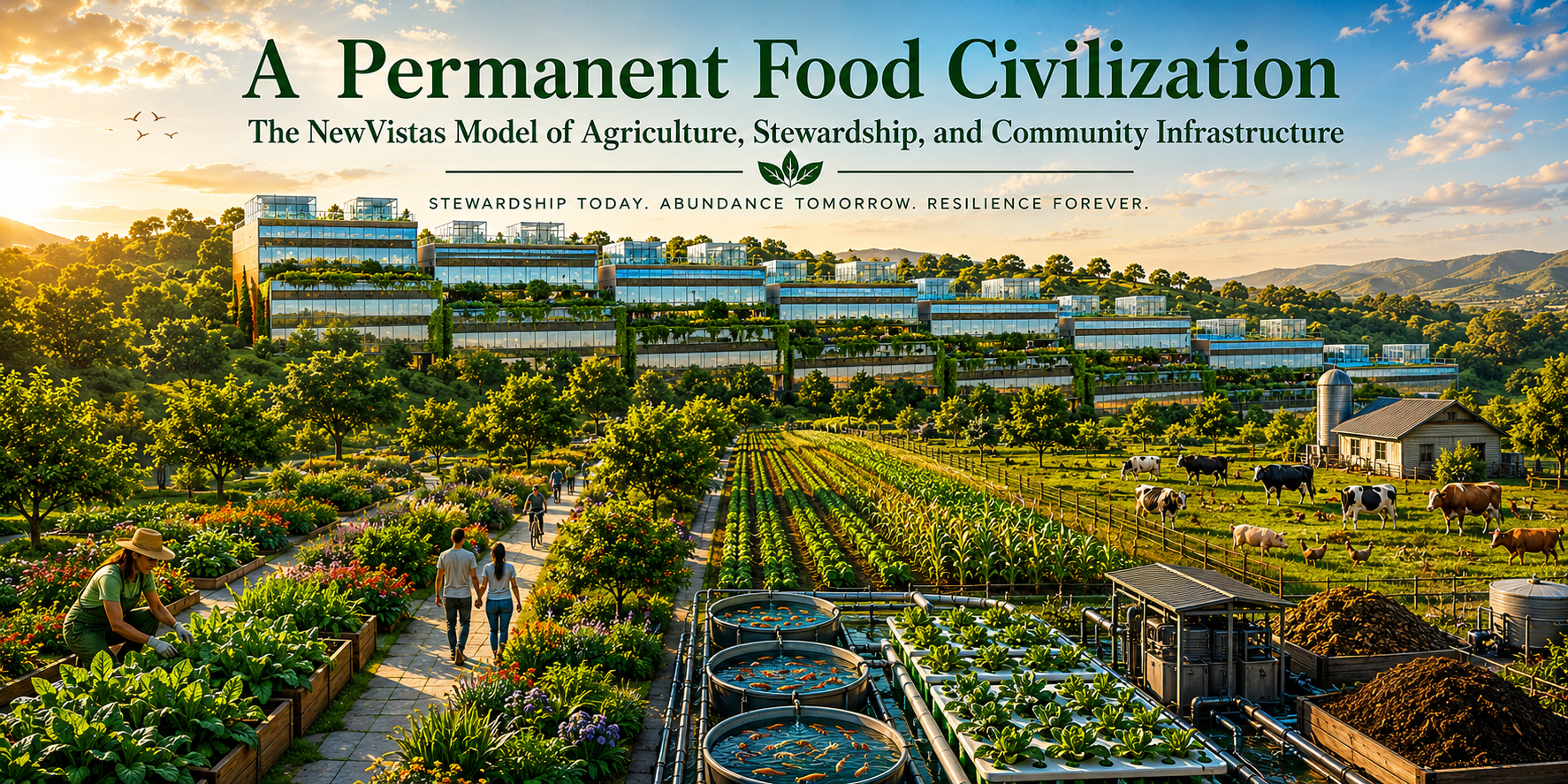
The paper is organized around twenty-four substantive sections that move from first principles to operating systems and then to long-term outcomes. It explains how Agency 4 governs standards without operating enterprises; how the four-layer production system unites residential greenhouse gardens, orchard-and-park subscription systems, industrial-zone vertical green aqua farms, and the outer permacultural field system; how controlled-environment farming, aquaponics, integrated animal agriculture, and silvopasture strengthen resilience; how restaurant-centered food logistics and nutrient recovery reduce waste and strengthen local circulation; and how artificial intelligence, robotics, and local water-energy-resource systems make a highly diversified agricultural order workable at community scale. It also clarifies the role of variable-depth greenhouse tray systems, canopy easements, rooftop greenhouse infrastructure, subscription-based park ecology, harvest-participation subscriptions, and cascading biological recovery in creating a food civilization that is both highly diverse and thermodynamically integrated. The result is a model designed not merely to feed 100,000 people, but to do so in a way that continuously improves soils, water systems, biodiversity, resilience, and long-term productive capacity.
Abstract. This paper presents a comprehensive model of agriculture, food preparation, ecological stewardship, and economic design for a NewVistas community of approximately 100,000 people. It argues that food should be organized not as a fragmented set of industries, but as a permanent food civilization governed by the Thousand-Year Standard: the requirement that productive systems improve the resources inherited by future generations. The paper explains how this standard is implemented through Agency 4 governance, the four-layer production system, controlled-environment farming, aquaponics, integrated animal agriculture, silvopasture, nutrient recovery, water resilience, restaurant-centered logistics, Footprint Economics, and advanced technological coordination. It further argues that the significance of the model extends beyond any single settlement, because each community combines substantial local diversity with a replicable general structure capable of expanding biodiversity, resilience, sustainability, and practical innovation across thousands of communities worldwide.
Section 1: The Thousand-Year Standard
Every agricultural system reflects a set of assumptions about time. Most modern agricultural systems are evaluated according to annual yields, quarterly profits, short-term commodity prices, or political cycles. NewVistas begins with a different measure. The central question is not whether a system produces abundant harvests this season, next year, or even within a generation. The central question is whether it can remain productive while improving the resources upon which future production depends.
This principle is known as the Thousand-Year Standard. It asks whether a particular agricultural practice, repeated continuously for one thousand years, would leave the land healthier or poorer, water systems stronger or weaker, biodiversity broader or narrower, and future generations with greater or lesser productive capacity. The standard therefore redefines agricultural success. Yield remains important because communities must be fed. Profitability remains important because stewardship enterprises must remain viable. Efficiency remains important because resources must be used wisely. Yet none of these measurements alone is sufficient.
Under this standard, agriculture becomes a stewardship activity rather than a resource-extraction activity. Soils are treated as living systems. Water is treated as a strategic inheritance. Biodiversity becomes a productive asset. Nutrient cycles become economic assets rather than waste problems. The objective is not merely to sustain current conditions, but to regenerate them so that each generation leaves stronger agricultural resources than it received. Soil quality should improve. Water systems should become more resilient. Ecological diversity should expand. Productive capacity should increase.
The Thousand-Year Standard also changes economics. Activities that create long-term ecological liabilities cannot be treated as successful merely because they generate short-term profits. Likewise, activities that improve productive resources create real value even when those benefits emerge slowly over decades. This philosophy governs every part of the NewVistas food civilization, including residential greenhouse gardens, park streets, the outer permacultural field system, aquaponics, restaurant infrastructure, integrated animal agriculture, nutrient recovery, and Footprint Economics.
Future generations cannot participate in today’s markets and cannot vote in today’s elections, yet they will inherit the consequences of today’s decisions. The Thousand-Year Standard serves as a practical way to represent their interests within present-day planning. Agriculture is therefore judged not only by what it produces, but by what it leaves behind. A successful agricultural civilization continuously improves the resources that make prosperity possible. The sections that follow show how this standard is translated into governance, infrastructure, production systems, and economic design throughout the NewVistas model.
Section 2: The NewVistas Food Civilization
Most modern societies treat food as a largely private household activity. Families purchase ingredients, transport them home, store them, prepare meals independently, and dispose of waste separately. Agriculture, food processing, transportation, restaurants, and consumers operate as related industries, but not as one deliberately integrated design. NewVistas adopts a different approach. Food is treated as a civilization-scale system in which agriculture, food processing, distribution, restaurants, ecological stewardship, technology, and community life are designed as components of one coherent framework.
The objective is not merely to produce food. The objective is to establish a permanent food civilization capable of supporting human prosperity for centuries while continuously improving the productive resources upon which future prosperity depends. This shift changes the role of nearly every institution in the food chain. Food preparation is concentrated within professional kitchens, restaurants, bakeries, food halls, meal-service providers, and hospitality enterprises. Residences retain small kitchenettes for convenience, beverages, snacks, and light preparation, but daily meals are generally obtained through commercial food providers. Food preparation thus becomes infrastructure rather than a massively duplicated household function.
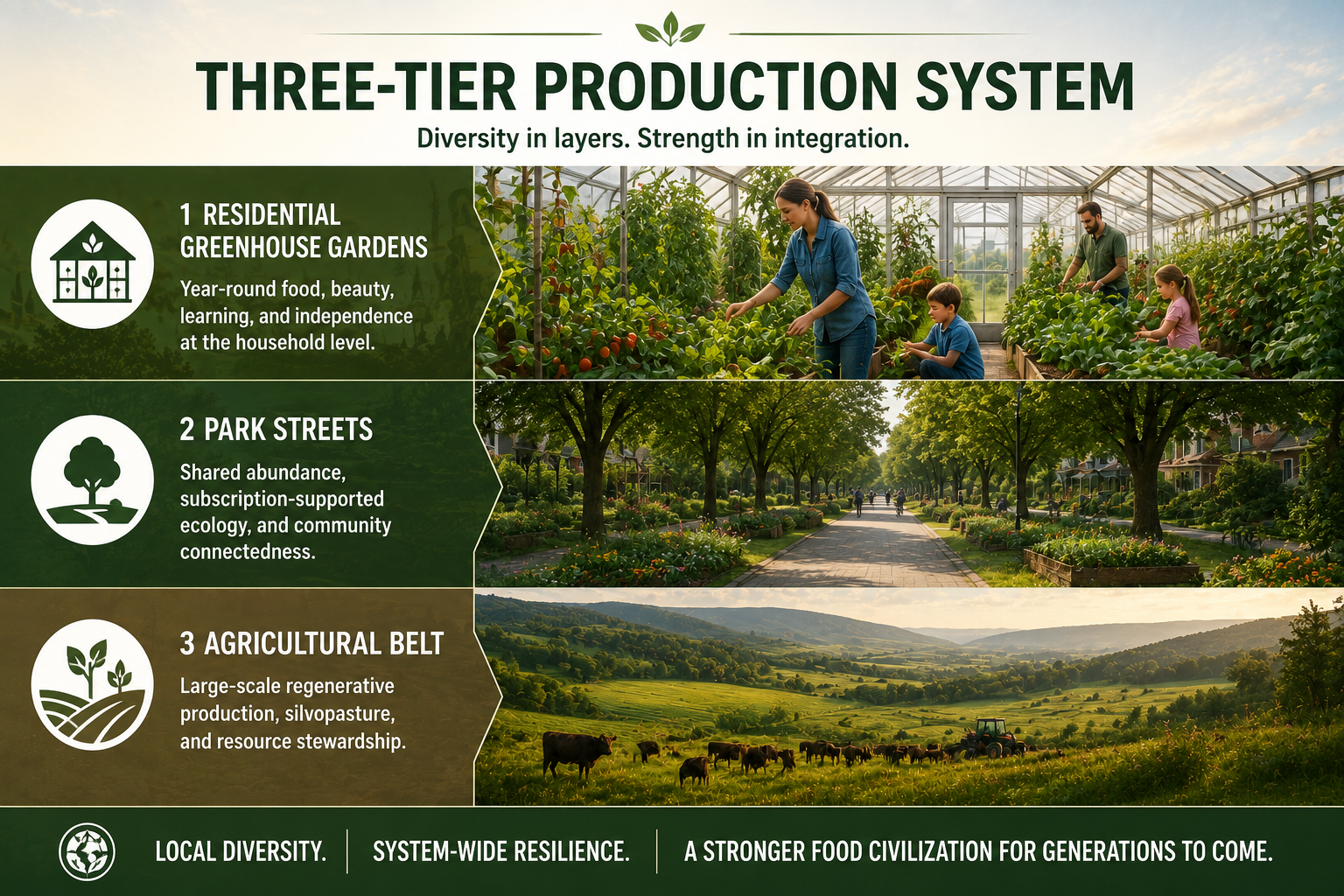
The production side of the model is organized around four interconnected layers. The first is the residential greenhouse garden network, which distributes participation, biodiversity preservation, species protection, education, and specialty production throughout daily life. The second is the network of 1,920 orchard-and-park subscription systems, which combine perennial food production, biodiversity, pollinator support, ecological hospitality, public participation, and harvest-right economics. The third is the system of vertical green aqua farms located in the mirrored industrial zone, where controlled-environment production, aquaponics, fish production, and rapid logistics are integrated with industrial utility flows. The fourth is the outer permacultural field system, which provides the larger-scale commercial production required to sustain the community. Together these four layers create a resilient food system in which knowledge, biodiversity, participation, controlled-environment intensity, and productive capacity are distributed rather than concentrated.
Supporting these layers are complementary systems that make the entire model operational. Aquaponics combines efficient protein and plant production. Integrated animal agriculture and silvopasture reconnect animals with broader ecological cycles. Nutrient-recovery systems convert residual materials into productive inputs. Water systems are designed for long-term resilience. Artificial intelligence and robotics increase precision, coordination, and adaptability. Restaurants occupy a particularly important place because they form one of the principal interfaces between agriculture and everyday life. Food moves rapidly from producers to kitchens and from kitchens to consumers, making seasonality, freshness, and local production visible within ordinary community experience.
The economic framework supporting this arrangement is Footprint Economics. Prices communicate not only labor and capital costs, but also broader resource requirements. Consumers remain free to choose, but the economic system makes environmental and stewardship implications more visible. The result is a food civilization rather than a collection of disconnected industries. Agriculture, ecology, restaurants, technology, economics, education, and community life are integrated into one system designed to create abundance while strengthening the productive assets inherited by future generations. Each of the remaining sections examines one component of that system and shows how the overall model functions as a permanent civilizational institution rather than a temporary agricultural program.
Section 3: Agency 4 Governance and Standards
The food civilization described in the opening sections requires a governance structure capable of protecting long-term standards without replacing entrepreneurial judgment. Agriculture is too important to be governed casually, because food production affects public health, environmental quality, economic opportunity, land stewardship, water systems, biodiversity, and the long-term productive capacity of civilization itself. Yet agriculture is also too complex to be centrally managed by a planning bureaucracy. NewVistas therefore establishes a clear distinction between governance and operations.
Agency 4 governs agriculture, food processing, food distribution, restaurant standards, food safety, agricultural stewardship, and agricultural measurement systems. It does not operate farms, restaurants, aquaponic facilities, livestock enterprises, greenhouses, orchards, or food-processing businesses. Its responsibility is governance rather than production.
This distinction is foundational. Agricultural systems have often failed in one of two ways: either they lack meaningful stewardship standards and gradually degrade soil, water, biodiversity, and long-term productive capacity, or they become excessively centralized and replace local knowledge, entrepreneurial initiative, and experimentation with bureaucratic control. NewVistas rejects both extremes. Agency 4 establishes standards while producers determine how those standards are achieved. Governance defines objectives. Operations determine methods. Governance establishes measurements. Producers innovate within those measurements.
The primary mission of Agency 4 is stewardship. The agency exists to protect the productive resources that future generations will inherit. Soil fertility, water systems, forests, orchards, biodiversity, pollinator populations, and agricultural infrastructure represent forms of accumulated productive capital that must not be consumed for short-term gain. The Thousand-Year Standard therefore becomes the governing philosophy of Agency 4. Every major policy, measurement system, and performance standard ultimately traces back to a single question: are agricultural resources becoming stronger or weaker over time?
Agency 4 possesses authority in several important areas. It establishes food safety requirements, sanitation standards, processing standards, inspection procedures, traceability systems, and public reporting requirements. It develops environmental performance standards covering soil quality, water stewardship, biodiversity, nutrient cycling, waste recovery, and resource conservation. It also develops agricultural measurement systems, because stewardship cannot exist without measurement. Soil organic matter, biological activity, erosion rates, water retention, nutrient balance, pollinator activity, and related indicators are monitored and reported so that agricultural performance becomes visible rather than assumed.
Agency 4 also administers the agricultural components of Footprint Economics. Different foods consume different quantities of land, water, energy, labor, infrastructure, and ecological resources. The agency develops methodologies that allow these differences to be measured and incorporated into economic decision-making. Transparency is therefore a major responsibility. Agricultural systems affect the entire community, so information regarding long-term performance must remain visible. Residents should know whether agricultural resources are improving, stable, or deteriorating. Public transparency strengthens accountability and encourages continuous improvement.
The limitations placed upon Agency 4 are equally important. The agency cannot determine what crops producers must grow, assign customers, establish monopolies, determine business models, eliminate competition, or dictate how producers achieve desired outcomes so long as community standards are satisfied. Competition remains essential because innovation emerges from experimentation. Different producers discover different solutions. New crops, technologies, production methods, processing systems, and business models can therefore be tested simultaneously throughout the community. Agency 4 governs the framework within which innovation occurs, but it does not replace innovation itself.
Agricultural dashboards support this governance model. Producers receive continuous access to performance information regarding productivity, profitability, soil health, water use, resource consumption, waste recovery, and long-term trends, while Agency 4 uses the same data to evaluate community-wide performance. The agency also works closely with other agencies. Agencies 15 and 16 assist with accounting, auditing, and performance verification. Agency 17 contributes educational programs, publications, and agricultural training. Agency 18 supports economic analysis and resource appraisal. Agencies 7, 8, and 9 support financing and capital systems.
Ultimately, Agency 4 exists because future generations cannot participate in current markets and cannot vote in current elections, yet they will inherit the consequences of today’s decisions. Agency 4 therefore serves as an institutional guardian of long-term agricultural interests, ensuring that stewardship remains visible even when short-term incentives point in a different direction. Within NewVistas, agriculture is not merely about producing food. It is about protecting and improving the systems that make food production possible, and Agency 4 exists to ensure that this responsibility is never forgotten.
Section 4: Permaculture and Regenerative Farming
The governance principles described in the previous section require an ecological operating logic capable of sustaining long-term productivity. Modern industrial agriculture has achieved extraordinary gains in output through mechanization, synthetic fertilizers, improved genetics, irrigation systems, chemical crop protection, and global transportation networks. NewVistas recognizes these achievements and seeks to retain the benefits of science, technology, and innovation. At the same time, it recognizes that many industrial agricultural systems remain dependent upon practices that can gradually weaken the very resources upon which long-term production depends.
Permaculture and regenerative farming therefore provide the ecological foundation of the NewVistas food civilization. They are not treated as narrow farming techniques, but as design philosophies that guide decisions throughout the entire food system. The underlying principle is straightforward: agricultural systems should become stronger with time rather than weaker. Soil should become richer, water systems more resilient, biodiversity more extensive, nutrient cycles more efficient, and productive capacity more durable.
Permaculture begins with observation. Rather than forcing nature into simplified industrial patterns, it seeks to understand how healthy ecosystems function and then design agricultural systems that cooperate with those processes. Diversity, resilience, redundancy, adaptability, and long-term stability become primary design objectives. This is especially important because monocultures, while often easier to manage, create vulnerabilities. Disease, pests, weather events, and market disruptions can affect entire production systems at once. Diverse agricultural systems are more resilient because setbacks in one area can often be offset by strength in another.
For this reason, NewVistas favors layered agricultural systems in which trees, shrubs, vines, berries, herbs, flowers, vegetables, pollinator species, medicinal plants, fungi, and livestock occupy complementary roles within the same ecological landscape. Productive systems thus become more complex, more stable, and more biologically rich over time. Perennial agriculture is especially important within this framework. Annual crops require repeated soil disturbance, planting, cultivation, and harvesting, whereas perennial systems continue producing for years or decades while simultaneously building ecological stability. Fruit trees, nut trees, berry systems, medicinal plants, perennial vegetables, and silvopasture all contribute to long-term resilience.
Soil is treated not as an inert growing medium, but as a living ecosystem. Healthy soils contain vast biological communities composed of bacteria, fungi, insects, worms, and countless other organisms. These communities cycle nutrients, improve water retention, increase plant health, and support long-term productivity. Regenerative farming seeks to strengthen these biological systems rather than replace them with external inputs whenever possible. Nutrient cycling is therefore foundational. In natural ecosystems, nutrients rarely become waste. Leaves become soil, animals redistribute nutrients, and microorganisms recycle organic matter. Regenerative agriculture attempts to imitate these cycles through composting, livestock integration, worm systems, insect systems, nutrient recovery, and related biological processes.
Water stewardship is equally central. Rainfall, groundwater, surface water, and soil moisture are treated as strategic resources rather than incidental inputs. Permaculture design encourages water retention, groundwater recharge, soil building, shade systems, and landscape features that slow runoff and increase infiltration. Water thus becomes a resource to be captured, stored, and reused rather than rapidly discarded. Pollinator systems receive comparable attention because many agricultural crops depend directly upon pollinators. Flowers, habitat corridors, nesting environments, and diverse plant communities help support healthy pollinator populations, benefiting both agriculture and the broader ecological system.
Regenerative agriculture also changes the role of livestock. Instead of existing separately from crop production, animals become integrated participants within larger ecological systems. Rotational grazing, silvopasture, poultry integration, nutrient cycling, and vegetation management allow animals to contribute positively to overall ecosystem health. These principles influence every component of the NewVistas food civilization. Residential greenhouse gardens emphasize diversity and species preservation. The 1,920 park streets function as perennial ecological food systems. The outer permacultural field system incorporates orchards, silvopasture, regenerative grazing, specialty crops, and diversified production. Nutrient-recovery systems recycle resources, and water systems strengthen resilience.
Artificial intelligence, robotics, sensors, and advanced technologies are not treated as alternatives to regenerative agriculture. They are tools that can strengthen regenerative systems by improving measurement, monitoring, forecasting, efficiency, and decision-making. The goal is not to recreate historical farming methods. It is to combine ecological understanding with modern science and technology in order to create agricultural systems capable of remaining productive indefinitely.
Permaculture and regenerative farming therefore serve as the ecological operating system of the NewVistas food civilization. They guide decisions regarding land, water, biodiversity, nutrient cycles, production methods, and long-term stewardship. Under the Thousand-Year Standard, agriculture succeeds only when future generations inherit stronger productive resources than those available today. Permaculture and regenerative farming provide the practical framework through which that objective becomes achievable.
Section 5: Distributed Farming and Stewardship
The ecological framework described in the previous section also requires a corresponding economic and organizational structure. The NewVistas agricultural system is built upon the principle that productive capacity should be widely distributed throughout society rather than concentrated within a small number of organizations. This principle influences not only agriculture, but also education, finance, manufacturing, hospitality, and governance. Within agriculture, however, it takes on special importance because food production directly affects the resilience, health, and long-term prosperity of the entire community.
Modern agricultural systems often favor concentration. Larger enterprises can purchase larger equipment, negotiate favorable contracts, influence supply chains, and achieve economies of scale. While these advantages can improve efficiency, concentration also creates risk. Disease outbreaks, management failures, transportation disruptions, labor shortages, weather events, or financial difficulties can affect large portions of the food system when productive capacity becomes concentrated in relatively few hands.
NewVistas seeks a different balance. Efficiency remains important, but resilience, diversity, adaptability, and stewardship are equally important. Productive opportunity is therefore distributed among many agricultural enterprises operating within common governance standards. This distributed structure creates a broad agricultural ecosystem in which commercial farms, orchard operators, greenhouse producers, aquaponic businesses, livestock producers, seed specialists, medicinal plant growers, park street stewards, specialty crop producers, pollinator managers, and food-processing enterprises all contribute to the food civilization.
The objective is not simply to create many businesses. It is to create many centers of knowledge, experimentation, and responsibility. Innovation emerges when large numbers of producers continuously test new ideas under real-world conditions. Different climates, soils, technologies, business models, and production methods create opportunities for learning and adaptation that centralized systems often struggle to match.
Stewardship occupies a central role within this framework. Agricultural resources are viewed not merely as assets to be consumed, but as productive inheritances that must be improved. Stewardship extends beyond legal ownership. A producer may possess operational authority over land, orchards, greenhouses, livestock systems, or processing facilities, but that authority carries obligations. Agricultural resources are expected to improve under stewardship. Soil quality should become stronger. Water systems should become more resilient. Biodiversity should increase. Nutrient cycles should become more efficient. Productive capacity should expand. The objective is not simply to preserve resources, but to enhance them.
This expectation changes the way success is evaluated. Financial performance remains important because businesses must remain viable. However, economic success alone is insufficient. Agricultural enterprises are also evaluated according to stewardship performance. Long-term resource improvement becomes an important measure of achievement. Competition remains essential because producers still compete for customers, restaurant contracts, specialty markets, subscriptions, processing relationships, and consumer loyalty. Competition encourages innovation, efficiency, and responsiveness, yet it occurs within a framework designed to protect long-term community interests.
The distributed model also strengthens entrepreneurship. Entry barriers are lower because productive opportunity is not concentrated within a small number of dominant organizations. New producers can experiment with specialty crops, unique business models, emerging technologies, and niche markets. Successful innovations spread naturally through observation, education, and market success. Agricultural education supports this process. Residential greenhouse gardens, park street systems, mentors, practice guides, apprenticeships, agricultural businesses, and community programs expose residents to food production from an early age, so knowledge remains broadly distributed throughout the population rather than concentrated among specialists.
Succession planning benefits as well. Future producers gain practical experience while opportunities remain available. Agricultural knowledge passes continuously between generations. New businesses emerge naturally, and productive capacity remains embedded within the community itself. Distributed farming further strengthens food security because diverse producers growing diverse crops through diverse systems create multiple layers of resilience. Problems affecting one crop, technology, or production method rarely threaten the entire food system. Adaptation becomes an ongoing process rather than an emergency response.
The NewVistas approach therefore rejects the assumption that concentration is the inevitable destination of agricultural progress. It proposes instead that long-term prosperity is best served when productive opportunity, responsibility, innovation, and stewardship are widely distributed. The result is an agricultural civilization composed of many stewards rather than a few dominant operators. Food production remains productive and competitive, but it also becomes resilient, adaptable, educational, and deeply connected to the broader community. Under the Thousand-Year Standard, distributed farming is not merely an economic arrangement. It is a stewardship strategy designed to ensure that agricultural knowledge, productive capacity, and responsibility remain permanently embedded within the civilization.
Section 6: The Four-Layer Production System
The ecological principles just described take institutional form through the structure of production itself. The NewVistas food civilization does not depend upon a single agricultural system. Instead, food production is distributed across four distinct but interconnected layers, each serving a different purpose, operating at a different scale, and contributing in its own way to the resilience of the community. Together these layers create a food system that is more diverse, adaptive, and durable than conventional models dependent upon large-scale commercial agriculture alone.
The production system consists of the rear apartment-building greenhouse box gardens, the 1,920 orchard-and-park systems placed in front of the residential and industrial villages, the vertical green aqua farms located in the mirrored industrial zone, and the outer permacultural field system organized in 2-acre, 5-acre, 10-acre, and 15-acre stewardship farms. These four layers perform different functions while supporting one another.
The first layer exists for participation, education, biodiversity, species preservation, and small-scale entrepreneurship. Across the community, 960 greenhouse facilities contain 92,160 micro gardens and more than 1.29 million individual growing boxes. Every resident has the opportunity to participate directly in food production through a structured stewardship system designed to keep all growing spaces actively managed. The greenhouse network is therefore not designed for bulk calorie production. Its larger purpose is to maintain agricultural knowledge throughout the population, encourage experimentation, preserve rare species, support medicinal and specialty crops, and keep direct participation embedded within daily life.
The second layer consists of the 1,920 productive orchard-and-park systems distributed throughout the community. Each occupies approximately two acres and functions as a perennial ecological food system placed in front of the housing villages and industrial villages. Together these sites create approximately 3,840 acres of productive ecological infrastructure integrated directly into daily experience. These systems are neither conventional orchards nor decorative parks. They are long-term subscription parks built around perennial productive diversity, including berries, nuts, fruits, vines, edible flowers, medicinal species, tea plants, and other long-lived harvestable plant systems. They function simultaneously as food-production systems, pollinator corridors, ecological hospitality environments, biodiversity reserves, social gathering places, emotional restoration spaces, and subscription-based public landscapes. Because these systems are embedded in a walkable community, harvest labor can also be mobilized locally when crops reach peak ripeness, allowing voluntary resident and restaurant participation to complement automation and improve harvest timing.
The third layer consists of the vertical green aqua farms placed in the mirrored industrial zone rather than in the outer agricultural acreage. These controlled-environment systems consolidate vertical gardening, aquaponics, fish production, specialized climate zones, and year-round biological production within the industrial districts, where thermodynamic integration, processing proximity, and logistics coordination are strongest. They are part of the industrial village system, not part of the outer permacultural field system.
The fourth layer consists of the outer permacultural field system occupying the remainder of the 5-by-5-mile community after subtracting the 2.88-square-mile inner square and the mirrored industrial square. This remaining agricultural ground is organized into 2-acre, 5-acre, 10-acre, and 15-acre stewardship farms that support diversified ecological agriculture, orchards, mixed animal systems, rotational systems, and larger-scale commercial production. It is the principal permacultural production landscape of the community.
The relationship among these four layers is one of mutual reinforcement. The greenhouse network develops agricultural knowledge, experimentation, biodiversity, and participation. The orchard-and-park systems provide perennial food production, pollinator systems, ecological hospitality, and distributed food infrastructure. The industrial-zone vertical farms provide controlled-environment intensity, aquaponic protein, and year-round specialty production. The outer permacultural field system provides broader commercial volume, ecological acreage, and long-term food security. Together they create multiple layers of redundancy. If one system experiences difficulty, the others continue functioning.
This layered structure also improves adaptability. New crops, technologies, production methods, and business models can emerge within greenhouse systems, orchard-and-park systems, vertical industrial farms, or permacultural field farms and then scale outward through the rest of the food civilization. Innovation therefore flows naturally through the entire system. Hundreds of farmers and thousands of residents, gardeners, stewards, processors, hospitality providers, and seasonal harvest participants are involved in the day-to-day plant and animal biological processes that keep the system functioning. The production structure reflects one of the central principles of NewVistas: resilience emerges from diversity. A civilization that depends upon only one food-production model remains vulnerable, whereas a civilization supported by multiple complementary systems is far more capable of adapting to changing environmental, economic, technological, and social conditions.
For this reason, the production structure serves as the foundation of the NewVistas food civilization. It connects participation, biodiversity, ecology, education, controlled-environment production, commercial farming, entrepreneurship, stewardship, and timely harvest coordination into a unified framework capable of supporting prosperity across generations.
Section 7: The Residential Garden Network
The Residential Garden Network represents the first layer of the NewVistas food civilization. Although it is the smallest layer in total food output, it is the foundational layer in terms of participation, stewardship, biodiversity, education, and species preservation. The network exists to ensure that food production remains a visible and active part of community life rather than becoming an activity performed only by specialists.
Each of the 960 apartment buildings within a NewVistas community is paired with a dedicated greenhouse garden facility. Each greenhouse occupies the rear garden zone of the apartment plat and follows an exact modular geometry: a 64-foot by 196-foot greenhouse organized on the universal 0.625-meter grid with a two-tile-wide central walkway, a raised utility floor, and a distributed rod lattice that supports cultivation, utilities, and environmental systems simultaneously. The greenhouse is not an accessory amenity. It is a permanent architectural and biological infrastructure layer integrated directly with the apartment building, commercial podium, fuel-cell systems, server infrastructure, water systems, and environmental controls. The network therefore joins daily residence, food production, medicinal cultivation, biodiversity, and environmental engineering in one continuous system.
Every greenhouse contains 96 micro gardens, and each micro garden contains fourteen individual 2-foot by 2-foot growing positions. Across the community, the system therefore contains 92,160 micro gardens and more than 1.29 million growing boxes or equivalent tray positions. While individual growing spaces are small, the network as a whole creates one of the largest distributed participation systems within the community. Its purpose is not bulk food production. The outer permacultural field system and park street systems fulfill that role. Instead, the greenhouse network exists to maximize participation in food production while also preserving rare species, supporting medicinal and specialty crops, and maintaining agricultural knowledge throughout the population.
The engineering of the greenhouse is itself agriculturally significant. A distributed stick lattice of slender polymer-coated steel rods functions simultaneously as structural support, trellis system, grow-box support, irrigation guide, drainage guide, nutrient-routing support, hanging support, and environmental-sensor support. The rods are not treated as isolated posts but as members of a braced cultivation lattice stabilized by grow boxes, shallow trays, floor and ceiling connections, and utility attachments. Their significance lies precisely in this distributed behavior: the system does not rely upon heavy individual members, but upon thousands of lightly scaled members laterally restrained at frequent intervals so that structure, cultivation, and utility routing reinforce one another. This allows the greenhouse to operate as a flexible, repairable, modular framework rather than a rigid shell. The cultivation layer is equally distinctive. Instead of relying upon one fixed root-zone geometry, the system can support variable-depth 2-foot by 2-foot trays and boxes, shallow longitudinal bracing trays, stacked gardens, and canopy easements above the seven-foot working zone. Root depth, canopy spread, and support geometry can therefore be adjusted according to crop type, medicinal specialization, mushroom systems, pollinator species, seed preservation, hanging systems, and culinary demand. The greenhouse thus functions as a programmable ecological framework rather than a uniform row-crop enclosure.
Thermodynamic integration makes this biodiversity practical. Waste heat from fuel cells and server infrastructure supports greenhouse heating, root-zone warming, and humidity stabilization. The same thermal flows may also drive absorption cooling for climate control. Electricity supports LED augmentation, pumps, sensors, irrigation, automation, and environmental management. Fuel-cell water, rain capture, greenhouse runoff, and recycled residential and commercial water streams support irrigation so that the greenhouse can operate with little or no external water demand. Carbon dioxide from fuel-cell systems can be routed into greenhouse environments to strengthen plant growth, while excess carbon streams can support larger controlled-environment systems in the industrial districts. Because these utility streams already exist as part of the apartment-level infrastructure, the greenhouse is freed from many of the costs that usually force greenhouse systems toward monoculture and narrow crop selection. That lower-cost ecological platform makes it economically feasible to cultivate rare herbs, edible flowers, medicinal plants, teas, fungi, aromatic species, heirloom cultivars, pollinator plants, micro-fruits, and experimental species at community scale.
Every resident receives first priority access to fourteen growing positions. If those spaces are not actively used, the opportunity passes to other residents within the apartment, then to others on the floor, then to residents of the building, then to residents of the associated village, and finally to commercial growers. This cascading allocation structure serves two purposes. It keeps the entire greenhouse productive and preserves participation as the first objective while still allowing commercial use whenever participation opportunities have been exhausted. No growing space is intentionally left idle. Every box, tray, or stewardship position remains under active management. The stewardship system is also economically light enough to preserve broad access. In the source design logic, the greenhouse is sustained by small recurring participation charges and long-life modular components rather than by heavy exclusive rents. This matters because the greenhouse is intended to remain a permanently available civilizational subsystem rather than a luxury amenity for a small minority.
The order of priority is clear. Participation is the first objective of the Residential Garden Network. Biodiversity is the second. Species preservation is the third. Food production, while still valuable, is a secondary benefit. This priority structure allows the greenhouse network to cultivate a remarkable variety of plants, including herbs, medicinal plants, specialty vegetables, edible flowers, berries, rare cultivars, pollinator plants, heirloom varieties, seed-production plants, and experimental crops. Commercial agriculture naturally focuses on crops that generate sufficient demand and revenue to justify large-scale production. The greenhouse network performs a different function. It provides a protected environment in which thousands of participants can cultivate unusual, specialized, educational, or culturally significant varieties that might otherwise disappear. The result is a community-wide biodiversity system and a living seed bank distributed throughout the population.
The educational and entrepreneurial benefits are equally important. Children and adults gain direct experience with plant growth, nutrient cycling, irrigation, environmental control, pest management, pollinator relationships, and food production. Gardeners may also sell products into restaurants, medicinal enterprises, specialty food providers, seed producers, nurseries, and other markets through digitally coordinated local demand systems that reduce waste by aligning planting schedules with anticipated culinary and medicinal needs. Rare herbs, edible flowers, medicinal plants, specialty vegetables, seedlings, mushrooms, and other high-value products therefore make even small growing spaces economically meaningful. The Residential Garden Network functions simultaneously as an educational system, a biodiversity system, a seed-preservation system, an entrepreneurship system, an innovation system, and a permanent greenhouse infrastructure embedded within the architecture and thermodynamics of daily life. Most importantly, it ensures that agriculture remains a lived experience rather than an invisible industry.
Section 8: The 1,920 Park Street System
The 1,920 Park Streets constitute the second layer of the NewVistas food civilization and one of the most distinctive elements of the entire community design. While the Residential Garden Network focuses on participation and biodiversity, and the outer permacultural field system focuses on commercial food production, the park streets occupy a unique position between these two systems. They combine food production, ecological stewardship, hospitality, biodiversity, recreation, emotional restoration, and social participation within a single integrated framework.
Historically, the word “street” often referred to inhabited public spaces rather than merely transportation corridors. The NewVistas park streets recover this older concept by creating productive ecological landscapes integrated directly into everyday life. They are not ornamental parks separated from economic activity, nor are they conventional orchards designed solely for agricultural yield. They are inhabited perennial ecological infrastructure. Each park street occupies approximately two acres, measuring 132 feet by 660 feet, and each is paired with an associated botanical roundabout of roughly ninety feet in diameter located at a principal intersection. Across 1,920 locations, the system contains approximately 3,840 acres of productive perennial landscape distributed throughout both residential and industrial village environments. Together, the streets and roundabouts form a continuous ecological network of pollinator corridors, seasonal displays, food production, and public identity spaces extending throughout the civilization.
The park streets are designed as layered perennial systems. Rather than maximizing mechanization or monoculture efficiency, they emphasize biodiversity, beauty, ecological maturity, and human participation. Typical systems may include fruit canopy trees, nut canopies, dwarf fruit varieties, berry systems, grape and other vine systems, edible understories, medicinal plants, tea gardens, edible flowers, fragrance gardens, flowering succession systems, pollinator corridors, seating clearings, contemplative spaces, and shaded gathering environments. The objective is not simply to maximize pounds of food produced per acre. It is to maximize ecological value, social value, emotional value, biodiversity, and long-term productive capacity while still producing significant quantities of food. All of these systems are built around long-term harvestable plants rather than short-cycle annual field patterns. Mature production may provide a major share of the community’s fruit and nut requirements while simultaneously supplying restaurants, preserves, medicinal products, specialty botanical goods, and direct harvesting opportunities. In practical terms, the park system is large enough to function as one of the principal perennial food infrastructures of the community rather than as a decorative supplement. At maturity, this acreage can satisfy most or all ordinary direct fruit-and-nut demand for a population at NewVistas scale, depending upon climate, maturity, species mix, and stewardship quality.
The economic model differs from conventional agriculture because park street stewards derive revenue from multiple complementary sources. The first is ecological participation. Residents may subscribe to multiple parks, build personal ecological portfolios, participate in blossom seasons, harvest periods, pollinator programs, tea-garden experiences, quiet contemplation access, fragrance walks, evening lighting events, or seasonal festivals. The park streets therefore function as subscription parks as well as productive perennial landscapes. Ecological experience itself thus becomes a valuable economic activity. The second source is food production. Fruit, nuts, berries, vine crops, edible flowers, medicinal plants, preserves, specialty products, and restaurant sales create additional revenue streams. The third source arises during harvest itself. Farmers and park stewards will often have incentives to automate portions of harvest work, especially when labor peaks are sharp, but the walkable structure of the community creates a major civilizational advantage: the inhabitants are already nearby and can participate voluntarily at the proper harvest moment. Farmers may also hire subcontractors for harvest work, and in practice every inhabitant is a potential subcontractor when the offered pay, subscription benefits, preferred access, or other advantages are strong enough. In many cases participation may also occur simply because harvest work, shared gathering, and the celebrations that follow are enjoyable when the steward organizes them wisely. Restaurants may subscribe not only for supply rights to specified products, but for priority harvest rights tied to participation by their own stewards in the harvest window. Residents may likewise hold harvest-participation subscriptions that provide preferred access, preferred pricing, or other defined advantages when they come and help gather produce at the correct time. This helps align harvest labor with biological ripeness rather than forcing crops to be taken too early for the convenience of industrial scheduling.
This distinction matters because conventional agriculture primarily monetizes extracted yield, whereas the park street system monetizes atmosphere, beauty, ecological timing, biodiversity, shade, emotional restoration, recurring participation, harvest participation, and food production simultaneously. Mature ecology therefore becomes financially productive rather than economically obsolete. Technology allows this model to function efficiently. Digital subscriptions, phone-location systems, passive authentication, automated accounting, AI coordination, and frictionless payment systems allow participants to enter, harvest, attend events, join harvest crews, or enjoy ecological amenities without heavy administrative burden. Dynamic seasonal pricing can reflect blossom peaks, self-pick periods, fragrance seasons, pollinator migrations, evening events, nut harvests, berry seasons, vine harvests, tea harvests, and assisted-harvest windows. This creates a recurring hospitality economy in which ecological moments themselves become economically meaningful. The park stewards therefore compete not only in fruit yield, but in ecological beauty, canopy maturity, biodiversity, seasonal richness, hospitality quality, harvest organization, and public desirability. Competition thus rewards long-term stewardship rather than short-term extraction alone.
Park street stewards occupy a distinctive role within the food civilization. They function simultaneously as agricultural producers, ecological curators, hospitality operators, landscape designers, biodiversity managers, and long-term caretakers. Stewardship extends beyond crop production to include the associated roundabout botanical center, which serves as a pollinator showcase, navigational landmark, fragrance garden, public identity node, and visible expression of each steward’s ecological style. Long-term maturity becomes economically valuable. As trees deepen their canopies, shade increases, biodiversity expands, pollinator systems strengthen, and emotional attachment grows. Unlike many conventional agricultural systems in which older orchards are eventually replaced once mechanized productivity declines, mature park-street ecologies often become more valuable over time.
The park streets also strengthen the farm-to-table and restaurant-centered logic of the community. Because these systems are embedded directly into ordinary circulation patterns, restaurants can receive same-day harvests of peak-ripeness fruit, edible flowers, nuts, berries, vine crops, tea products, rare cultivars, and seasonal botanical ingredients. Residents can snack during walks, harvest directly, gather nuts, pick berries, or participate in seasonal food events and assisted harvests. Food production thus becomes socially integrated, emotionally integrated, and ecologically integrated into daily civilization life. Within the broader four-layer production system, the 1,920 Park Streets provide a critical bridge between participation and production. They connect residents to ecological systems, support biodiversity, produce food, strengthen pollinator populations, generate hospitality revenue, and create one of the most distinctive features of the NewVistas food civilization.
Section 9: The Outer Permacultural Field System
The outer permacultural field system of NewVistas forms the largest field-production layer of the food civilization. While the Residential Garden Network emphasizes participation, biodiversity, and species preservation, the orchard-and-park systems emphasize perennial ecological production and hospitality, and the vertical green aqua farms intensify controlled-environment production within the mirrored industrial zone, the outer permacultural field system provides the broad land base required to sustain a community of approximately 100,000 people.
The total community occupies a 5-by-5-mile square. Within that total, the 2.88-square-mile inner square and the mirrored industrial square are not counted as part of the outer permacultural field system. The outer permacultural field system is the remainder after those interior allocations are subtracted, and that remaining ground constitutes the principal field-production landscape of the community.
The outer permacultural field system is organized into stewardship farms of 2 acres, 5 acres, 10 acres, and 15 acres. These smaller and medium parcels allow diversified ecological agriculture, orchards, mixed crop systems, rotational systems, compost systems, moderate animal systems, and specialty production to remain directly integrated with community life while still providing substantial commercial output. The system is not designed as a single monocultural belt. It is designed as a distributed permacultural landscape composed of many stewardship enterprises operating under common standards.
The outer permacultural field system is not the location of the vertical green aqua farms. Those vertically integrated aquaponic and controlled-environment systems belong to the mirrored industrial zone, where they benefit from building-scale utility integration, processing proximity, and rapid logistics. The outer permacultural field system instead concentrates on permacultural field agriculture, orchards, regenerative mixed production, grazing integration, silvopasture, and broader landscape stewardship.
The field zone contains a wide variety of agricultural enterprises. Vegetable producers, orchard operators, silvopasture systems, grazing operations, seed producers, medicinal plant cultivators, specialty crop growers, mixed-animal enterprises, and food-processing support businesses operate within this larger agricultural ecosystem. This diversity reduces dependence upon any single crop or production method, improves resilience against disease, weather events, market changes, and supply disruptions, encourages experimentation and innovation, and creates multiple pathways through which productive capacity can evolve over time.
The outer permacultural field system is not designed as a monoculture landscape. Permaculture design, regenerative agriculture, biodiversity, nutrient cycling, water stewardship, pollinator support, and long-term soil improvement remain central objectives. The field zone therefore functions simultaneously as a commercial production system and a stewardship system. Food production is expected to increase while ecological resources are expected to improve.
Within this larger production zone, NewVistas distinguishes between nearer walking-distance stewardship farms and broader hinterland production. Closer to the principal residential community, the 2-acre, 5-acre, 10-acre, and 15-acre farms allow agroforestry, mixed ecological agriculture, compost systems, rotational systems, moderate animal systems, and resilient specialty production to remain socially integrated with daily life. These nearer systems support education, regular participation, and short transport distances. Beyond these nearer zones, larger grazing systems, dry-farm systems, and extensive landscape-stewardship operations may occupy wider hinterland areas. Even when production occurs at larger scales, operators remain socially anchored to the community rather than separated into isolated agricultural settlements.
This principle has direct operational consequences for the more distant hinterland systems. Dry farmers and grazing stewards reside in the community, not in separate remote settlements. Because these wider landscapes may require long travel times, continuous oversight, or twenty-four-hour stewardship responses during critical periods, operators work on rotational schedules such as one week on and one week off while retaining their permanent place within community life. During on-site periods they lease community-owned residential buses or similar mobile dwelling units designed to replicate the ordinary apartment-suite standard as closely as practical. The purpose is not luxury, but civilizational continuity.
Commercial agriculture within the outer permacultural field system focuses on products that require larger production scales than can be achieved within residential gardens or orchard-and-park systems. Vegetables, grains, proteins, livestock products, processing crops, specialty products, and food-service ingredients are all produced within this landscape. The outer permacultural field system also supports a substantial processing relationship with the industrial districts. Food-processing enterprises, preservation facilities, seed operations, packaging systems, cold storage, specialty-product businesses, and restaurant supply systems convert raw agricultural production into finished products ready for consumption.
This integration reduces transportation requirements and shortens supply chains. Food moves rapidly from field to processor and from processor to restaurant. Freshness improves while waste declines, and economic value remains within the community rather than being exported to distant processing centers. Agricultural entrepreneurs therefore play a central role. The field system is designed to support a large number of independent producers rather than a small number of dominant organizations. New enterprises can enter the market, experiment with different approaches, and compete within a framework of common stewardship standards.
Innovation is continuous. New technologies, crop varieties, business models, robotics systems, water-management techniques, environmental controls, and production methods can be tested under real-world conditions. Successful innovations spread naturally through competition, observation, and economic success. Water management occupies a particularly important role because agricultural systems depend upon reliable access to water, yet long-term sustainability requires careful resource management. Retention systems, groundwater protection, irrigation technologies, rain capture, soil improvement, and regenerative practices all contribute to long-term water resilience.
Livestock systems are integrated into the outer permacultural field system rather than isolated from it. Rotational grazing, silvopasture, nutrient cycling, and ecological integration allow animals to contribute positively to broader agricultural systems. Hundreds of farmers and thousands of participants are involved in the day-to-day plant and animal biological processes that animate this larger agricultural landscape, from planting and pruning to animal care, composting, nutrient recovery, harvesting, and distribution.
The outer permacultural field system therefore functions as far more than unused space beyond the inner square. It is a commercial ecosystem, stewardship system, innovation platform, educational resource, resilience strategy, and long-term productive asset. Within the larger food civilization, it supplies the field-scale ecological acreage necessary to feed the community while remaining fully aligned with the stewardship responsibilities and long-term vision that define the NewVistas model.
Section 10: Water Systems and Resilience
Water is one of the most important strategic resources within any agricultural civilization. Without reliable water systems, even the most productive soils, advanced technologies, and well-designed agricultural enterprises cannot sustain long-term food production. For this reason, NewVistas treats water not merely as a utility, but as a foundational civilizational asset whose stewardship directly influences the prosperity of future generations.
The Thousand-Year Standard applies as fully to water as it does to soil, biodiversity, and food production. Every generation inherits water resources from those who came before and holds those resources in trust for those who will follow. Water systems must therefore become more resilient rather than less resilient over time.
Modern societies often approach water as a distribution problem. Reservoirs, pipelines, pumps, treatment facilities, and irrigation systems are designed to move water from one location to another. While these technologies remain important, NewVistas treats water as part of a larger ecological system. Rainfall, groundwater, surface water, soil moisture, vegetation, wetlands, ponds, streams, greenhouse systems, rooftop systems, and biological infrastructures all influence water availability. Water stewardship therefore requires attention to entire landscapes rather than individual infrastructure components alone.
The NewVistas food civilization incorporates water management throughout all four production layers. The Residential Greenhouse Network, the park street system, the industrial controlled-environment layer, and the outer permacultural field system each contribute to water resilience in different ways. Within the Residential Greenhouse Network, water use is highly controlled. Small growing spaces allow precise irrigation and careful monitoring. Fuel-cell water, rain capture, greenhouse runoff, apartment and podium runoff, and recycled residential and commercial water streams contribute to local irrigation and reduce dependence upon external supplies. Water efficiency thus becomes a normal component of everyday stewardship, and participants learn the relationship between water, plant health, soil quality, and food production through direct experience.
The 1,920 park streets contribute to water resilience through perennial vegetation, shade, deep-rooted plant systems, soil improvement, pollinator landscapes, and long-term ecological stability. Perennial systems generally require less disturbance and often improve water retention over time. The result is an ecological infrastructure that supports both food production and water conservation. The outer permacultural field system contains the largest water-management systems within the community. Irrigation infrastructure, retention systems, groundwater protection measures, rain capture, water storage, aquaponic facilities, regenerative farming practices, soil-building systems, and carbon-rich soil amendments all contribute to long-term resilience.
One of the most important principles is water retention. Rainfall that immediately leaves the landscape represents a lost opportunity. NewVistas therefore encourages landscape designs that slow, spread, capture, and store water. Healthy soils, perennial vegetation, ponds, wetlands, retention features, and biochar-enriched soil systems all increase the amount of water available for future use. Soil health plays a particularly important role because organic matter functions as a natural water-storage system. Healthy soils can absorb and retain substantially more water than degraded soils, so regenerative agriculture contributes directly to drought resilience by improving the water-holding capacity of agricultural landscapes.
Groundwater protection receives equal attention. Many modern agricultural systems rely heavily upon groundwater extraction while paying insufficient attention to recharge. NewVistas seeks to maintain a balance between use and replenishment. Groundwater is treated as a strategic reserve rather than an unlimited resource. Aquaponics further strengthens water efficiency because water is continuously recycled through the system. As a result, substantial quantities of food can be produced using relatively small amounts of water compared with many conventional agricultural methods. Fish production and plant production become integrated within a shared nutrient and water cycle.
Water recycling also contributes to resilience. Treated water, nutrient-recovery systems, greenhouse runoff recovery, and carefully designed reuse systems reduce unnecessary demand upon fresh water supplies. Multiple uses can be obtained from the same water before it ultimately returns to the environment. Climate variability further reinforces the importance of resilient water systems. Future conditions may include drought, changing precipitation patterns, extreme weather events, or other uncertainties. NewVistas therefore designs water systems around resilience rather than average conditions. Redundancy becomes an important design principle. Multiple sources of water, multiple storage systems, multiple distribution pathways, and multiple conservation strategies reduce the risk associated with any single point of failure.
Technology strengthens these efforts. Sensors, automation, artificial intelligence, weather forecasting systems, soil-moisture monitoring, irrigation controls, environmental dashboards, and closed-loop hydrological monitoring improve efficiency while reducing waste. Water management becomes increasingly precise without sacrificing resilience. The relationship between water and biodiversity is also recognized. Healthy ecological systems support healthier water systems. Vegetation stabilizes soils, reduces erosion, improves infiltration, supports pollinators, and strengthens ecosystem resilience. Water stewardship and ecological stewardship therefore reinforce one another.
Food security ultimately depends upon water security. A community capable of managing water wisely gains substantial advantages in agricultural productivity, economic stability, environmental quality, and long-term resilience. For this reason, water management is not treated as a specialized technical issue. It is an integral component of the entire NewVistas food civilization. Every garden, every park street, every farm, every aquaponic facility, every livestock system, every rooftop greenhouse, and every food enterprise depends upon responsible water stewardship.
Under the Thousand-Year Standard, successful water systems are not those that merely satisfy today’s needs. They are systems that leave future generations with stronger, more resilient, and more productive water resources than those available today.
Section 11: Controlled Environment Farming
Controlled Environment Farming occupies an important position within the NewVistas food civilization. While rear apartment greenhouse gardens, orchard-and-park systems, and the outer permacultural field system provide much of the community’s food production, certain crops benefit significantly from production within carefully managed environments. Controlled Environment Farming therefore complements the broader agricultural system rather than replacing it.
Historically, agriculture has been constrained by weather, seasonal variation, pests, temperature extremes, water availability, and other environmental factors. Modern greenhouse systems, rooftop cultivation layers, vertical farms, indoor growing facilities, and environmental-control technologies allow producers to manage many of these variables directly. The result is greater reliability, higher quality, improved resource efficiency, and year-round production. NewVistas embraces these technologies where they create genuine long-term value. The objective is not technological novelty. It is more efficient food production that simultaneously strengthens resilience and stewardship.
In NewVistas, controlled environments are not merely enclosed growing rooms. They are integrated thermodynamic and biological infrastructures. At the residential scale, the rear apartment-building greenhouse systems use exact modular geometry, raised utility floors, distributed rod lattices, removable tiles, and interchangeable grow boxes or trays. The cultivation layer can support variable-depth 2-foot by 2-foot modules, shallow longitudinal trays, stacked gardens, hanging systems, and canopy easements above the seven-foot working height. This allows the same greenhouse lattice to support shallow herb systems, edible flowers, medicinal plants, mushrooms, pollinator species, tomatoes, cucumbers, dwarf fruit, propagation systems, and experimental ecologies without requiring one universal box depth or one universal crop geometry.
At the industrial scale, the vertical green aqua farms are located in the mirrored industrial zone rather than in the outer permacultural field system. This placement is deliberate. The mirrored industrial districts provide the best setting for vertical gardening, aquaponics, fish production, oxygen-generation systems, climate zoning, waste-heat capture, carbon-dioxide routing, processing support, robotics, and rapid restaurant logistics. These industrial-zone facilities form the principal large-scale controlled-environment layer of the community. They are vertically integrated biological production systems tied directly to industrial utility flows and food-processing infrastructure.
Rooftop greenhouse systems extend this same logic upward into the architecture of the community. The rooftop greenhouse layer is designed as an integrated biological, nutrient, water, pollination, medicinal, and food-production infrastructure rather than as unused overhead space. Walkable modular roof tiles, raised removable floor systems, under-floor utility voids, trellis systems, sensors, robotic access, pollinator infrastructure, fungal chambers, hydroponic modules, climate-specialized zones, and service pathways turn the roof itself into a working environmental layer. Rooftop systems are especially suited to high-value biological production rather than bulk calories.
These systems are particularly valuable because they operate as thermodynamic receivers of byproducts already generated elsewhere in the community. Waste heat from fuel cells and distributed server infrastructure supports greenhouse heating, root-zone warming, medicinal drying, humidity stabilization, and winter climate control. The same waste heat can also power absorption cooling systems for cooled zones, alpine or storage environments, humidity reduction, and seasonal stabilization. Electricity generated on site supports LED augmentation, photoperiod control, pumps, environmental sensors, automation, robotics, communications, and AI controls. Fuel-cell water, rain capture, greenhouse runoff, apartment-roof runoff, podium-roof runoff, and recycled water streams support irrigation and environmental management. Carbon dioxide from fuel-cell systems can be routed into greenhouse environments to improve photosynthesis and plant growth. Because these facilities convert existing utility streams into productive biological inputs, controlled-environment agriculture becomes far less dependent upon costly stand-alone utility loads and therefore far more capable of supporting biodiversity rather than monoculture.
Climate zoning is one of the greatest advantages of this approach. Different greenhouse, rooftop, or industrial vertical-farm zones may specialize in entirely different biological systems. Tropical spice systems, alpine medicinal systems, Mediterranean herbs, pollinator ecosystems, fungal chambers, hydroponic systems, tea cultivation, berry systems, seedling propagation, humidity-specialized zones, and medicinal drying rooms can coexist within one coordinated community. AI-controlled lighting, irrigation, mineralization, airflow, carbon-dioxide concentration, nutrient delivery, and temperature management allow these specialized environments to remain stable and productive.
Controlled environments also participate directly in broader nutrient and waste-recovery logic. Rooftop greenhouse waste, fungal substrates, plant residues, pollinator-support materials, and seasonal biological outputs do not stand apart from the rest of the food civilization. They feed into the same cascading biological-recovery systems described elsewhere in this paper, linking rooftops, apartment greenhouses, industrial vertical farms, insects, fungi, soils, and surrounding agricultural landscapes into one distributed biological metabolism.
Water efficiency represents another major benefit. Controlled environments often use substantially less water than conventional field agriculture because losses through evaporation, runoff, and inefficient distribution are greatly reduced. Water can be measured, routed, recovered, recycled, and managed with precision. Land efficiency also improves. Vertical growing systems can dramatically increase production per square foot by utilizing multiple growing layers. These systems are particularly effective for leafy greens, herbs, medicinal plants, edible flowers, specialty vegetables, seedlings, propagation materials, mushrooms, and other high-value crops. The relationship between these facilities and restaurants is therefore especially important within NewVistas. Because the eat-out policy is a fixed feature of the community and most meals are prepared within commercial kitchens, controlled-environment producers can respond rapidly to changing culinary and medicinal needs while maintaining predictable quality and year-round supply.
Controlled environments also support innovation. Producers can experiment with new crop varieties, environmental controls, oxygenation technologies, nutrient systems, sensor arrays, robotic maintenance, and climate-management techniques under carefully monitored conditions. Successful innovations may later be expanded into other parts of the food civilization. Artificial intelligence plays an increasingly important role. Environmental sensors, predictive analytics, automated controls, robotics, lighting systems, nutrient management, and climate optimization technologies allow producers to manage facilities with exceptional precision. Energy efficiency remains important, and these systems are still evaluated according to Footprint Economics and the Thousand-Year Standard. Technologies are adopted when their long-term benefits justify their resource requirements and when they strengthen resilience, stewardship, and biodiversity. Within the broader food civilization, Controlled Environment Farming functions as a precision production layer that supplies high-quality specialty crops, strengthens year-round availability, increases resource efficiency, and embeds living biological systems directly into the architecture, industrial ecology, and thermodynamics of the community.
Section 12: Aquaponics and Fish Farming
Aquaponics and fish farming occupy a strategic position within the NewVistas food civilization. While many agricultural systems focus upon crops or livestock, aquaponics integrates protein production and plant production into a single biological system. Fish, plants, microorganisms, water systems, environmental controls, and technology operate together within a continuous nutrient cycle that produces both food and ecological efficiency.
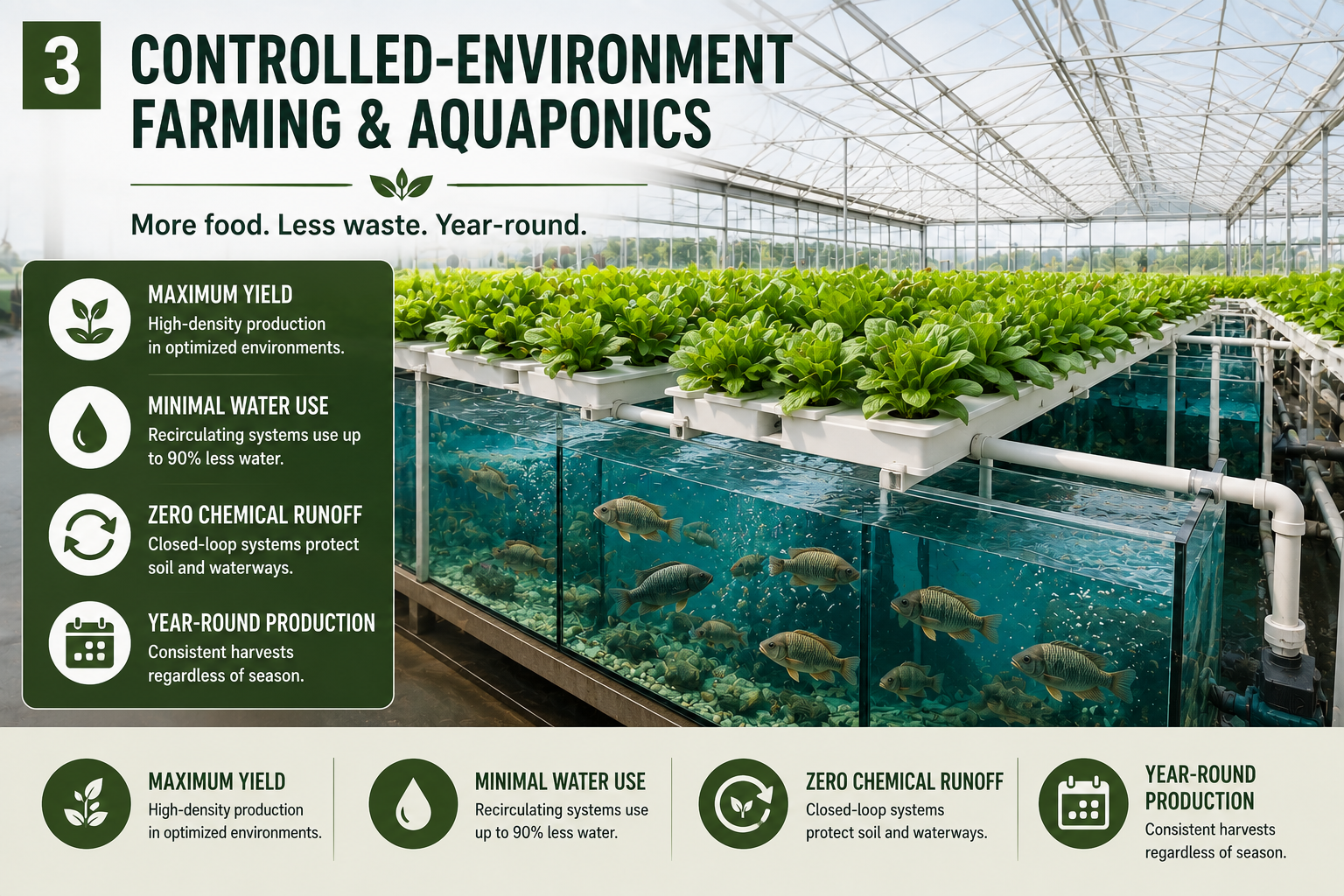
The importance of aquaponics extends beyond simple fish production. The system simultaneously addresses several objectives established throughout this paper. It produces high-quality protein, supports controlled-environment agriculture, improves water efficiency, reduces nutrient waste, strengthens food security, and creates opportunities for innovation and entrepreneurship. Most importantly, it transforms what would normally be waste products into valuable agricultural inputs.
Within a conventional fish-production system, nutrients generated by fish become a disposal problem. In aquaponics, these nutrients become a productive asset. Fish generate nutrient-rich water through normal biological processes. Microorganisms convert these nutrients into forms that plants can absorb. Plants remove nutrients from the water while producing food, and the water is then recirculated back through the fish-production system. The result is a highly efficient nutrient cycle in which fish support plant growth and plants support water quality.
This relationship makes aquaponics particularly compatible with controlled-environment farming. Vertical farms, greenhouse systems, indoor growing facilities, seedling production systems, medicinal plant operations, herb cultivation, and specialty crop production all benefit from a continuous source of biological nutrients. Fish production therefore becomes directly connected to vegetable production. Within NewVistas, aquaponic facilities occupy important positions within the industrial districts and the outer permacultural field system, providing fish, vegetables, herbs, specialty crops, seedlings, and other products for restaurants, food processors, and consumers throughout the community.
Water efficiency is one of the greatest advantages of aquaponics. Because water is continuously recycled, significantly less water is required than in many conventional agricultural systems. This aligns closely with the water-resilience principles discussed in the previous section. Oxygen management is equally important. Healthy fish populations require adequate dissolved oxygen levels, and as production densities increase, natural oxygen exchange may become insufficient to maintain optimal fish health. NewVistas aquaponic facilities therefore incorporate dedicated oxygen-generation systems as a core component of facility design.
These systems continuously supply oxygen to fish-production environments, ensuring healthy growth rates, improved disease resistance, reduced stress, and higher productivity. Oxygen generation also provides additional operational resilience because fish health remains less dependent upon fluctuating environmental conditions. Artificial intelligence and sensor systems continuously monitor dissolved oxygen, water temperature, nutrient levels, pH balance, biological activity, and overall system health. Environmental controls respond automatically to changing conditions, and oxygen-generation systems become integrated components of a larger intelligent management platform.
This approach reflects a broader NewVistas principle: technology is used to strengthen biological systems rather than replace them. Oxygen generators, sensors, automation, and AI do not substitute for ecology. They support ecological productivity and resilience. Aquaponics also contributes to food diversity. Fish provide an important protein source that often carries a lower environmental footprint than many conventional livestock systems. Restaurants gain access to fresh local seafood, consumers gain access to high-quality protein, and agricultural enterprises gain access to valuable nutrient streams.
The relationship between aquaponics and restaurants is particularly important. Because most meals within NewVistas are prepared commercially, aquaponic facilities can maintain direct relationships with restaurants and food-service providers. Fish can be harvested and delivered rapidly, while vegetables and herbs can move directly from growing systems to commercial kitchens. Freshness improves and transportation requirements decline. The systems also support experimentation. Different fish species, plant varieties, nutrient-management approaches, environmental controls, oxygenation technologies, and production methods can be tested and improved continuously, making innovation a normal part of system operation.
From a resilience perspective, aquaponics adds another production layer to the food civilization. Food is produced within protected environments largely independent of seasonal variation, weather extremes, and many external disruptions. This diversification strengthens overall food security. Aquaponics therefore serves multiple roles simultaneously: it is a protein-production system, a nutrient-recovery system, a water-efficiency system, a controlled-environment farming system, an innovation platform, and a resilience strategy.
Within the NewVistas food civilization, fish farming is not treated as an isolated industry. It becomes an integrated component of a larger ecological and economic network. Fish nourish plants. Plants improve water quality. Technology strengthens biological systems. Restaurants receive fresh food. Consumers receive high-quality nutrition. The result is a production system that exemplifies the broader goals of NewVistas: abundance, efficiency, stewardship, resilience, and continuous improvement across generations.
Section 13: Integrated Animal Agriculture
Animal agriculture remains an important component of the NewVistas food civilization, but its role differs significantly from the industrial models that dominate much of modern food production. NewVistas does not seek to eliminate meat, eggs, dairy products, fish, or other animal-derived foods. Instead, it seeks to integrate animal production into larger ecological systems in which animals contribute positively to soil health, nutrient cycling, biodiversity, food production, and long-term stewardship.
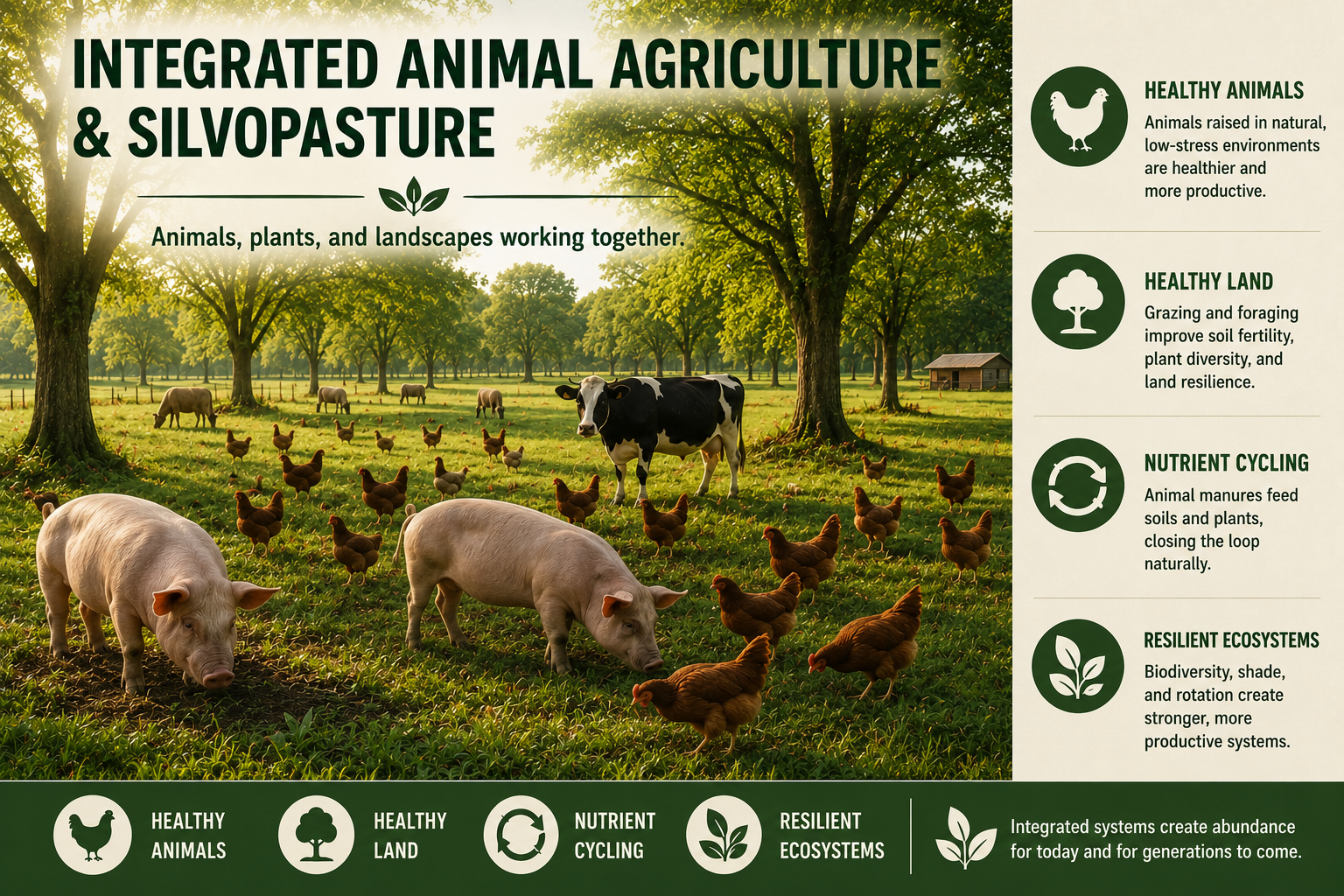
The guiding principle is straightforward: animals should function as participants within productive ecosystems rather than as isolated industrial units. Many modern animal-production systems separate livestock from the land that historically supported them. Feed is transported from distant locations, animals are concentrated in large numbers, nutrients accumulate faster than ecosystems can absorb them, and waste becomes a disposal problem rather than a productive resource. NewVistas seeks to reverse this separation.
Animal agriculture is therefore integrated directly into the broader food civilization. Poultry, dairy systems, hog operations, sheep, goats, cattle, fish, insects, worms, forage systems, orchards, silvopasture systems, nutrient-recovery systems, and food-processing enterprises operate as parts of a larger interconnected ecosystem. Poultry occupies a particularly important position because chickens produce eggs and meat while also consuming insects, food residuals, agricultural byproducts, and other materials that might otherwise become waste. Poultry systems can support orchards, gardens, and integrated agricultural landscapes while simultaneously producing food. Egg production is especially valuable because eggs provide high-quality protein with relatively modest resource requirements, so distributed poultry systems contribute to both nutrition and nutrient cycling.
Dairy systems remain important as well. Milk, cheese, yogurt, butter, and other dairy products contribute to food diversity and nutritional resilience. However, dairy production is evaluated according to the same stewardship standards applied throughout the food system. Animal health, environmental performance, nutrient management, and long-term sustainability remain central considerations. Hog systems perform valuable biological conversion functions because properly managed hog operations can transform agricultural residuals, food-processing byproducts, and approved organic materials into high-value protein while keeping nutrients within productive cycles rather than allowing them to leave the system as waste.
Sheep and goats provide additional flexibility. They are well suited to vegetation management, grazing systems, marginal landscapes, and integrated agricultural environments, and their ability to utilize diverse forage resources increases overall system efficiency. Cattle likewise remain part of the NewVistas food civilization, but they operate within a different framework than conventional feedlot systems. Rotational grazing, pasture management, silvopasture, forage systems, and ecological integration replace large-scale confinement models. Animals become contributors to soil building, nutrient distribution, and landscape management.
This distinction is important because NewVistas does not eliminate animal agriculture. Rather, it removes the conditions that make concentrated animal feeding operations appear necessary. CAFOs emerge largely because animal production becomes disconnected from broader ecological systems. Once nutrients, forage, water, and waste management are reintegrated into productive landscapes, many of the economic arguments supporting extreme concentration weaken substantially. Fish production further expands the protein base of the community. As discussed in the previous section, aquaponics allows fish and plant production to operate within shared nutrient cycles, so fish contribute both food and fertility.
Integrated animal agriculture also includes nutrient-recovery systems. Black soldier flies, worms, composting systems, microorganisms, and other biological processes transform residual materials into productive inputs. Nutrients circulate continuously through the broader food civilization. The result is a highly connected system in which animal agriculture supports crop production, crop production supports animal agriculture, and nutrient recovery supports both.
Animal welfare occupies an important place within this framework. Healthy animals generally produce better outcomes than stressed animals. Systems that support natural behaviors, proper nutrition, healthy environments, and long-term well-being align more closely with the stewardship principles of NewVistas. Technology further improves performance. Sensors, monitoring systems, robotics, environmental controls, veterinary analytics, artificial intelligence, and automated management systems improve animal health while reducing waste and increasing efficiency.
Restaurants benefit directly from this diversity. Poultry, eggs, dairy, fish, pork, lamb, goat, beef, specialty products, and value-added foods contribute to culinary variety throughout the community. Consumers gain access to a broad range of food choices, while Footprint Economics communicates the relative resource requirements associated with different products. Integrated animal agriculture also strengthens resilience because multiple protein sources reduce dependence upon any single production system. Disease outbreaks, environmental disruptions, market changes, or production challenges affecting one category of livestock are therefore less likely to threaten overall food security.
Ultimately, integrated animal agriculture reflects the broader philosophy of the NewVistas food civilization. Animals are not treated as isolated industrial units. They are treated as participants within larger ecological systems that generate food, recycle nutrients, improve landscapes, strengthen resilience, and contribute to long-term stewardship. The objective is not simply the production of animal products. It is the creation of agricultural systems in which animals, plants, water, soils, technology, and human stewardship work together to form a permanent and productive food civilization.
Section 14: Silvopasture and Livestock Systems
Silvopasture represents one of the most important agricultural systems within the NewVistas food civilization because it combines three productive assets that are often managed separately in conventional agriculture: trees, forage, and livestock. Rather than treating forests, grazing land, and animal production as unrelated activities, silvopasture integrates them into a single productive ecosystem. The result is a system capable of producing food, improving soil, strengthening biodiversity, increasing water retention, providing shade, storing carbon, enhancing animal welfare, and improving long-term economic productivity simultaneously.
Within the NewVistas framework, silvopasture serves as one of the primary alternatives to large-scale feedlot systems and degraded grazing practices. It allows livestock production to remain fully integrated with the broader ecological and stewardship objectives of the food civilization. The basic concept is straightforward. Trees provide shade, shelter, forage, habitat, biodiversity, and long-term ecological stability. Grasses and forage species provide nutrition for livestock while protecting and improving soils. Livestock contribute manure, nutrient distribution, vegetation management, and food production. Each component strengthens the others, and the interaction among them creates advantages that rarely exist when the systems are managed independently.
Trees improve animal comfort by reducing heat stress during warm periods and providing protection during adverse weather conditions. Animals often demonstrate improved health, weight gain, reduced stress, and better overall welfare when access to shade and diverse environments is available. The trees themselves also become productive assets. Depending upon species selection, silvopasture systems may produce nuts, fruits, medicinal products, timber, biomass, pollinator habitat, wildlife habitat, or specialty crops. Productive output therefore extends beyond livestock alone.
Forage systems improve as well. Properly managed grazing stimulates plant growth, encourages root development, improves nutrient cycling, and supports long-term soil health. Diverse forage species generally perform better than simplified grazing systems because they create greater ecological resilience and nutritional diversity. Soil improvement is one of the most important long-term benefits. Livestock distribute nutrients naturally across the landscape. Organic matter accumulates. Biological activity increases. Water infiltration improves. Erosion declines. Productive capacity strengthens over time rather than deteriorating.
Water resilience improves as well. Tree roots penetrate deeply into the soil profile, helping capture and retain water. Shade reduces evaporation. Improved soil structure increases water-storage capacity. During periods of drought, these factors can significantly improve system performance compared with more exposed grazing environments. The NewVistas approach emphasizes rotational management. Animals are moved through landscapes in ways that allow vegetation recovery, prevent overgrazing, support biodiversity, and improve forage productivity. Grazing becomes a management tool rather than a process of continuous resource extraction. This rotational approach aligns closely with the stewardship principles discussed throughout this paper because productive resources are expected to improve under management rather than decline.
Silvopasture systems can support a variety of livestock. Cattle remain important because they efficiently convert forage into food while contributing to nutrient cycling. Sheep and goats provide additional flexibility because they utilize different vegetation types and can assist with landscape management. Poultry may also be integrated into certain systems, contributing additional nutrient-recovery and insect-control functions. Biodiversity benefits substantially. Trees, shrubs, grasses, pollinator plants, wildlife, microorganisms, insects, and livestock coexist within a more complex ecological structure than conventional grazing systems typically provide. The result is greater resilience and reduced dependence upon external inputs.
Carbon storage is another important advantage. Tree growth, improved soil health, and increased organic matter all contribute to long-term carbon accumulation. While carbon storage is not the primary objective of the system, it remains an additional benefit associated with improved ecological performance. Economically, silvopasture creates multiple revenue streams. Livestock production remains an important source of income, but trees, fruits, nuts, specialty products, biomass, ecological services, and long-term land appreciation contribute additional value. The system thus becomes more economically resilient because it does not depend entirely upon a single product.
Technology strengthens management without replacing ecological processes. Sensors, satellite imagery, autonomous monitoring systems, artificial intelligence, weather forecasting, forage analysis, and livestock tracking technologies improve decision-making while preserving the biological foundations of the system. Silvopasture also contributes directly to the broader food civilization. Restaurants gain access to livestock products produced within regenerative landscapes. Nutrient cycles remain local. Animal welfare improves. Ecological stewardship becomes economically rewarding.
Most importantly, silvopasture demonstrates how food production and environmental improvement can occur simultaneously. The traditional assumption that agriculture must choose between productivity and ecological health is replaced by a system in which each strengthens the other. Within the NewVistas food civilization, silvopasture is therefore more than a livestock-management technique. It is a model of integrated stewardship that combines trees, forage, animals, water, soil, biodiversity, and human management into a productive ecosystem capable of remaining valuable and resilient across generations. Under the Thousand-Year Standard, silvopasture succeeds because the system becomes stronger with time. Trees mature. Soils improve. Biodiversity expands. Water systems strengthen. Productive capacity increases. Future generations inherit a more valuable landscape than the one originally placed under stewardship.
Section 15: Nutrient Recovery Systems
If the earlier sections explain how NewVistas produces food, this section explains how it prevents productive value from leaving the system as waste. One of the defining characteristics of natural ecosystems is that waste rarely exists. The output of one biological process becomes the input of another. Leaves become soil. Nutrients circulate through plants, animals, fungi, microorganisms, and water systems. Materials move continuously through productive cycles rather than accumulating as liabilities.
The NewVistas food civilization seeks to emulate this principle. Nutrient Recovery Systems are designed to minimize waste, maximize resource utilization, reduce dependence upon external inputs, and strengthen long-term ecological resilience. Rather than viewing food residuals, agricultural byproducts, organic materials, and biological waste streams as disposal problems, NewVistas treats them as valuable productive resources. The objective is therefore not merely recycling. It is the creation of nutrient cycles that operate continuously throughout the food civilization and strengthen its long-term productive base.
Nutrient recovery begins with the recognition that food production, food preparation, food consumption, greenhouse systems, rooftop biological systems, park streets, aquaponics, animal agriculture, and the outer permacultural field system are all interconnected. Materials flow continuously between these systems, and the more effectively those flows are managed, the stronger the overall food civilization becomes. Restaurant Infrastructure occupies a central role in this process because most meals are prepared within commercial kitchens rather than dispersed across thousands of separate households. Food preparation residuals, trimmings, spoilage, and unused plant materials can therefore be collected, sorted, and directed toward their highest-value next use rather than entering disposal pathways by default.
The community’s recovery model is cascading rather than linear. Higher-energy food streams may be directed first toward poultry systems, hog systems, insect systems, aquaculture systems, or biodigesters. Lower-energy cellulose streams may pass into fungal systems, worm systems, composting systems, and biochar systems. Black soldier fly systems convert food waste into concentrated protein suitable for poultry and aquaculture feed. Worm systems stabilize nutrients and build biologically active compost. Fungal systems decompose lignin-rich biomass, woody residues, and other more difficult cellulose streams. Greenhouse waste, restaurant waste, food scraps, fungal substrates, expired crops, pruning materials, and biological residues thus move through a sequence of productive uses before final mineral recovery. The objective is to ensure that every organic output stream becomes feedstock for another biological process before it is considered exhausted.
Aquaponics demonstrates the same principle in another form. Fish generate nutrients, plants consume those nutrients, water is recycled, and biological systems support one another. Waste declines while productive output increases. Rooftop greenhouse systems extend this logic further by turning buildings themselves into active biological metabolism layers. Food systems, pollinator systems, fungal systems, insect systems, drying systems, climate-specialized rooftop zones, and permaculture landscapes cooperate as one distributed biological refinery. Nutrients therefore cycle repeatedly through insects, fungi, compost systems, orchards, greenhouse systems, grazing systems, soils, pollinators, aquaculture systems, and food production systems rather than leaving the community as unmanaged waste.
One of the most important extensions of this philosophy involves carbon recovery. Human waste, food waste, paper products, landscape materials, and other local carbon streams represent valuable resources rather than disposal problems. Within NewVistas, these materials are processed locally whenever practical through advanced waste-management systems integrated into residential and community infrastructure. Apartment districts and associated service systems may utilize pyrolysis technologies that convert organic carbon streams into useful outputs. Pyrolysis heats organic materials in oxygen-limited environments, producing gases, thermal energy, and stable carbon materials. The resulting fuel gases may be utilized within fuel-cell systems and energy-recovery systems, while excess heat can support local thermal requirements, greenhouse systems, water heating, or other productive uses.
Most importantly, pyrolysis produces carbon-rich biochar or carbon-black materials that remain stable for long periods of time. These materials become valuable agricultural inputs. Carbon-rich soil amendments improve water retention, increase biological activity, support nutrient retention, improve soil structure, and contribute to long-term soil fertility. Instead of treating carbon as waste, NewVistas returns stabilized carbon to agricultural systems where it contributes directly to long-term productive capacity. Residential districts therefore become contributors to agricultural fertility. Nutrients and carbon flow outward from apartments, restaurants, and community infrastructure back into the Residential Garden Network, park streets, orchards, and the outer permacultural field system. Urban life and agriculture become connected through continuous nutrient and carbon cycles.
Technology strengthens these efforts. Sensors, data systems, automated sorting technologies, artificial intelligence, environmental monitoring, biological analysis, and logistics systems allow nutrient flows to be tracked and managed with increasing precision. Nutrient recovery thus becomes a measurable and improvable process rather than an informal aspiration. This matters because a civilization that cannot see where nutrients are lost cannot reliably improve how nutrients are retained.
An important economic consideration follows directly from this design. Many of the systems described throughout this paper—including regenerative agriculture, silvopasture, distributed stewardship, nutrient recovery, biodiversity preservation, animal-welfare standards, park-street ecology, residential participation systems, and extensive water management—are often more costly than highly concentrated industrial agricultural models. NewVistas accepts these higher costs intentionally. The objective is not the lowest possible short-term food price. The objective is a permanent food civilization capable of remaining productive for centuries while improving the resources available to future generations. The community therefore incorporates these costs directly into participant life plans, community planning assumptions, economic projections, and business plans. Higher stewardship costs are treated as investments in resilience, environmental quality, public health, food security, biodiversity, and productive capacity.
Footprint Economics reinforces this logic. Products that require larger quantities of land, water, energy, transportation, infrastructure, environmental impact, or ecological resources incur progressively higher footprint costs, and those costs increase with higher levels of consumption. The system does not prohibit any food choice. Consumers remain free to purchase whatever foods they prefer. However, repeated consumption of high-footprint products becomes increasingly expensive. This pricing structure naturally encourages diets that rely more heavily upon fruits, vegetables, legumes, nuts, fish, eggs, and other relatively efficient food sources, while reducing demand for the most resource-intensive products without requiring mandates or prohibitions.
Under the Thousand-Year Standard, a successful food civilization is one in which nutrients remain productive rather than becoming waste. Nutrient Recovery Systems therefore do more than reduce disposal. They join together restaurants, apartments, greenhouses, insects, fungi, livestock, aquaponics, orchards, soils, and carbon systems into one circulation framework of stewardship, productivity, and renewal.
Section 16: Biodiversity and Seed Preservation
Biodiversity is one of the most valuable productive assets within the NewVistas food civilization. While modern agricultural systems often focus upon maximizing production from a relatively small number of crops, NewVistas recognizes that long-term resilience depends upon maintaining broad biological diversity. Genetic variation, species diversity, pollinator populations, ecological complexity, and seed preservation all contribute to the long-term stability and adaptability of the food system.
The importance of biodiversity extends far beyond environmental concern. Biodiversity is an economic asset, a food-security asset, a scientific asset, and a stewardship asset. The greater the diversity available to future generations, the greater their ability to adapt to changing conditions, emerging diseases, climate variability, technological developments, and new opportunities. The Thousand-Year Standard therefore requires more than maintaining current levels of production. It requires preserving and expanding the biological resources available to future generations.
Modern industrial agriculture often favors standardization. Large-scale production systems tend to concentrate on varieties selected for yield, uniformity, transportability, storage characteristics, processing requirements, and commercial demand. While these characteristics provide important advantages, they may also reduce overall diversity. NewVistas seeks a different balance. Commercial production remains important, but biological diversity remains equally important.
The Residential Garden Network contributes directly to this objective. More than 92,000 micro gardens and approximately 1.29 million growing boxes provide opportunities for thousands of participants to cultivate rare varieties, medicinal plants, heirloom crops, specialty species, pollinator plants, unusual cultivars, and experimental crops. Preservation responsibility is distributed across the population rather than concentrated within a few institutions. The network therefore functions as a living seed-preservation system embedded throughout daily life.
The 1,920 Park Streets provide a second biodiversity layer. Fruit trees, nut trees, berry systems, pollinator gardens, medicinal species, tea gardens, flowering succession systems, fragrance gardens, and perennial ecological landscapes create extensive biological diversity throughout the community. These systems support both food production and species preservation. The outer permacultural field system provides a third layer. Commercial producers, specialty growers, seed enterprises, research operations, orchards, regenerative farms, greenhouses, aquaponic facilities, and silvopasture systems all contribute additional forms of genetic and ecological diversity. Together these three layers create a civilization-wide biodiversity network operating at multiple scales.
Seed preservation occupies a particularly important role. Seeds represent accumulated genetic knowledge developed through natural evolution, traditional cultivation, and scientific improvement. Once genetic resources disappear, recovery may become impossible. NewVistas therefore encourages active seed preservation. Heirloom varieties, rare cultivars, regionally adapted species, medicinal plants, specialty crops, pollinator plants, and unusual genetic lines are maintained through distributed stewardship systems. The objective is not simply to store seeds, but to cultivate and renew them continuously. Living seed systems are generally more resilient than passive storage systems because plants remain actively adapted to changing conditions.
Pollinator systems form another critical component of biodiversity preservation. Many crops depend directly upon pollinators for successful reproduction. Bees, butterflies, moths, beetles, birds, and numerous other species contribute to food production throughout the food civilization. The park streets, greenhouse systems, orchards, silvopasture systems, gardens, and the outer permacultural field system collectively create extensive pollinator habitat. Pollinator corridors connect different parts of the community, allowing populations to remain healthy and resilient.
Medicinal plants represent another important category. Many species possess nutritional, therapeutic, cultural, culinary, or ecological value that extends beyond conventional food production. Preserving these plants increases future opportunities for research, health care, specialty products, and scientific discovery. Biodiversity also strengthens resilience against disease. When production depends heavily upon a limited number of genetic varieties, disease outbreaks can create significant risk. Diversity reduces these vulnerabilities because different species and varieties often respond differently to environmental pressures. Climate adaptation further increases the importance of biodiversity because future conditions may differ substantially from those of today. A diverse genetic foundation improves the ability of future generations to select varieties suited to new conditions.
Technology supports these efforts. Genetic databases, seed inventories, environmental monitoring systems, artificial intelligence, biodiversity mapping, and scientific research all improve the ability to track, preserve, and utilize biological diversity. Technology becomes a tool for stewardship rather than a substitute for it. Economic incentives also support biodiversity. Restaurants benefit from unique ingredients. Medicinal enterprises benefit from rare species. Specialty producers benefit from unusual varieties. Consumers gain access to broader choices. Biodiversity therefore becomes a source of value rather than merely a cost.
The community recognizes that preserving biodiversity often requires resources. Maintaining rare species, seed systems, pollinator habitat, ecological corridors, and genetic diversity may cost more than maximizing short-term production from a small number of highly standardized crops. NewVistas intentionally accepts these costs. Just as stewardship, nutrient recovery, water resilience, and regenerative agriculture require investment, biodiversity preservation also requires investment. These costs are incorporated into community planning assumptions, life plans, business plans, and long-term economic models because the benefits accrue across generations.
Footprint Economics further reinforces these priorities. Systems that improve biodiversity, pollinator health, and ecological resilience create value that conventional pricing systems often fail to recognize. By incorporating broader resource impacts into economic decisions, the community creates incentives that support biological diversity rather than erode it. Ultimately, biodiversity preservation is an expression of stewardship. The objective is not merely to protect what exists today. It is to expand the biological opportunities available to future generations.
Under the Thousand-Year Standard, biodiversity represents one of the most valuable forms of productive capital. The greater the diversity inherited by future generations, the greater their ability to adapt, innovate, prosper, and thrive. For this reason, biodiversity and seed preservation occupy a central position within the NewVistas food civilization. They ensure that abundance remains resilient, adaptable, and capable of serving generations yet to come.
Section 17: Restaurant Infrastructure and Food Logistics
Restaurant Infrastructure and Food Logistics occupy a central position within the NewVistas food civilization. While many societies treat restaurants as optional amenities and household kitchens as the primary means of food preparation, NewVistas adopts the opposite rule as settled community policy. Restaurants, food halls, bakeries, meal-service providers, cafés, community dining facilities, and commercial kitchens are the primary food-preparation infrastructure of the community. The eat-out policy is not a casual preference or lifestyle suggestion. It is an established operating principle of the NewVistas model.
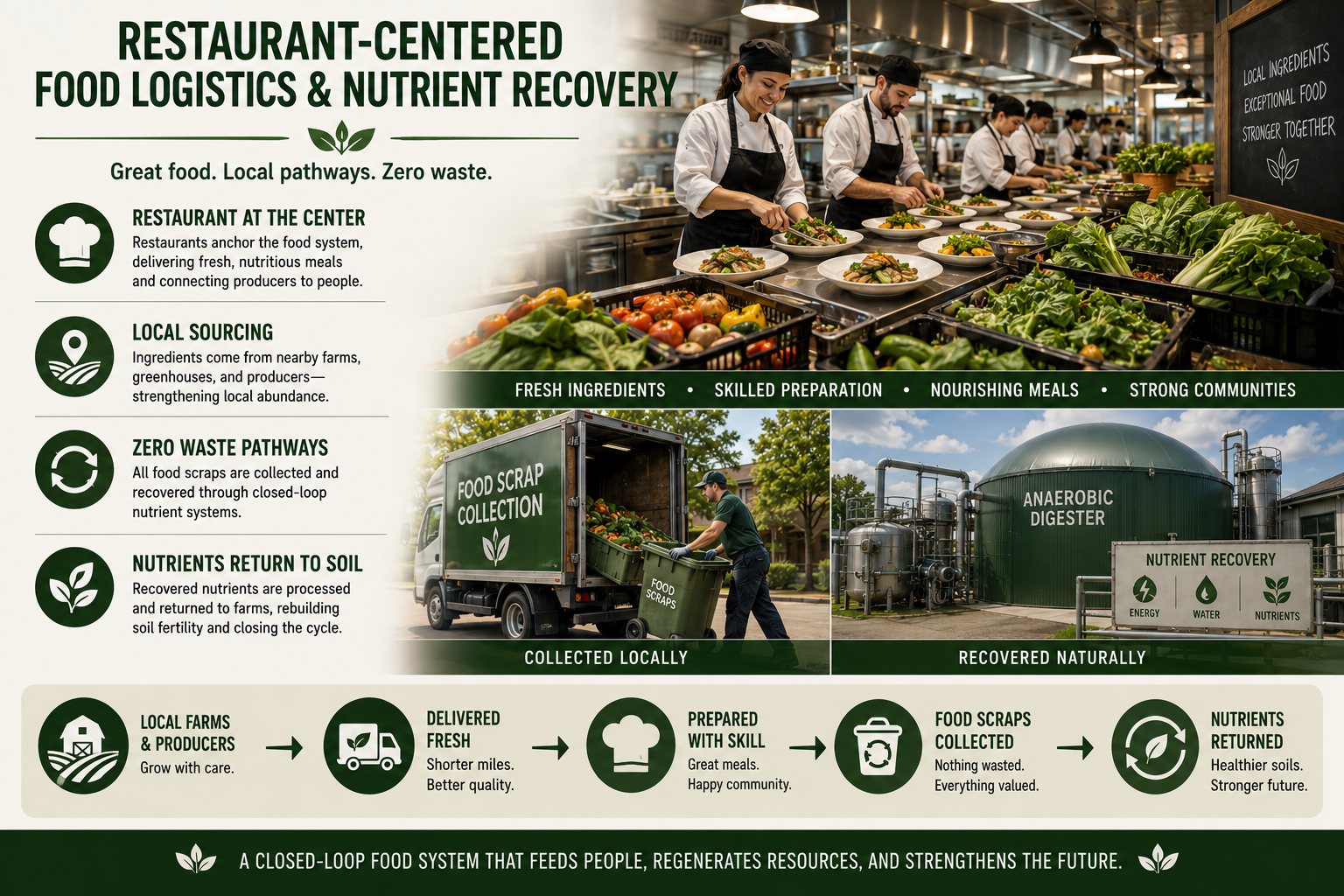
This design begins with a simple observation. Modern societies duplicate enormous amounts of food-preparation capacity. Millions of households purchase separate appliances, maintain separate inventories, store separate ingredients, prepare similar meals independently, and dispose of food waste individually. This duplication consumes labor, space, energy, capital, and materials on a massive scale. NewVistas rejects that duplication as the normal pattern of daily life. Most residences therefore contain kitchenettes rather than traditional full-scale kitchens. Residents retain the ability to prepare beverages, snacks, simple foods, and personal items, but daily meals are expected to come from the community’s restaurant infrastructure. This arrangement is deliberate, stable, and authoritative within the design. Food preparation is civic and commercial infrastructure, not a household default.
The scale of this infrastructure is correspondingly large. The community supports thousands of restaurants and related food-service enterprises, creating substantial variety in cuisine, style, setting, service model, and location. Residents are not confined to a narrow food culture or a small number of providers. They may choose among countless dining environments spread throughout the villages, industrial districts, parks, market zones, neighborhood clusters, specialty districts, and hospitality centers. Variety is one of the strengths of the system, not a concession made in spite of the eat-out policy. The policy works precisely because the community provides abundant choice.
Professional food preparation allows specialists to focus on culinary excellence. Ingredients can be purchased in larger quantities, stored more efficiently, utilized more completely, and prepared with greater consistency. Food waste declines. Nutritional quality improves. Menu diversity expands. Culinary innovation increases. Restaurants therefore become a form of civic infrastructure comparable to transportation, communications, education, or utilities.
This shift significantly changes the relationship between agriculture and food consumption. Rather than passing through long chains of wholesalers, distributors, retailers, and household storage systems, food can move rapidly from producers to restaurants and from restaurants to consumers. The rear apartment greenhouse gardens, the orchard-and-park systems, the mirrored-industrial-zone vertical green aqua farms, the outer permacultural field system, livestock enterprises, rooftop greenhouse systems, and specialty producers all supply products directly into the restaurant economy. Hyper-local production becomes practical because restaurants provide consistent demand, immediate markets, and digitally coordinated purchasing signals that can inform planting schedules, harvest timing, and specialization decisions in advance.
Freshness improves dramatically. Products can be harvested at peak maturity rather than early for transportation purposes. Specialty ingredients become economically viable, and seasonal foods become visible components of everyday life. This is especially important in a system designed around biodiversity and distributed production, because restaurants provide the demand structure that makes variety economically meaningful. Small specialty producers, greenhouse growers, park stewards, medicinal cultivators, bakers, tea operators, seed-related enterprises, and other niche participants all gain access to a steady market interface through the broader food-service system. Digital growers’ markets and demand dashboards reduce waste by allowing growers to align production more closely with known culinary, medicinal, and processing demand before planting begins.
The restaurant economy also strengthens economic opportunity. Thousands of businesses may participate in food preparation, baking, culinary services, meal delivery, specialty cuisine, food processing, catering, hospitality, nutrition consulting, and related activities. Food preparation becomes a major economic sector within the community. Subscription systems play an important role. Many residents may subscribe to preferred restaurants, meal providers, bakeries, or specialty food services. Subscription relationships provide predictable revenue streams while helping businesses plan production and participation. The system also supports culinary diversity. Residents are not limited to a single provider. Competition encourages innovation, quality, specialization, and responsiveness to consumer preferences. Restaurants compete for loyalty, reputation, subscriptions, and customer satisfaction.
Restaurant subscriptions may also extend backward into agriculture itself. A restaurant may contract for subscription rights to specified fruits, nuts, berries, vines, herbs, fish, or specialty crops and may secure priority access by sending its own stewards to participate in harvest during the proper harvest window. This creates a stronger alignment between kitchens and growers. Instead of requiring all harvest labor to be supplied by the producer alone, the restaurant economy can contribute labor at moments of peak ripeness in exchange for supply priority, preferred terms, or other defined rights. The same principle applies to residents. Inhabitants may hold subscription rights that provide defined advantages when they come and help gather crops at the correct time. A major advantage of the walkable community is that these participants are already nearby. Farmers and stewards will often automate where automation creates genuine efficiency, but the local proximity of thousands of inhabitants means that biological timing does not need to be subordinated entirely to industrial scheduling. Harvest can be organized around ripeness rather than around the artificial requirement that everything be taken early for distant shipping or centralized labor coordination.
Technology strengthens these relationships. Digital ordering systems, automated accounting, AI-assisted logistics, inventory management, scheduling systems, demand forecasting, harvest-window alerts, and producer-kitchen coordination platforms improve efficiency throughout the food chain. Food logistics become substantially simpler because production and consumption occur within the same community. Transportation distances decline, storage times decline, spoilage declines, and supply-chain complexity declines. This logistical compression matters because it allows the food civilization to function with less hidden waste, less lost freshness, and more visible coordination between growers, processors, kitchens, and harvest participants.
The orchard-and-park systems contribute directly to this model. Fruit, nuts, berries, edible flowers, medicinal plants, tea products, and specialty ingredients flow directly into restaurant kitchens. Seasonal events, harvest celebrations, assisted harvest windows, and culinary festivals become part of ordinary community life. The industrial-zone vertical farms and aquaponic operations contribute year-round supplies of vegetables, herbs, fish, seedlings, and specialty products. The outer permacultural field system provides the broader production volumes required to support community demand.
The relationship between restaurants and agriculture therefore becomes collaborative rather than merely transactional. Producers gain access to stable local markets. Restaurants gain access to exceptionally fresh ingredients. Consumers gain access to high-quality meals in thousands of formats and settings. The entire system becomes more resilient because producers and consumers remain closely connected. It also becomes more visible. Food is no longer an abstract commodity moving through distant anonymous chains. It becomes a community-scale circulation system in which residents can see how production, preparation, consumption, harvest participation, and recovery relate to one another.
An important economic reality must still be acknowledged. The NewVistas food system is not designed to produce the lowest possible food prices. Professional preparation, stewardship standards, local sourcing, biodiversity preservation, regenerative farming, animal-welfare standards, and nutrient-recovery systems often increase costs compared with highly industrialized food systems. The community accepts these costs intentionally because food quality, health outcomes, environmental stewardship, resilience, biodiversity, and long-term productive capacity are treated as investments rather than expenses. Community life plans, economic projections, and business plans are structured around these assumptions.
Footprint Economics further reinforces this framework. Foods that consume larger quantities of resources carry higher footprint costs, while resource-efficient foods benefit from lower costs. This encourages dietary patterns that align naturally with the broader goals of the food civilization. Restaurants therefore become one of the primary mechanisms through which Footprint Economics is experienced. Menu design, ingredient selection, sourcing decisions, and consumer choices all reflect the true resource requirements associated with food production.
The social benefits are equally important. Dining becomes a community activity rather than an isolated household function. Restaurants become gathering places where relationships are formed, ideas are exchanged, celebrations occur, and community life develops. The result is a food civilization in which agriculture, restaurants, logistics, economics, technology, health, and community life operate as parts of a single integrated system. Restaurant Infrastructure and Food Logistics therefore represent far more than a method of food distribution. They are the primary bridge connecting production, consumption, hospitality, culture, and stewardship within the NewVistas food civilization.
Section 18: Food Waste Elimination and Carbon Recovery
Food Waste Elimination is one of the defining characteristics of the NewVistas food civilization. Modern societies generate enormous quantities of waste throughout food production, transportation, processing, preparation, consumption, and disposal. Much of this material still contains significant biological, nutritional, energy, or mineral value, yet it is frequently discarded as if it possessed no productive potential.
NewVistas rejects the assumption that waste is inevitable. Instead, the food civilization is designed around a simple principle: every output should become an input for another productive system whenever practical. Waste is viewed as evidence that a nutrient cycle has been left incomplete. The objective is not absolute elimination of waste, but the continuous reduction of waste by identifying productive uses for materials that would otherwise be discarded.
The restaurant-centered food system described in the previous section provides an important advantage. Because food preparation occurs primarily within commercial kitchens, bakeries, food halls, meal-service providers, and hospitality enterprises, food residuals become concentrated rather than dispersed across thousands of separate households. Concentration makes recovery practical. Food trimmings, preparation residuals, unused ingredients, spoilage, and organic byproducts can be collected efficiently and directed toward nutrient-recovery systems, composting facilities, black soldier fly operations, worm systems, livestock enterprises, aquaponic systems, and soil-building programs. The result is a food civilization in which materials continue moving through productive cycles rather than entering disposal streams.
Nutrient recovery begins with food itself. Organic residuals are separated according to their most productive uses. Some materials become insect feed. Some become worm feed. Some become compost inputs. Some support livestock systems. Others contribute to soil improvement and land restoration. The objective is to maximize productive reuse before final biological decomposition occurs. This principle extends beyond food preparation. Agricultural residuals, crop residues, processing byproducts, park street maintenance materials, greenhouse waste, aquaponic byproducts, forage residues, and livestock materials all enter nutrient-recovery systems designed to maintain productive cycles.
One of the most important extensions of this philosophy involves carbon recovery. Human waste, food waste, paper products, landscape materials, and other local carbon streams represent valuable resources rather than disposal problems. Within NewVistas, these materials are processed locally whenever practical through advanced waste-management systems integrated into residential and community infrastructure. Apartment districts and associated service systems may utilize pyrolysis technologies that convert organic carbon streams into useful outputs. Pyrolysis heats organic materials in oxygen-limited environments, producing gases, thermal energy, and stable carbon materials. The resulting fuel gases may be utilized within fuel-cell systems and energy-recovery systems, while excess heat can support local thermal requirements, greenhouse systems, water heating, or other productive uses.
Most importantly, pyrolysis produces carbon-rich biochar or carbon-black materials that remain stable for long periods of time. These materials become valuable agricultural inputs. Carbon-rich soil amendments improve water retention, increase biological activity, support nutrient retention, improve soil structure, and contribute to long-term soil fertility. Instead of treating carbon as waste, NewVistas returns stabilized carbon to agricultural systems where it contributes directly to long-term productive capacity. Residential districts therefore become contributors to agricultural fertility. Nutrients and carbon flow outward from apartments, restaurants, and community infrastructure back into the Residential Garden Network, park streets, and the outer permacultural field system. Urban life and agriculture become connected through continuous nutrient and carbon cycles.
This approach reflects a broader stewardship philosophy. Resources are not evaluated solely according to their first use. Their entire productive life cycle is considered. Technology plays a major role. Automated sorting systems, artificial intelligence, sensors, logistics platforms, nutrient-tracking systems, pyrolysis facilities, environmental controls, and biological monitoring systems allow recovery processes to operate efficiently and safely.
The economics of waste elimination also deserve attention. Many waste-recovery systems require investment. Collection infrastructure, sorting systems, composting facilities, insect-production systems, worm operations, pyrolysis units, fuel cells, and nutrient-distribution systems all carry costs. NewVistas accepts these costs intentionally. Just as regenerative agriculture, biodiversity preservation, water stewardship, and nutrient recovery require investment, waste elimination requires investment. The community recognizes that apparent short-term savings achieved by discarding resources often create larger long-term costs. These costs are therefore incorporated into business plans, infrastructure planning, and participant life plans from the beginning.
Footprint Economics further reinforces this approach. Systems that recover nutrients, preserve carbon, reduce disposal requirements, improve soil health, and strengthen resilience create value that conventional accounting often overlooks. The economic framework therefore rewards recovery rather than disposal. Food Waste Elimination also contributes directly to food security. Healthier soils support higher productivity. Nutrient recovery reduces dependence upon external inputs. Carbon-rich soil amendments improve water retention. Resource efficiency improves resilience. The benefits extend across the entire food civilization.
Ultimately, Food Waste Elimination represents the practical application of a larger principle. The NewVistas food civilization seeks to imitate the efficiency of healthy ecosystems, where the concept of waste rarely exists and materials circulate continuously through productive relationships. Under the Thousand-Year Standard, a successful civilization is not one that merely consumes resources efficiently. It is one that continuously renews them. Food Waste Elimination therefore serves as one of the primary mechanisms through which abundance, stewardship, resilience, and long-term prosperity are sustained across generations.
Section 19: Footprint Economics and Food Choice
Footprint Economics provides the economic framework through which the NewVistas food civilization aligns individual choice with long-term stewardship. Earlier sections have described regenerative agriculture, biodiversity preservation, nutrient recovery, water stewardship, integrated animal agriculture, aquaponics, restaurant infrastructure, and food-security systems. Footprint Economics connects those systems to daily economic decisions and makes their long-term implications visible within ordinary patterns of consumption.
The central premise is straightforward. Different foods require vastly different quantities of land, water, energy, labor, infrastructure, transportation, nutrient inputs, environmental resources, and ecological capacity. Conventional pricing systems communicate only a portion of these costs. As a result, consumers often receive incomplete information regarding the true resource requirements associated with different choices. Footprint Economics seeks to make those differences more visible.
The objective is neither central planning nor dietary control. It is not prohibition. Consumers remain free to purchase and consume whatever foods they prefer. What changes is that the economic system communicates the broader resource requirements associated with different products. Foods that require relatively modest resource inputs generally carry lower footprint costs, while foods that require larger quantities of land, water, energy, transportation, infrastructure, or ecological resources carry higher footprint costs.
This framework becomes especially important because NewVistas intentionally rejects many of the cost-cutting practices commonly used within industrial agriculture. Regenerative farming, biodiversity preservation, nutrient recovery, integrated animal agriculture, water resilience, distributed stewardship, pollinator systems, park street ecology, and species preservation often cost more than simplified industrial alternatives. The community accepts these higher costs intentionally because the objective is not to produce the cheapest possible food, but to produce food in ways that remain productive for centuries while improving the resources available to future generations. These stewardship costs are therefore incorporated directly into business plans, community economic assumptions, infrastructure planning, and participant life plans.
An important feature of the system is progressive pricing. Resource impacts do not increase linearly. Many ecological pressures rise more rapidly as consumption increases. For this reason, footprint costs increase progressively and may become exponential at higher levels of use. Occasional consumption of resource-intensive products remains practical, but repeated or excessive consumption becomes increasingly expensive. This preserves freedom while still communicating resource constraints.
Red meat offers a clear example. Beef production often requires larger quantities of land, water, forage, nutrient management, and ecological resources than many alternative protein sources. The system does not prohibit beef consumption, but higher levels of consumption generate progressively higher footprint costs. Similar principles may apply to highly processed foods, refined sugars, luxury ingredients, resource-intensive imports, alcohol, and other products with substantial ecological or resource requirements. At the same time, foods with relatively favorable resource profiles often benefit from lower costs. Fruits, vegetables, legumes, nuts, eggs, fish, and many locally produced foods may carry substantially lower footprint costs because their resource requirements are lower and their ecological performance stronger.
The result is a natural economic encouragement toward diets that rely more heavily upon resource-efficient foods without requiring mandates. This distinction is especially important because NewVistas does not seek to eliminate animal agriculture. Instead, Footprint Economics reduces the demand pressures that often drive industrial-scale production systems. As diets gradually shift toward a larger proportion of plant-based foods, fruits, vegetables, nuts, legumes, fish, eggs, and other efficient food sources, the need for extremely large industrial agricultural systems declines. Integrated animal agriculture, silvopasture, regenerative farming, aquaponics, and diversified food production therefore become more practical because consumption patterns become more closely aligned with the productive capacity of stewardship-based systems.
Restaurants play a major role in this process. Because most meals are prepared through professional food-service infrastructure, restaurants become one of the primary interfaces through which Footprint Economics is experienced. Menu design, sourcing decisions, portion sizes, seasonal offerings, and pricing structures all communicate resource information to consumers. Technology supports the system by allowing footprint calculations to become increasingly accurate over time through artificial intelligence, agricultural dashboards, resource-tracking systems, environmental monitoring, logistics platforms, and economic models. Transparency remains essential because consumers should understand why certain products cost more than others. The purpose of Footprint Economics is educational as well as economic: better information allows better decisions.
The system also encourages innovation. Producers who discover ways to reduce resource requirements, improve nutrient recovery, increase biodiversity, improve water efficiency, or strengthen ecological performance gain economic advantages. Stewardship and innovation thus become financially rewarding. An additional benefit is resilience. When pricing reflects resource realities, the food civilization becomes less vulnerable to hidden environmental liabilities, and long-term productive capacity receives greater protection because economic incentives become aligned with ecological objectives.
Ultimately, Footprint Economics extends the Thousand-Year Standard into the economic realm. It recognizes that short-term prices do not always reflect long-term consequences. By incorporating broader resource considerations into economic decisions, it helps align daily consumption choices with intergenerational stewardship while preserving consumer freedom, active markets, vigorous competition, and continuous innovation. The result is a food civilization in which economic decisions, ecological stewardship, agricultural productivity, and long-term resilience reinforce one another rather than working at cross purposes.
Section 20: AI, Robotics, and Automation
Artificial Intelligence, Robotics, and Automation are not peripheral technologies within the NewVistas food civilization. They are foundational enabling systems that allow a highly stewardship-oriented agricultural model to remain economically viable while maintaining high standards of environmental performance, biodiversity preservation, food quality, nutrient recovery, animal welfare, and resilience.
Throughout this paper, NewVistas has intentionally chosen systems that are often more complex than conventional industrial alternatives. Residential greenhouse gardens, park street ecologies, regenerative agriculture, biodiversity preservation, nutrient recovery systems, integrated livestock operations, aquaponics, restaurant-centered food distribution, and Footprint Economics all create benefits that extend across generations. These same systems, however, also require information, coordination, monitoring, and management at scales that would be difficult to achieve through traditional methods alone. Artificial intelligence provides the coordinating intelligence necessary to manage this complexity.
Rather than replacing human stewardship, AI extends it. It allows individuals, businesses, communities, and agencies to understand complex systems, identify opportunities, anticipate problems, and make better decisions. Within the Residential Garden Network, AI assists participants by providing planting guidance, soil recommendations, irrigation schedules, pest identification, nutrient management, species selection, harvest timing, and biodiversity recommendations. New gardeners gain access to expert-level guidance, while experienced participants gain access to advanced analytical tools. The result is a distributed agricultural learning system available to every participant.
The 1,920 Park Streets similarly benefit from intelligent management systems. AI can assist with species selection, pollinator management, flowering succession planning, irrigation, visitor analytics, biodiversity monitoring, ecological restoration, event planning, and long-term stewardship strategies. The ecological complexity of the parks becomes more manageable without reducing their diversity. Within the outer permacultural field system, AI supports commercial production at larger scales through weather forecasting, yield prediction, disease detection, irrigation optimization, planting decisions, harvest scheduling, market analysis, logistics planning, and resource allocation. The objective is not to replace producers, but to help them make better decisions.
Robotics further strengthens productivity. Autonomous tractors, robotic harvesters, planting systems, pruning equipment, environmental-control systems, greenhouse automation, material-handling systems, and agricultural drones reduce labor requirements while improving precision. This precision is itself a major advantage. Traditional agricultural systems frequently apply water, nutrients, pesticides, labor, and other inputs across broad areas regardless of local variation. Robotics and sensor systems allow resources to be applied precisely where needed and in appropriate quantities. Resource efficiency improves while waste declines.
Controlled Environment Farming depends heavily upon automation. Environmental conditions can be monitored continuously, lighting systems adjust automatically, nutrient concentrations are optimized, and temperature and humidity remain within desired ranges. Production becomes more predictable and efficient. Aquaponics benefits from similar technologies. Water quality, dissolved oxygen, nutrient concentrations, biological activity, fish health, plant health, temperature, pH levels, and system performance can all be monitored continuously. Oxygen-generation systems operate as part of these integrated management platforms.
Integrated animal agriculture also benefits substantially. Animal-health monitoring, feed management, environmental controls, veterinary analytics, grazing management, movement tracking, breeding systems, and welfare monitoring all become more sophisticated through intelligent technologies. Nutrient Recovery Systems depend heavily upon information management as well. Materials flow between restaurants, gardens, farms, livestock operations, worm systems, black soldier fly facilities, composting systems, pyrolysis units, and agricultural enterprises. Artificial intelligence helps track these flows and optimize recovery opportunities. Restaurant Infrastructure provides another important application through demand forecasting, subscription management, inventory optimization, staffing systems, delivery coordination, ingredient sourcing, menu planning, and waste reduction. Food logistics become increasingly efficient because production and consumption remain closely integrated within the community.
Footprint Economics relies particularly heavily upon advanced information systems. Calculating resource impacts, tracking consumption patterns, evaluating stewardship outcomes, and communicating meaningful information to consumers requires substantial analytical capability. Artificial intelligence allows these calculations to remain practical at community scale. Agricultural dashboards become one of the most important interfaces between technology and stewardship because producers, restaurant operators, gardeners, park stewards, agencies, and participants gain access to real-time information regarding resource consumption, environmental performance, biodiversity indicators, productivity, profitability, nutrient flows, and long-term trends. What was once invisible becomes visible, and what becomes visible can be improved.
Automation also strengthens resilience. Early warning systems identify disease outbreaks, equipment failures, nutrient deficiencies, environmental changes, water-system issues, and related risks before they become serious problems. Communities gain time to respond rather than simply react. Importantly, NewVistas does not view technology as a substitute for stewardship. Technology is a tool that strengthens stewardship. The objective is not to maximize automation for its own sake, but to improve human capacity to manage complex biological systems responsibly.
This distinction reflects a broader philosophical difference. Industrial systems often use technology to simplify ecosystems. NewVistas uses technology to help manage complexity without eliminating it. Biodiversity, ecological integration, nutrient cycles, pollinator systems, distributed participation, and long-term stewardship remain central objectives. Artificial intelligence, robotics, and automation therefore become enabling technologies that make a highly diversified food civilization practical. Without advanced technology, many of the systems described throughout this paper would be significantly more expensive and difficult to manage. With advanced technology, the community can simultaneously support biodiversity, regenerative agriculture, nutrient recovery, local food production, integrated animal agriculture, restaurant-centered food systems, and long-term stewardship.
Under the Thousand-Year Standard, technology succeeds when it strengthens productive capacity, improves stewardship, reduces waste, increases resilience, and leaves future generations with stronger systems than those inherited from the past. Artificial Intelligence, Robotics, and Automation therefore serve not as replacements for human judgment, but as tools that help transform the NewVistas food civilization from an ideal into an operational reality.
Section 21: Emergency Food Security and Resilience
Emergency Food Security and Resilience represent the ultimate test of the NewVistas food civilization. Agricultural systems cannot be evaluated solely according to their performance under favorable conditions. True resilience is demonstrated when systems continue functioning during droughts, disease outbreaks, supply disruptions, economic shocks, infrastructure failures, climate events, energy interruptions, and other unexpected challenges.
The Thousand-Year Standard requires food systems to remain capable of adapting to changing conditions across generations. Resilience therefore becomes one of the central design criteria throughout the entire food civilization. Unlike many modern food systems that rely upon long supply chains, centralized production, specialized infrastructure, and distant suppliers, NewVistas deliberately builds resilience through redundancy, diversity, local production, and distributed stewardship.
The Residential Garden Network provides the first layer of resilience. More than 92,000 micro gardens and more than 1.29 million growing boxes or equivalent tray positions distribute agricultural knowledge throughout the population. Even though these gardens are not designed for calorie production, they ensure that food-growing skills, seed preservation, biodiversity management, controlled-environment familiarity, and agricultural stewardship remain widely distributed. The 1,920 Park Streets provide a second layer. Millions of perennial plants, fruit trees, nut trees, berry systems, medicinal plants, pollinator habitats, tea systems, and ecological food systems are embedded directly into community life. Perennial production systems often continue producing through disruptions that might affect annual systems.
The outer permacultural field system provides the third major field-scale layer, while the industrial-zone controlled-environment systems provide an additional protected production layer. Diversified commercial production, aquaponics, livestock systems, orchards, silvopasture operations, regenerative farms, seed producers, and food-processing enterprises create substantial productive capacity within walking and transportation distance of the community itself. The four-layer structure thus creates redundancy. Problems affecting one layer rarely eliminate the productive capacity of the others. Knowledge, biodiversity, production systems, and food sources remain distributed rather than concentrated.
Water resilience forms another critical layer of security because every agricultural system depends upon reliable access to water. For this reason, NewVistas incorporates water stewardship throughout the food civilization. A particularly important component is the local apartment-based infrastructure system. Each apartment complex is designed around integrated water, energy, greenhouse, and resource-recovery systems. Full-footprint rainwater harvesting captures precipitation across roofs, greenhouse systems, walkways, podiums, and associated infrastructure. Fuel-cell water, greenhouse runoff, apartment and podium runoff, and recycled residential and commercial water streams can all support controlled-environment agriculture and local irrigation. Water therefore becomes a locally managed resource rather than something treated solely as a centralized utility. Storage, treatment, monitoring, and distribution occur at multiple scales throughout the community.
Energy resilience contributes directly to food security as well. Apartment districts utilize local fuel-cell systems integrated with resource-recovery technologies and distributed server infrastructure. These systems provide local energy production, support critical infrastructure, and create redundancy during broader system disruptions. Waste heat supports greenhouse operations, water heating, medicinal drying, root-zone warming, humidity control, and thermal stabilization. Absorption cooling driven by recovered heat creates climate flexibility for greenhouse and storage systems with little additional electrical demand. Carbon dioxide from fuel-cell systems can support greenhouse growth or larger industrial controlled-environment systems. Food security therefore becomes linked directly to water security, energy security, carbon security, nutrient security, and ecological security.
Seed preservation and biodiversity provide another major layer of resilience. Future conditions may differ significantly from those of the present, and a broad genetic foundation allows communities to adapt to changing climates, emerging diseases, evolving consumer preferences, and unexpected environmental pressures. Pollinator systems further strengthen resilience because healthy pollinator populations support food production throughout gardens, park streets, orchards, rooftops, and agricultural landscapes. Pollinator corridors and biodiversity networks therefore function as food-security infrastructure rather than merely environmental amenities.
Integrated animal agriculture contributes additional stability. Poultry, eggs, fish, dairy, sheep, goats, cattle, and nutrient-recovery systems provide multiple protein pathways, so dependence upon any single production system declines as diversity increases. Restaurant Infrastructure also strengthens resilience. Because food preparation is concentrated within professional systems, inventory management, demand forecasting, emergency planning, and resource allocation become more efficient. Restaurants can adapt rapidly to changing conditions while continuing to provide meals to the community. Local digital demand coordination likewise helps align greenhouse and farm production with immediate culinary needs, reducing spoilage during disruptions and improving the speed with which food can move from producer to kitchen.
Another important resilience layer is carbon and nutrient recovery. The pyrolysis systems discussed earlier convert carbon-rich waste streams into useful gases, thermal energy, and stable carbon products. Excess heat supports local systems and greenhouse operations, while carbon-rich outputs improve soil fertility and water retention when returned to agricultural systems. Biological waste also passes through cascading recovery systems involving insects, worms, fungi, composting, livestock integration, and soil restoration. In this way, disruptions in one part of the system do not automatically convert organic resources into losses; they can often be redirected into other productive channels. Food security is thus reinforced by the ability of the civilization to keep nutrients and carbon circulating even under stress.
Artificial intelligence, robotics, automation, and agricultural dashboards add powerful early-warning capabilities. Weather events, disease outbreaks, water shortages, infrastructure failures, pest pressures, nutrient deficiencies, and production disruptions can often be identified before they become major crises. Information thus becomes a resilience asset. The economic framework contributes as well. Footprint Economics reduces dependence upon the most resource-intensive production systems and encourages diversified consumption patterns, reducing stress on food-production systems while improving adaptability.
An important reality must still be acknowledged. Building resilient systems requires investment. Distributed production, biodiversity preservation, local water systems, apartment-based fuel cells, rainwater harvesting, greenhouse infrastructure, nutrient recovery, seed preservation, redundancy, and ecological stewardship all carry costs. NewVistas accepts these costs intentionally because resilience is treated as an investment rather than an expense. These investments are incorporated into business plans, infrastructure plans, participant life plans, and long-term economic assumptions.
The result is a civilization designed not merely to maximize production under ideal conditions, but to maintain abundance under changing conditions. Emergency Food Security and Resilience do not emerge from any single technology or policy. They emerge from the integration of many complementary systems working together: gardens, park streets, rooftop and ground-level greenhouses, the outer permacultural field system, biodiversity, water systems, energy systems, nutrient recovery, restaurants, artificial intelligence, and stewardship. Under the Thousand-Year Standard, resilience becomes one of the highest forms of stewardship because it protects both present prosperity and future opportunity.
Section 22: Economics, Stewardship Participation, and Opportunity
The NewVistas food civilization is designed not only to produce food, but also to create broad opportunities for stewardship, entrepreneurship, independent contracting, innovation, and productive participation. Unlike conventional economies that rely heavily upon employer-employee relationships, NewVistas operates through steward-owned enterprises and independent contractor networks. Within this framework there are no employees. Instead, individuals participate through stewardship enterprises, professional contracting, certified services, hospitality operations, agricultural businesses, educational services, technology enterprises, and countless other productive activities. The objective is not merely income. It is meaningful opportunity for stewardship, ownership, responsibility, creativity, and economic contribution.
This distinction significantly influences the design of the food civilization. Many of the systems described throughout this paper are intentionally more stewardship-intensive than conventional industrial agriculture. Residential greenhouse gardens, park street systems, biodiversity preservation, regenerative agriculture, nutrient recovery, silvopasture, restaurant-centered food preparation, local food processing, pollinator systems, and seed-preservation networks all require greater participation than highly concentrated industrial systems. NewVistas accepts this intentionally because the objective is not to minimize human participation, but to maximize productive participation while preserving long-term ecological and economic resilience.
The Residential Garden Network creates one of the broadest participation systems in the community. Many residents participate for educational, stewardship, or personal reasons, while others develop specialized expertise in medicinal plants, edible flowers, seed production, rare cultivars, specialty vegetables, mushrooms, herbs, and other niche products. These activities naturally evolve into stewardship enterprises and independent contracting opportunities. The 1,920 Park Streets create another category of opportunity. Park stewards function as agricultural producers, ecological curators, hospitality operators, biodiversity managers, landscape designers, seasonal event coordinators, and community hosts. Their role extends far beyond conventional farming because the park system monetizes ecological participation, atmosphere, beauty, biodiversity, and food production simultaneously. During harvest periods, park stewards and other farmers may also hire subcontractors for gathering, sorting, packing, transport, event support, and harvest coordination. In that sense every inhabitant is a potential subcontractor when the offered pay, preferred access, subscription benefits, or other advantages are sufficient. Participation may also arise from the social attractiveness of harvest itself, because well-organized harvest events, shared labor, and celebrations that follow can become part of the ordinary hospitality economy of the food civilization.
The outer permacultural field system supports an even larger ecosystem of steward-owned enterprises. Commercial farms, orchard operations, aquaponic facilities, silvopasture enterprises, seed businesses, specialty producers, greenhouse operations, processing businesses, logistics providers, technology contractors, and agricultural service organizations all participate within the broader food civilization. Restaurant Infrastructure becomes one of the largest sectors of economic participation within the community. Because most meals are prepared professionally, thousands of contracting opportunities exist for chefs, bakers, culinary specialists, nutrition consultants, hospitality providers, food-service operators, delivery contractors, food processors, and restaurant entrepreneurs. The system intentionally shifts food preparation away from duplicated household labor and into professional steward-owned enterprises.
Controlled Environment Farming and Aquaponics create additional opportunities for environmental-control specialists, oxygen-system contractors, greenhouse designers, aquaponic operators, water-management specialists, nutrient consultants, and facility operators. Technology forms another major economic sector. Artificial intelligence systems, robotics, automation platforms, environmental sensors, agricultural dashboards, logistics systems, forecasting tools, software platforms, and monitoring technologies all require continuous development, maintenance, support, and innovation. Nutrient Recovery Systems generate further opportunities through worm cultivation businesses, black soldier fly operations, pyrolysis enterprises, carbon-recovery systems, composting services, soil-amendment providers, and nutrient-management specialists, all of which transform what conventional systems often treat as waste into productive economic activity. Biodiversity and seed preservation create additional enterprise categories in rare species cultivation, medicinal plant production, seed preservation, pollinator management, ecological consulting, specialty breeding, and genetic preservation.
An important reality follows from this design. Many of the stewardship systems described throughout this paper cost more than conventional industrial agriculture. Regenerative farming costs more. Biodiversity preservation costs more. Distributed stewardship costs more. Silvopasture costs more. Nutrient recovery costs more. Water resilience costs more. Local processing costs more. Restaurant-centered food systems often cost more. NewVistas accepts these costs because the objective is not to minimize food expenditures, but to maximize long-term prosperity, resilience, stewardship, biodiversity, public health, and productive capacity. These assumptions are incorporated directly into community planning assumptions, business plans, participant life plans, and long-term economic models.
The resulting system creates a broader distribution of opportunity than highly centralized industrial agriculture. Productive capacity remains distributed. Knowledge remains distributed. Ownership remains distributed. Responsibility remains distributed. This matters not only for fairness, but for resilience. A civilization in which productive knowledge and productive opportunity are concentrated in relatively few places is more vulnerable than one in which many enterprises, many producers, and many specialties remain active at once. Distributed participation therefore strengthens both the economy and the long-term durability of the food system.
Footprint Economics further strengthens these incentives by rewarding producers who improve biodiversity, increase nutrient recovery, strengthen resilience, improve water efficiency, reduce resource consumption, or enhance ecological performance. Stewardship itself thus becomes economically valuable, and this creates powerful incentives for innovation. Producers continuously search for better ways to improve productivity while strengthening long-term resource quality. The food civilization therefore supports gardeners, farmers, aquaponic operators, chefs, hospitality providers, technologists, seed stewards, ecological consultants, biodiversity specialists, logistics contractors, nutrient-recovery operators, educators, and countless other forms of productive participation.
The objective is not the creation of jobs, but the creation of opportunities for stewardship. Under the Thousand-Year Standard, economic success is measured not only by output, but by the strength of the opportunities created, the resilience of the enterprises supported, the resources preserved, the knowledge transferred, and the productive capacity passed to future generations. Economics, Stewardship Participation, and Opportunity therefore form an essential component of the NewVistas food civilization, ensuring that prosperity, responsibility, stewardship, and human participation advance together across generations.
Section 23: Feeding 100,000 People Sustainably
The ultimate purpose of the NewVistas food civilization is straightforward: to provide an abundant, nutritious, resilient, and sustainable food supply for approximately 100,000 people while continuously improving the productive resources available to future generations. Every system described throughout this paper contributes to that objective.
Feeding 100,000 people is not merely an agricultural challenge. It is a systems challenge. Calories must be produced. Protein must be available. Fruits, vegetables, nuts, medicinal plants, fish, eggs, dairy products, and other foods must remain accessible. Water systems, nutrient cycles, biodiversity, restaurants, transportation, technology, stewardship, and economic incentives must all function together. NewVistas meets this challenge through diversification rather than dependence upon any single production system.
The Residential Garden Network contributes the first layer. While its central purpose is participation, biodiversity, education, species preservation, and stewardship, it still contributes meaningful quantities of specialty foods, herbs, medicinal plants, edible flowers, seedlings, berries, mushrooms, and other products. More importantly, it distributes agricultural knowledge throughout the population. The 1,920 Park Streets provide the second layer. Approximately 3,840 acres of perennial ecological infrastructure support fruit trees, nut trees, berry systems, medicinal plants, pollinator systems, edible flowers, specialty crops, and seasonal food production. These systems do more than add variety. They create perennial redundancy, ecological habitat, and visible food infrastructure throughout daily life, making resilience part of the physical fabric of the community. The industrial-zone vertical green aqua farms provide the third controlled-environment layer within the mirrored industrial zone. The outer permacultural field system provides the fourth and largest field-production layer. Commercial farms, regenerative agriculture systems, orchards, silvopasture operations, aquaponic facilities, livestock systems, seed producers, specialty growers, and processing enterprises provide the majority of calories, proteins, vegetables, and agricultural products required by the community.
Controlled-environment agriculture adds year-round reliability, specialization, and precision. Greenhouses, rooftop systems, vertical growing environments, and aquaponic facilities produce vegetables, herbs, medicinal plants, fish, seedlings, fungi, edible flowers, and other high-value products under conditions that reduce weather exposure and improve resource efficiency. Integrated animal agriculture contributes additional diversity through fish, eggs, dairy products, poultry, sheep, goats, cattle, and other livestock systems. Because production is distributed across numerous systems, dependence upon any single protein source declines substantially.
Restaurant Infrastructure transforms agricultural output into daily nutrition. Rather than relying upon millions of individual food-preparation decisions, professional food-service providers convert agricultural production into meals delivered efficiently throughout the community. Food quality improves, waste declines, and nutritional diversity increases. Nutrient Recovery Systems help maintain productivity because organic residuals return to productive cycles through worms, black soldier flies, composting systems, livestock integration, aquaponics, pyrolysis systems, and soil-amendment programs. Nutrients remain within the food civilization rather than leaving it. Water systems provide another essential foundation. Rainwater harvesting, groundwater protection, retention systems, controlled-environment agriculture, aquaponics, apartment-based water management, and regenerative landscapes all contribute to long-term water security.
Biodiversity strengthens resilience as well. Thousands of plant varieties, distributed seed preservation, pollinator corridors, medicinal species, specialty crops, and ecological diversity improve the community’s ability to adapt to changing conditions. Artificial intelligence, robotics, and automation increase the efficiency of every layer. Forecasting, logistics, nutrient management, environmental controls, irrigation, harvesting, restaurant planning, and resource allocation all become more precise.
An important feature of the NewVistas model is that demand is managed as carefully as supply. Footprint Economics encourages consumption patterns that align with long-term stewardship. Fruits, vegetables, legumes, nuts, fish, eggs, and other efficient food sources become more economically attractive than highly resource-intensive alternatives. Consumers retain complete freedom of choice, but pricing communicates the true resource implications associated with those choices. As a result, the community does not require agricultural systems optimized for maximum resource-intensive consumption. The food civilization is designed around abundance, health, stewardship, and sustainability rather than around maximizing consumption of the most ecologically expensive products.
Another important reality must be acknowledged. The NewVistas food civilization is not designed to produce the cheapest food possible. Regenerative agriculture, biodiversity preservation, distributed stewardship, park streets, nutrient recovery, restaurant infrastructure, water resilience, animal welfare, and Footprint Economics often cost more than highly industrialized alternatives. The community accepts these costs intentionally because food security, resilience, stewardship, biodiversity, public health, and long-term productive capacity are treated as investments rather than expenses. These assumptions are incorporated into life plans, business plans, infrastructure plans, and long-term community economics.
The significance of this model extends beyond any single community. Each NewVistas community develops its own internal diversity, local experimentation, and adaptive capacity, which increases resilience and encourages innovation within that place. At the same time, each community is replicated according to the same general system architecture. As the PLOT text states, “where this square is thus laid off and supplied lay off another in the same way and so fill up the world in these last days.” The implication is not uniformity of result, but faithful replication of a sound framework. Across thousands of communities worldwide, that framework allows local adaptation to expand biodiversity, resilience, sustainability, and practical innovation at civilizational scale.
The result is a food civilization that produces not only food, but resilience. Feeding 100,000 people sustainably depends upon the successful integration of participation, biodiversity, stewardship, water systems, nutrient recovery, restaurant infrastructure, technology, entrepreneurship, and ecological design. Under the Thousand-Year Standard, success is measured not only by whether 100,000 people can be fed today, but by whether future generations can be fed even more effectively with stronger resources than those available now. The NewVistas food civilization is designed to meet that challenge. Its purpose is not simply to produce abundance. Its purpose is to sustain abundance indefinitely.
Section 24: A Permanent Food Civilization
The purpose of the NewVistas food civilization extends far beyond producing food. Food is the visible output of a much larger system composed of stewardship, ecology, biodiversity, technology, economics, water management, nutrient recovery, entrepreneurship, hospitality, education, and community life. The ultimate objective is not simply abundance. It is permanence.
Throughout history, civilizations have risen and declined according to their ability to manage the resources upon which prosperity depends. Productive soils, reliable water systems, biological diversity, agricultural knowledge, social stability, and economic resilience have always formed the foundation of long-term success. When these foundations weaken, civilizations become vulnerable regardless of their achievements in other areas. NewVistas therefore begins with the recognition that agriculture is not merely an industry. It is one of the primary systems through which civilization sustains itself across generations.
For this reason, the food civilization is built upon the Thousand-Year Standard. Every major decision is evaluated according to whether it strengthens or weakens the productive resources that future generations will inherit. The question is not simply whether a system works today, but whether it leaves the future stronger than the present. This standard informs every component of the model. The Residential Garden Network ensures that agricultural knowledge remains distributed throughout the population. The 1,920 Park Streets transform food production into ecological infrastructure integrated directly into daily life. The outer permacultural field system provides the commercial productive capacity required to support a community of approximately 100,000 people while remaining aligned with regenerative and stewardship principles.
Controlled Environment Farming, Aquaponics, Integrated Animal Agriculture, Silvopasture, Nutrient Recovery Systems, and Biodiversity Preservation contribute additional layers of resilience and productivity. Restaurant Infrastructure connects production directly to consumption so that food becomes fresher, more diverse, more efficient, and more social. Water systems, rainwater harvesting, apartment-based resource infrastructure, pyrolysis systems, carbon recovery, and local fuel-cell systems create resilience that extends beyond agriculture itself. Artificial Intelligence, Robotics, and Automation provide the information and coordination necessary to manage complexity without sacrificing diversity. Footprint Economics ensures that economic incentives support rather than undermine long-term stewardship. Consumers remain free to choose, yet prices communicate the broader resource implications associated with those choices.
A major theme has appeared repeatedly throughout this paper: many of the systems described here cost more than modern industrial alternatives. Regenerative agriculture costs more. Biodiversity preservation costs more. Distributed stewardship costs more. Water resilience costs more. Restaurant-centered food systems often cost more. Nutrient recovery costs more. Animal-welfare standards cost more. Species preservation costs more. NewVistas accepts these costs intentionally because the objective is not to minimize immediate expense, but to maximize long-term prosperity. The community recognizes that apparent efficiencies often conceal future liabilities. Soil degradation, biodiversity loss, water depletion, waste accumulation, ecological simplification, and excessive concentration may reduce short-term costs while increasing long-term risks. The NewVistas food civilization therefore invests deliberately in stewardship, resilience, biodiversity, productive capacity, and future generations. These investments are incorporated directly into participant life plans, community planning assumptions, business plans, infrastructure systems, and economic expectations.
The result is not merely a food system, but a civilizational system. Food security becomes linked to water security. Water security becomes linked to energy security. Energy security becomes linked to nutrient recovery. Nutrient recovery becomes linked to soil health. Soil health becomes linked to biodiversity. Biodiversity becomes linked to resilience. Resilience becomes linked to prosperity. Each component strengthens the others.
This significance also extends beyond any single community. Each NewVistas community is designed to cultivate substantial internal diversity in species, production methods, enterprises, and stewardship practices. That local diversity strengthens resilience and creates fertile conditions for experimentation and innovation. Yet the same general community structure is also replicated across many communities, so the wider network multiplies these gains. As the PLOT text states, “where this square is thus laid off and supplied lay off another in the same way and so fill up the world in these last days.” This principle is central to the NewVistas vision. Replication does not produce sameness in outcome. It produces a stable framework within which local adaptation continually expands ecological richness, practical knowledge, sustainability, and long-term resilience across thousands of communities worldwide.
The NewVistas food civilization therefore represents a shift in perspective. Food is no longer viewed as a commodity produced by distant specialists and consumed by passive customers. It becomes a shared stewardship system. Residents participate through gardens. Park stewards cultivate ecological infrastructure. Farmers manage productive landscapes. Restaurant operators transform ingredients into meals. Technology specialists support coordination. Entrepreneurs create new opportunities. Every participant contributes in some way to the larger system.
Under the Thousand-Year Standard, success is measured not only by the quantity of food produced, but by the condition of the resources left behind. A successful food civilization leaves richer soils, stronger water systems, greater biodiversity, more resilient infrastructure, broader knowledge, and greater productive capacity than it inherited. That is the ultimate purpose of NewVistas: not simply to feed people, but to create a permanent agricultural civilization capable of sustaining abundance, stewardship, resilience, prosperity, and opportunity across generations to come.
Source Note. The concluding discussion of replicated communities draws upon the expansion logic expressed in the PLOT text: “where this square is thus laid off and supplied lay off another in the same way and so fill up the world in these last days.” In this paper, that principle is interpreted as a framework for the repeated establishment of communities built on the same governing pattern while still allowing substantial local adaptation, ecological diversity, and practical innovation in each place.
Author’s Note. This paper is written as a systems-level position paper intended to clarify the governing principles, institutional structure, and long-term logic of the NewVistas food civilization. It is designed to serve both as a professional explanatory document and as a practical conceptual foundation for future planning, refinement, and implementation.
Glossary of Core Terms
Thousand-Year Standard. The governing principle that agricultural and economic systems should be judged according to whether they strengthen or weaken the productive resources inherited by future generations.
Food Civilization. An integrated system in which agriculture, food preparation, ecological stewardship, infrastructure, and economics are designed as parts of one coherent long-term civilizational framework rather than as separate industries.
Agency 4. The governing body responsible for agricultural standards, food safety, stewardship measurement, and related food-system oversight, while not operating productive enterprises directly.
Residential Garden Network. The first production layer, consisting of distributed greenhouse micro-gardens intended for participation, biodiversity, education, species preservation, specialty production, and local experimentation within thermodynamically integrated controlled-environment infrastructure.
Park Streets. The second production layer, consisting of orchard-and-park subscription systems: perennial ecological landscapes that combine food production, biodiversity, hospitality, recreation, harvest participation, and public involvement.
Subscription Ecology. The recurring participation model through which residents subscribe to ecological access, harvest periods, seasonal events, hospitality experiences, and other forms of ongoing relationship with productive landscapes such as the park streets.
Outer Permacultural Field System. The fourth and largest production layer, consisting of the diversified permacultural farmland outside the inner square and mirrored industrial square that supplies the majority of field-scale food, raw materials, and processing inputs for the community.
Footprint Economics. The pricing framework through which resource use, ecological impact, and long-term stewardship costs are made more visible in economic decision-making while preserving freedom of choice.
Nutrient Recovery Systems. The integrated processes through which food residuals, agricultural byproducts, organic materials, and carbon streams are returned to productive use rather than treated as waste.
Stewardship. The responsibility to improve productive assets such as soil, water, biodiversity, infrastructure, and knowledge rather than merely consume or preserve them in static form.
Hinterland Steward Rotation. The rotational stewardship arrangement through which distant dry farmers and grazing stewards continue to reside in the community while serving remote agricultural systems on scheduled intervals, using community-owned residential mobile units that preserve the ordinary community living standard during on-site deployment.
Controlled Environment Farming. Food production conducted within managed greenhouse, rooftop, indoor, or vertical environments where temperature, humidity, lighting, nutrients, irrigation, and other key variables can be regulated with precision.
Silvopasture. An integrated agricultural system that combines trees, forage, and livestock within one productive landscape so that animal production, soil improvement, biodiversity, shade, water retention, and long-term land value strengthen one another.
Aquaponics. An integrated fish-and-plant production system in which fish generate nutrients, microorganisms convert those nutrients into plant-available forms, plants absorb them, and water is continuously recirculated through the shared biological cycle.
Canopy Easement. The upper greenhouse volume reserved for lateral foliage, hanging systems, and trellised growth above the clear human working zone, allowing biological expansion without obstructing circulation and access below.
Variable-Depth Tray System. The modular greenhouse cultivation framework in which standardized 2-foot by 2-foot growing positions can support different root-zone depths, shallow bracing trays, stacked boxes, and crop-specific growing geometries within one shared structural lattice.
Replicated Community Pattern. The principle that once one community is properly established and supplied, additional communities are to be laid out in the same general fashion, allowing a repeatable framework to expand while supporting local adaptation, biodiversity, and innovation in each place.
Sources and References
Primary Sources
- Plat of the City of Zion, circa Early June–25 June 1833. The Joseph Smith Papers.
- City of Zion. Place entry. The Joseph Smith Papers.
- Plan of the House of the Lord, between 1 and 25 June 1833. The Joseph Smith Papers.
- Relevant 1833 revelations concerning stewardship, order, and building, including the June 1833 revelations associated with community pattern and institutional preparation. The Joseph Smith Papers.
Modern Technical Literature
- Selected technical literature on regenerative agriculture.
- Selected technical literature on controlled-environment farming.
- Selected technical literature on aquaponics.
- Selected technical literature on nutrient recovery.
- Selected technical literature on water resilience.
- Selected technical literature on biodiversity preservation.
- Selected technical literature on restaurant logistics.
- Selected technical literature on ecological economics.