
Organizational Structure
NewVistas communities are designed to function more effectively, with much less bureaucratic inefficiency and political manipulation. The design of these communities is derived in early LDS movement revelations, including the Plat of the City of Zion, the design ogf the House of the Lord, and the LAW.
In the modern era, humanity has made much progress in decreasing discriminatory hierarchical abuses and bringing about greater freedoms and equality for women, racial minorities, the disabled, singles, LGBTQ+ people, adherents of any religion or spiritual practice, and the impoverished.
Much progress remains to be made. This is however hampered by today’s inefficiencies, inequities, and manipulations of today’s systems, including economic, governmental, industrial, agricultural, and community infrastructural systems.
Crucially too, decisive steps to bring on board all demographic groups on an equal footing remain elusive. The plat-based community system recognizes four major demographic groups that are present in every society, and along which lines equality in service and opportunity can be achieved – partnered males, partnered females, single males, and single females.
Replacing these systems with the correctly scaled, calibrated, and transparent plat-based NewVistas system will enable humanity to make even greater social progress and raise the quality of living for all who choose to participate. In fact, the community is meant “for all people everywhere.”

Participants’ organization
A NewVistas community can begin to take shape before the physical campus, as follows:
Limited partner—The core unit of a NewVistas community is a limited partner. Each limited partner, with deposits in the Capital Bank of at least $20,000, also runs a successful business, and, in the built-up physical campus, lives in the community.
Unit— Limited partners live in apartments. An apartment building has 4 apartment floors, each with a maximum capacity of 32 people, though the usual number is 25 participants. around 10 of them are limited partners, while the rest are dependents. The participants occupying one floor form a unit. A unit is served by a captain, who recruits and helps participants access community services.
Division – It is composed of participants from diverse demographic divisions: partnered males (A), partnered females (B), single females (C), and single males(D).
Branch— Four units, residing in the same apartment building, form a branch. The branch, consisting of around 100 participants, is served by four captains, each from one of the four demographic divisions – A, B, C, or D. the four captains form a branch presidency.
Group – Based on the division they belong to (A, B, C, or D), participants form a group. there are four groups. Group 1 consists of partnered males and partnered females (AB). Group 2 consists of single males and single females (CD). Group 3 consists of partnered males and single males (AD), while group 4 consists of partnered females and single females (BC).
Class – Within groups, there are classes, which are defined by age.

Village—Ten branches comprise a village. Villages organize activities for specific groups, such as youth, elderly, or singles. A village is served by three presidencies, each with four individuals, and these presidencies form a village board. A full-sized NewVistas campus contains 96 villages, each occupying half a block.
District—Four villages comprise a district. Districts organize activities, sports, and service projects that need many individuals to be successful. A district is served by three presidencies, each with four individuals, and these presidencies form a district board. A full-sized NewVistas campus contains 24 districts, with each district responsible for one of the community’s 24 central multipurpose buildings.
Community—Full communities of approximately 100,000 people can coordinate large-scale activities such as arts festivals, sports tournaments, drama, and large service projects.
Branch, village, and district presidencies coordinate to ensure that there is diversity throughout the community. This is reflected in captains’ recruitment, where they are guided by community bylaws, village presidencies, and data analysis by the Human Relations Agency’s automated system to establish an optimal mix.
Community Organizational Structure
The core organizational unit in NewVistas is a presidency composed of four individual presidents, each representing one of the four divisions – A, B, C, or D. All are equal in status. While they serve autonomously, they make relevant decisions together. Every time a presidency meets, the presiding and clerking responsibilities rotate among the four presidents.
The NewVistas system is a matrix rather than a hierarchy. It breaks down most community functions into strictly defined duties that most unpaid public servants can accomplish in about four hours a week. Due to the demanding nature of their roles, agency presidents – operational, regulatory, and trustee – are full-time, serving for four hours for four days a week. All others are part-time, with presidents serving for 45 minutes from Monday to Thursday each week, from 8AM.

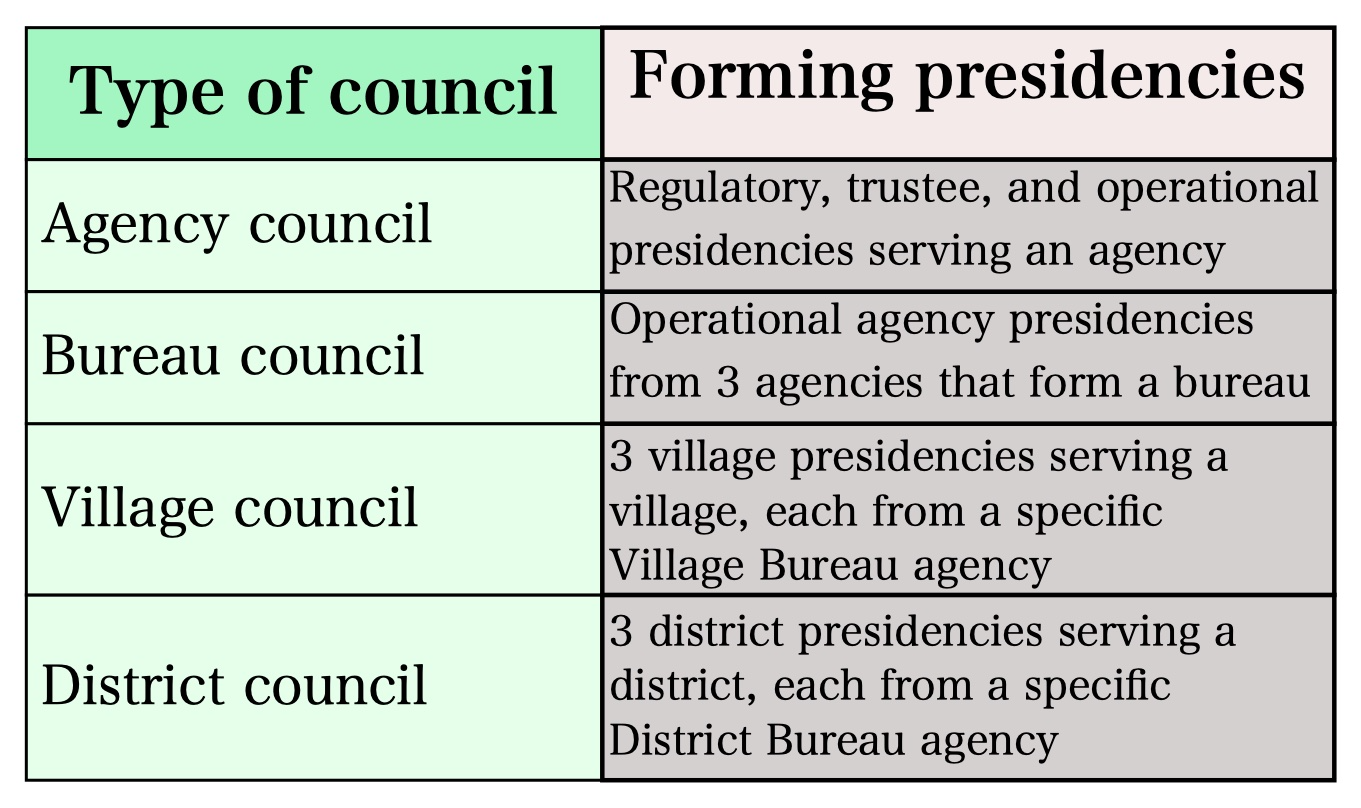
The three agency presidencies that serve each of the 24 agencies form an agency council, which serves as an important tool of checking individual performance and a platform for collaborative service. Village and district presidencies also form village and district councils respectively. In addition, operational agency presidencies serving three agencies in the same bureau form a bureau council, responsible for fostering inter-agency cooperation and forming consensus on issues of community-wide significance.
In a NewVistas community of up to 100,000 people, the organizational structure comprises 5,760 individuals, or about 6% of the community’s total population. Serving in precisely defined and voluntary roles, these presidents work together in 1,440 four-person presidencies.
At a community-wide level, 480 of these presidencies (1,920 individuals) formally meet each quarter for quarterly conferences, during which operational agency presidencies present their agencies’ progress over the last quarter.
The other 960 presidencies, which serve the community at the branch level (and are called branch presidency as a unit of four, and captains as individual presidents) are not part of the 480 presidencies.
In summary, councils are organized as follows:
With the exception of the 12 trustee agency presidencies and 960 branch presidencies, all other community presidencies function within two departments: the Human and Financial Capital Department and the Process and Property Department. Each department contains four bureaus and 12 agencies. A community’s 24 agencies also function within three verticals, each with eight agencies.
In a NewVistas community, public servants have term and tenure limits, so no long-term public careers are possible. The focus stays on each defined position rather than on the individual serving in that position, so every community participant always knows exactly which position to consult for a particular need, even when the individual serving in that position has changed.
Worldwide NewVistas
NewVistas is a worldwide pattern and system for up to 12 billion people1 living in as many as 120,000 communities grouped into 2,400 NewVista councils of 50.
The graphic below shows the organization of the world with all people, or most of them being participants in the NewVistas system.
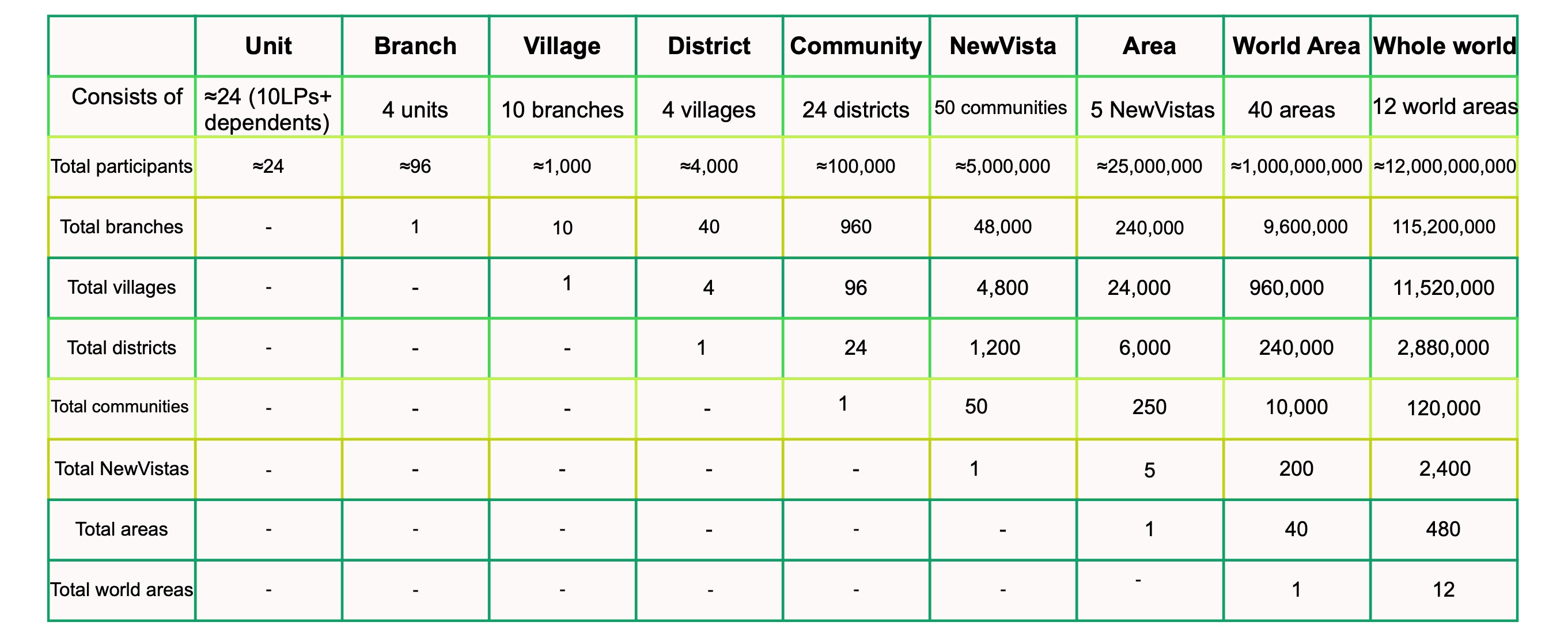
At the worldwide NewVistas level, 12 area presidencies (48 individuals) form four demographic boards and can appoint up to 490 assistant area presidencies (1,960 individuals). The assistant area presidents visit communities remotely two by two (single male, single female, partnered male, partnered female) to appoint community trustee presidencies and help maintain overall system integrity.
- The United Nations predicts that the world population will reach 11.2 billion in 2100 and stabilize soon thereafter. See World Population Prospects.[↩]