
Community Trustee Council
Each NewVistas community of around 100,000 individuals is a perpetual trust with no individual owners and with all community participants as the trust’s beneficiaries.
Through a community banking system, the community holds the combined capital and property for the benefit of all 75,000–100,000 participants. Various community agencies offer a variety of services to enable participants succeed in community life and in business.
The Trustee council consists of 12 trustee agency presidencies. Since each presidency coonsists of four presidents – representing partnered males (A), partnered females (B), single males (C), and singel females (D) – the full trustee council has 48 members.
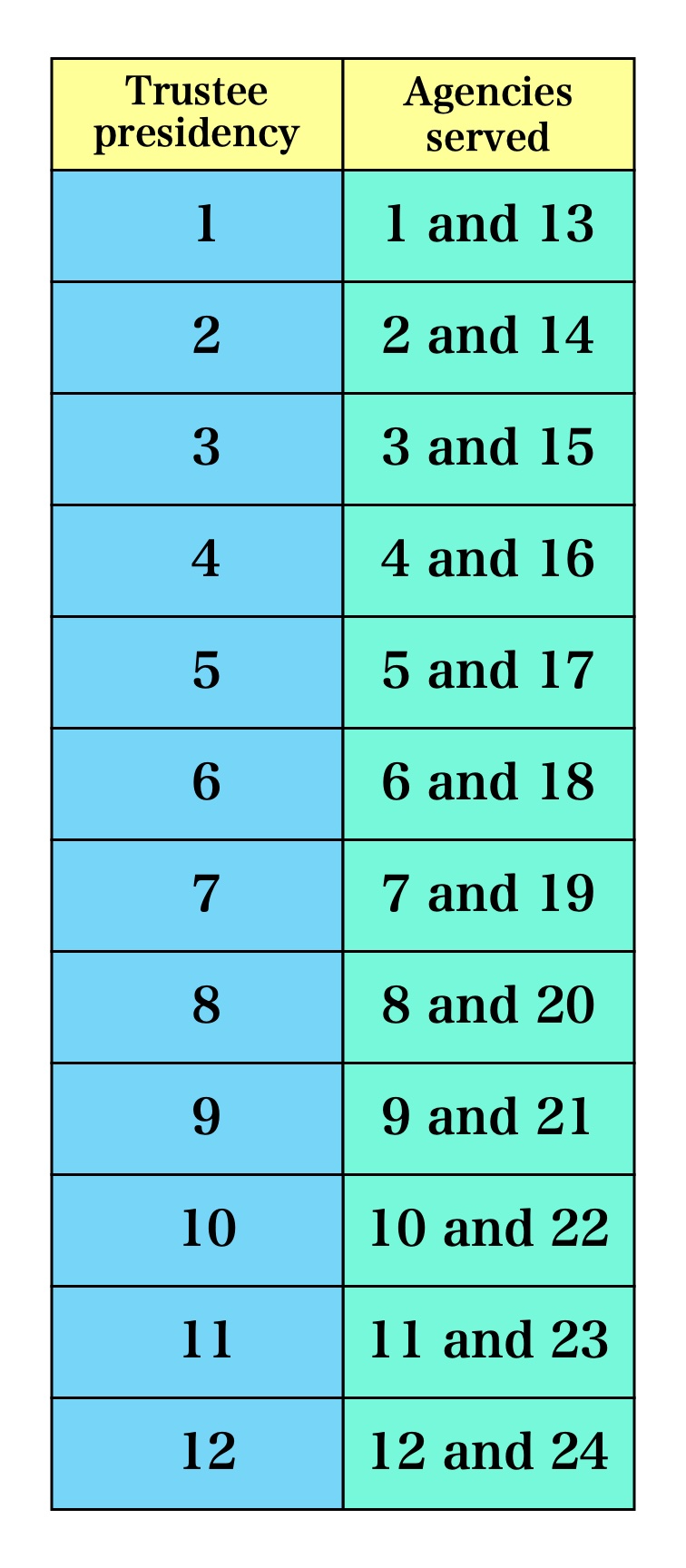
Each trustee presidency serves two agencies, one in the Human and Financial Capital Department (agencies 1 – 12), and another in the Process and Property Department (agencies 13 – 24). If a presidency serves agency 1, they also serve agency 13, etc, as shown in the table below.
Trustees in agency councils
Trustee agency presidencies are legally responsible for the agencies they serve. They have the capacity to contractually commit their agency, and originate strategies and budgets. Before any of the things they propose or originate is implemented, it goes through an agency council, which they form, alongside operational and regulatory agency presidencies. The agency council approves or rejects trustees’ proposals, after which the operational agency presidency implements what is approved, while the regulatory agency presidency checks for compliance with various guidelines and the law.
Trustees’ sub-councils
The 24 agencies in a community are organized into eight bureaus of three agencies each. The three trustee agency presidencies which serve agencies from the same bureau form a trustee bureau council, or a trustee subcouncil. Since each trustee presidency serves two agencies, they belong, from an operational standpoint, to two subcouncils. But since it is the same presidencies, there are 4 sub-councils of 3 presidencies each.
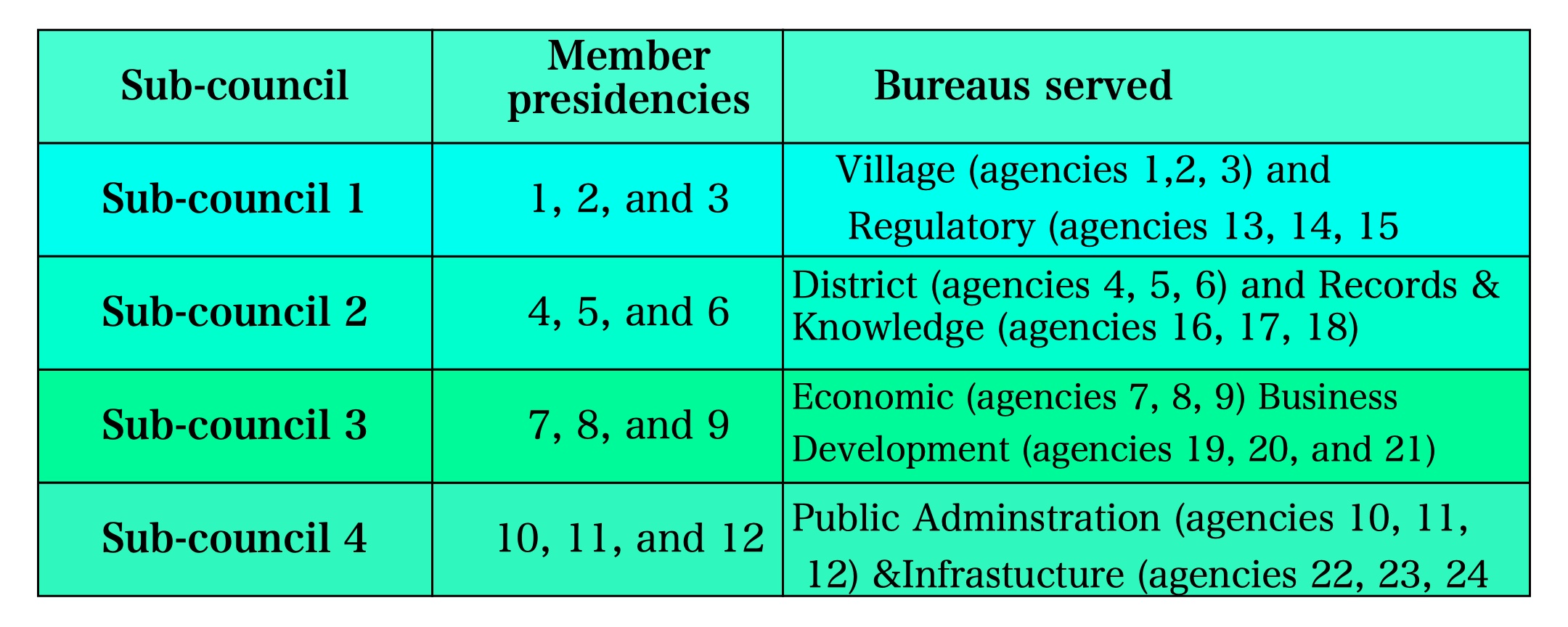
Trustee presidencies are independent of the organizational structure’s two departments, while all other public-servant positions are categorized into the Human & Financial Capital Department or the Process & Property Department.
Selection and service
Trustee agency presidencies are initially selected by the respective area presidency, which is responsible for establishing communities. After this, trustee presidencies are self-replacing, removing the need for them to be selected again by area presidencies when their four-year term ends.
Once the trustee council is established, its next role is selecting and training operational agency presidencies for the first time. Operational agency presidencies, and where applicable, bureau councils, select other presidencies who will serve in their agency or bureau.
A majority of trustees’ focus is trained on agencies and bureaus. However, they also have an overall role as the body which has the ultimate responsibility for advancing participants’ and the community’s interests. Their decisions, proposals, and other actions heavily influence the community’s fortunes, even with the presence of numerous checks and balances to their operations.
Trustees execute the provisions and guidelines of the community as a perpetual trust. The council of trustees is a policy body that must not stray from the provisions of the trust instrument. The council can offer interpretations of trust language and general direction, but it is not an administrative body.

The duties of a community’s council of trustees include the following:
- Select the first batch of as the community’s 24 agency president positions (96 individuals) using the prescribed procedure
- Serve in agencies as presidencies and agency council members
- Originate agency strategies and budgets
- Spearhead overall community strategic planning in within the trustee council
Trustees serve for 4 years. Every year, one president in a presidency is replaced. Across the 48 – member council, therefore, 12 presidents are replaced. An important part of the trustee councils’ job is to ensure incoming presidents settle down quickly through effective training and mentorship.
Alongside operational and regulatory agency presidents, trustees do not actively operate businesses, having sold their stakes to focus solely on serving the community. They do so on a full-time basis, serving for four hours for four days a week, with additional hours for regular meetings.
For more details about a community’s council of trustees, see this article.