
Agency 17 Publishing
Practice Guides, Constitutional Knowledge, and Course Publication
Agency 17 creates a constitutional knowledge common for NewVistas: a system where education, publication, digital libraries, Practice Guide certification, conference records, AI-assisted search, and capability verification become trustworthy, accessible, and future-ready without creating a centralized school monopoly, information ministry, curriculum bureaucracy, or surveillance system.
This work develops Agency 17 as the NewVistas governance rail for publishable knowledge, practice-based education, digital-library admissibility, archival continuity, quarterly conference publication, and non-surveillance capability verification. Its purpose is not to give Agency 17 control over information, education, law, media, or student records. Instead, it governs the standards by which knowledge becomes publishable, searchable, teachable, certifiable, accessible, translatable, archivable, and admissible within the wider NewVistas constitutional system.
The framework replaces the industrial school model with a distributed learning architecture. Education no longer depends on centralized school buildings, permanent curriculum bureaucracies, homework, GPA, class ranking, or public academic hierarchy. Instead, learning is divided between Agency 5 Learning Mentors, who support foundational human formation, and Agency 17 Practice Guides, who transfer capability inside stewarded enterprises such as utilities, food systems, fabrication, media, AI systems, publishing, gardens, transportation, accounting, health support, hospitality, music, and engineering.
Agency 17 also governs the publication integrity of the community digital library and quarterly conference records. It ensures that knowledge is versioned, searchable, accessible, translated, AI-indexed, and preserved over time. But it does not independently determine truth or legal validity. Validity must come from the proper constitutional rails; Agency 17 only publishes what has already passed the appropriate process. The paper’s central contribution is to show how a community can make knowledge durable, education practical, AI useful, and records trustworthy without turning knowledge into monopoly, schooling into bureaucracy, or evaluation into surveillance.
Table 1. Agency 17
| Dimension | Agency 17 Governs | Agency 17 Does Not Do |
| Knowledge | Publication standards, admissibility, metadata, archives, version continuity | Does not independently determine truth or legal validity |
| Education | Practice Guide certification and course-publication standards | Does not operate schools or employ teachers |
| Digital Library | Digital-library standards, indexing rules, accessibility, translation, archival integrity | Does not run a centralized government library |
| AI | AI disclosure, indexing, translation, summarization, search, accessibility standards | Does not give AI legal-validity authority |
| Conferences | Conference-publication protocols, recording standards, archival continuity | Does not operate conferences directly |
| Student Records | Record format and admissibility standards | Does not own student records or create public rankings |
| Evaluation | Supervised capability verification standards | Does not use homework, GPA, class rank, honor rolls, or public academic hierarchy |
| Execution | Certified stewards who execute publishing, teaching, archiving, indexing, and conference functions | Does not become an operating bureaucracy |
Figure 1. Agency 17 Constitutional Architecture
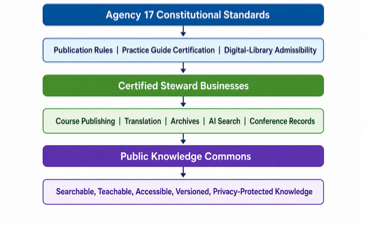
Agency 17 is built around six major claims. First, NewVistas education is a bipartite course-governance system, not an industrial school system. Agency 5 governs Learning Mentors who support literacy, numeracy, cognition, ethics, emotional development, life planning, communication, and foundational capability. Agency 17 governs Practice Guides who teach inside real stewarded environments. Second, the exact-half rule prevents educational capture. One-half of verified course-blocks must come through Agency 5 Learning Mentors, and one-half through Agency 17 Practice Guides. This prevents abstract academic formation from becoming detached from real life, and prevents practical training from becoming narrow, vocational, or underdeveloped.
Third, Practice Guide courses must be published exactly one quarter in advance. This creates transparent course-market coordination. Students, guardians, adults, Learning Mentors, Practice Guides, and scheduling stewards can compare courses before the quarter begins. Fourth, NewVistas turns the walkable community into a campus. Learning happens in gardens, shops, kitchens, media studios, fabrication spaces, utility systems, clinics, music spaces, conference rooms, digital environments, and real enterprises. Walkability reduces transport cost, schedule friction, supervision burden, and dependence on centralized school compounds. Fifth, Agency 17 preserves constitutional memory through a versioned digital-library system. The digital library includes bylaws after valid adoption, course catalogs, conference proceedings, certification registers, standards, technical manuals, educational materials, translations, media archives, AI-readable datasets, public metrics, and approved external works. Agency 17 preserves publication integrity, but it does not create legal validity. Sixth, Agency 17 replaces industrial academic sorting with supervised capability verification. Homework, GPA, ranking, honor rolls, public percentiles, and valedictorian systems are removed. Students demonstrate real capability under supervised conditions, and evidence is stored in participant-owned educational records.
Table 2. Methodology
| Methodological Layer | What It Models | Why It Matters |
| Bipartite Education Graph | Education is divided between Agency 5 Learning Mentors and Agency 17 Practice Guides | Prevents centralized school monopoly and balances formation with practice |
| Exact-Half Course Constraint | Agency 5 and Agency 17 each supply one-half of verified course-blocks | Prevents educational capture by either academic bureaucracy or narrow vocationalism |
| Course-Publication Tuple | Every Practice Guide course must disclose guide identity, certification, location, schedule, duration, prerequisites, cost, safety, tools, AI use, outcomes, accessibility, and record method | Makes course selection transparent and comparable |
| Publication DAG | The digital library is a versioned, integrity-preserving knowledge graph | Preserves constitutional memory without making Agency 17 a truth monopoly |
| AI Containment | AI may assist indexing, translation, accessibility, summaries, and search | Ensures AI does not validate law or replace human certification |
| Supervised Capability Verification | Capability is demonstrated to live under supervised practice conditions | Replaces homework, GPA, rank, and public academic hierarchy |
| Student-Owned Records | Capability evidence belongs to the participant and is stored in a personal educational vault | Prevents educational surveillance and public dossiers |
| Conference Publication | Quarterly conference records become searchable constitutional memory | Preserves public knowledge while protecting private records |
Figure 2: Education without industrial Schooling
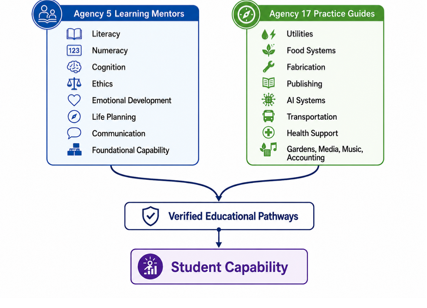
Table 3. Agency 5 and Agency 17 Educational Division
| Agency 5 Learning Mentors | Agency 17 Practice Guides |
| Foundational formation | Practical stewardship transfer |
| Literacy and numeracy | Enterprise-based capability |
| Emotional maturity | Real-world practice |
| Ethics and life planning | Productive environments |
| Conceptual reasoning | Tools, workflows, systems, and operational judgment |
| Human development | Stewardship capability |
| One-half of course-blocks | One-half of course-blocks |
This dual structure ensures that NewVistas education is neither purely academic nor narrowly vocational. It is both human formation and practical capability.
Course Publication as Educational Market Coordination
Every Agency 17 Practice Guide course must be published one quarter before delivery. A course publication must include the Practice Guide’s identity, certification status, location, schedule, duration, prerequisites, participation limit, direct cost, safety requirements, required tools or materials, AI systems used, expected outcomes, accessibility provisions, and student-owned record or evaluation method. This publication requirement replaces bureaucratic course assignment with transparent coordination. Families, students, adults, mentors, guides, and scheduling stewards can compare course offerings in advance. Weak courses lose demand. Strong courses attract participation. New courses can emerge as technology, industry, and community need change. Agency 17 does not dictate identical curricula or assign students. It governs the publication schema and admissibility rules that make courses comparable, safe, transparent, and accountable.
Table 4. Required Practice Guide Course Publication Fields
| Field | Meaning |
| Practice Guide Identity | Who is offering the course |
| Certification Status | Whether the guide is certified under Agency 17 standards |
| Location | Where the course occurs |
| Schedule | When the course occurs |
| Duration | How long it runs |
| Prerequisites | What must be known or completed first |
| Class Size / Participation Limit | How many participants can join |
| Direct Course Cost | What the course costs directly |
| Safety Requirements | What safety rules or preparation apply |
| Tools / Materials | What equipment or materials are required |
| AI Systems Used | What AI tools are involved |
| Expected Outcomes | What the learner should be able to do |
| Accessibility Provisions | How access needs are supported |
| Student-Owned Record Method | How capability evidence is recorded and controlled |
Walkability and the Community as Campus
A major result of the paper is that walkability transforms education. In industrial schooling, students must be transported to centralized school compounds. That creates distance burden, transport cost, schedule friction, parking needs, supervision demands, and dependence on institutional facilities. In NewVistas, learning nodes are distributed throughout the community. A child may attend a Learning Mentor session, a greenhouse practice course, a music lesson, a fabrication demonstration, a kitchen sanitation sequence, a media production workshop, and a conference-publication activity within the same walkable system. This lowers transaction costs and increases exposure to real productive environments. The gain is not merely cultural. It is economic and institutional. Education becomes easier to access, more practical, more integrated with daily life, and less dependent on expensive centralized school infrastructure.
Digital Library and Constitutional Memory
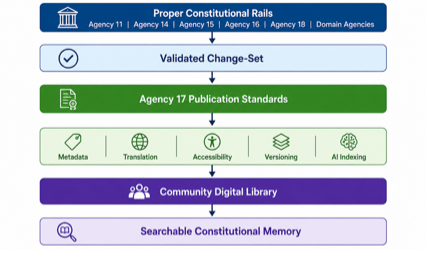
Agency 17 governs the community digital library as a versioned publication system. The library is not a centralized government information office. It is a governed public knowledge common composed of certified stewards who publish, index, translate, preserve, search, summarize, and maintain interoperable records. The digital library includes valid bylaws, course catalogs, conference proceedings, certification registers, standards publications, technical manuals, educational materials, translations, media archives, AI-readable datasets, public metrics, historical records, and approved external works.
The key principle is that publication integrity is not the same as legal validity. Agency 17 may publish what has passed the proper constitutional rails, but it cannot make an invalid rule valid merely by publishing it. A legal template may require Agency 14. A systems version may require Agency 11. Accounting representation may require Agency 16. Metrics may require Agency 18. Audit integrity may require Agency 15. Domain standards may require the proper domain agency. Agency 17 makes valid knowledge visible, durable, searchable, teachable, accessible, and archivable. It does not create truth by itself.
Figure 3. Publication Integrity Without Truth Monopoly
AI as Tool, Not Authority
AI is essential to Agency 17’s scalability. It can assist transcription, translation, indexing, archive search, accessibility conversion, course outline drafting, summary generation, version comparison, contradiction detection, citation management, personalized learning support, and semantic search. But AI has zero legal-validity weight. An AI-generated explanation of a bylaw is not the bylaw. An AI translation is not the legal source unless properly certified. An AI summary of a conference is not the constitutional record unless reviewed and admitted through the correct publication standards.
AI belongs in the indexing layer, not the validation layer. It may improve access, comprehension, searchability, translation, and learning support. It may not validate law, create binding standards, grant exceptions, or replace accountable human certification. This allows NewVistas to use AI aggressively without surrendering governance to AI.
Table 5. Permitted and Prohibited AI Roles
| AI May Assist With | AI May Not Do |
| Translation | Validate law |
| Search | Create constitutional authority |
| Summarization | Replace human certification |
| Metadata generation | Grant exceptions |
| Accessibility conversion | Determine legal status |
| Version comparison | Become the official record by itself |
| Contradiction detection | Control education |
| Personalized learning support | Own student records |
| Citation support | Create binding standards |
Capability Verification in an AI-Saturated World
The paper gives special attention to why industrial homework no longer works. In the older model, homework served as a signal of student capability. Higher-capability students could complete assignments at lower effort cost, while lower-capability students faced higher effort cost. Teachers could infer capability from the submitted artifact. Generative AI breaks this model. As AI becomes more capable, both high- and low-capability students can produce polished homework at nearly the same low cost. The artifact no longer reliably reveals student understanding. It may reveal access to tools, prompt skill, concealment strategy, parental support, or optimization behavior rather than real mastery.
This collapses the homework signal. The system moves from a separating equilibrium, where homework distinguished capability types, to a pooling equilibrium, where different capability types can submit similar AI-generated work. NewVistas therefore removes homework as an evidence mechanism. This is not anti-learning. It is an evidence-quality rule. Learning still happens, but unsupervised artifacts are no longer treated as reliable proof of mastery. Agency 17 replaces homework with live, supervised capability verification. A learner demonstrates capability in a real or controlled practice environment. The Practice Guide observes process, not merely final output. AI may be used transparently, but the learner’s reasoning, safety, communication, collaboration, sequencing, judgment, and operational execution remain observable.
Figure 4. From Homework Signal to Capability Verification
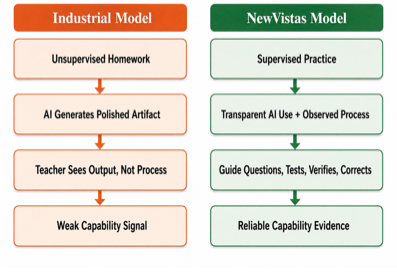
Table 6. Industrial Evaluation vs NewVistas Capability Verification
| Industrial Schooling | NewVistas Agency 17 Model |
| Homework as evidence | Supervised practice as evidence |
| GPA | Capability milestone |
| Class rank | Participant-owned record |
| Honor roll | Demonstrated competence |
| Public percentile | Private capability evidence |
| Valedictorian status | No public hierarchy |
| Unsupervised artifact | Observed process |
| AI as cheating risk | AI as transparent tool |
| Teacher infers from output | Practice Guide verifies live performance |
| Student identity shaped by ranking | Student record controlled by participant |
Student-Owned Records and Non-Surveillance Education
Agency 17 does not create public student dossiers. Capability evidence belongs to the participant. Records are stored in student-owned educational vaults and may include certifications, mastery comments, portfolios, mentor feedback, guide feedback, projects, and supervised demonstrations.
The student controls disclosure. A mentor, guide, certification reviewer, life-plan support process, or stewardship opportunity may receive relevant information only for an authorized purpose and with participant-controlled access. This preserves accountability without surveillance. Capability becomes real but not publicly ranked. Learning becomes verifiable but not institutionalized into permanent public hierarchy.
Quarterly Conferences as Public Constitutional Memory
Agency 17 also governs publication and archival integrity for quarterly conference proceedings within its jurisdiction. The four demographic courts contain 1,920 constitutional seats: four courts with 480 seats each. Agency 5 governs the partnered-male and partnered-female courts. Agency 17 governs the single-male and single-female courts. Conference publication is not entertainment or spectacle. It is constitutional memory. Agencies report, standards are updated, bylaws are communicated, steward results are disclosed in admissible form, educational offerings are announced, and archives are updated.
Certified stewards may execute recording, transcription, translation, accessibility conversion, semantic tagging, AI summarization, streaming, indexing, and digital preservation. Agency 17 governs publication order and archival integrity. The goal is broad public dissemination of constitutional knowledge while protecting individual privacy. Conference publication must not expose personal health, education, financial, legal, life-plan, business-plan, service, or personal-history records.
Certification, Competition, and Quality Without Monopoly
Agency 17 certifies stewards who execute publication, education, archive, digital-library, translation, metadata, AI-search, conference, and media-preservation functions. These may include publishers, editors, translators, archivists, librarians, course publishers, Practice Guides, conference operators, AI educational operators, transcription providers, accessibility specialists, metadata specialists, indexing specialists, semantic search providers, streaming providers, bookstore operators, and digital repository operators.
Certification creates admissibility, not monopoly. A certified steward is allowed to participate, but must still attract users through quality, reputation, cost, accessibility, and outcomes. Better quality, stronger reputation, better accessibility, and better outcomes increase demand. Higher cost, all else equal, reduces demand. This preserves the governance-operation split. Agency 17 governs standards. Certified stewards compete. The agency does not become a school system, publishing monopoly, digital-library operator, or information ministry.
Table 7. Key Theoretical Results
| Result | Main Claim | Institutional Meaning |
| Result 1 | The bipartite education graph decentralizes education | Learning can be distributed across Learning Mentor and Practice Guide nodes instead of centralized school monopolies |
| Result 2 | The exact-half rule prevents educational capture | Formation and practice remain structurally balanced |
| Result 3 | One-quarter course publication enables course-market coordination | Education adapts through transparent published offerings rather than centralized curriculum planning |
| Result 4 | Walkability reduces educational transaction costs | The community becomes the campus, reducing transport and scheduling burdens |
| Result 5 | The publication DAG preserves constitutional memory | Agency 17 preserves records without becoming a truth monopoly |
| Result 6 | AI is an informational substrate, not a constitutional officer | AI supports search, translation, indexing, and accessibility but has no legal-validity power |
| Result 7 | AI collapses the homework signal | Unsupervised homework no longer reliably reveals human capability |
| Result 8 | Live supervised verification restores incentive compatibility | Students are rewarded for demonstrated capability, not AI-generated artifacts |
| Result 9 | Capability vectors dominate ordinal ranking | Student progress is represented by demonstrated capabilities, not GPA or rank |
| Result 10 | Agency 17 verifies capability without surveillance | Records are participant-owned and not converted into public dossiers |
| Integrated Result | Agency 17 creates constitutional knowledge commons | Knowledge becomes publishable, teachable, searchable, durable, AI-assisted, privacy-protected, and steward-executed |
The education system is modeled as a bipartite graph connecting Agency 5 Learning Mentor nodes and Agency 17 Practice Guide nodes. The exact half condition ensures both sides supply equal shares of verified course blocks. The course-publication tuple ensures every Practice Guide course is transparent before selection. The publication DAG ensures the digital library preserves versioned constitutional memory. The AI-containment condition ensures AI improves access but never creates legal validity. The homework signaling model shows why AI destroys the reliability of unsupervised homework. The live-verification model replaces homework with supervised capability demonstration. The capability-vector model replaces GPA and rank with absolute demonstrated skills. The student-vault model preserves privacy and prevents educational surveillance.
This is important because AI is making the old education system unstable. Homework can be generated. Grades can be gamed. Ranking produces stress and positional competition. Centralized curricula move slowly. Digital libraries can become chaotic or monopolized. AI can either improve access to knowledge or quietly become an authority structure. Public records can either preserve constitutional memory or turn into surveillance.
Agency 17 offers a different path. It builds a system where knowledge is public but personal records are private; AI is powerful but contained; education is practical but not narrow; certification creates reliability but not monopoly; conferences preserve public memory without exposing private life; and capability is verified through supervised practice rather than public ranking. The result is a lifelong learning and publication system designed for an AI-enabled, walkable, steward-led civilization. Agency 17 shows path through which NewVistas can replace industrial schooling and centralized information control with a constitutional knowledge common: a distributed, AI-assisted, practice-based, privacy-protecting system where learning is lived, capability is demonstrated, and public knowledge remains durable across generations.