
Agency 23: Utilities
Building-Centric Utility Civilization in New Vistas
Agency 23 transforms utilities from centralized municipal infrastructure into a decentralized, building-centric, AI-managed, thermodynamically integrated utility civilization. It governs the standards by which every New Vistas apartment building and mirrored industrial building functions as a semi-autonomous utility organism producing electricity, recoverable heat, cooling, water recovery, air cleaning, waste conversion, CO₂ routing, recyclable-material compaction, server support, and process-gas potential—without Agency 23 owning assets, operating utilities, financing equipment, holding custody, accumulating reserves, collecting utility profits, or absorbing losses.
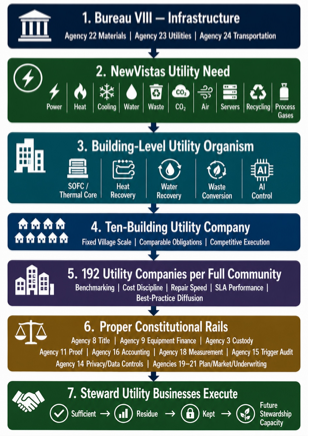
Bureau VIII supplies the upstream prerequisites of stewardship: materials, utilities, and movement capacity. Within that bureau, Agency 23 governs continuous utility service-provision standards, not utility inventory, downstream allocation, fuel ownership, asset custody, or operational control. Utility stewards administer through productive utility work. Agency 23 governs standards. Excess profit above sufficient becomes residue and is always kept as future stewardship capacity. Utility systems must therefore be self-financing, contract-priced, internally credit-compatible, no-reserve, and steward-executed rather than subsidy-based, reserve-based, agency-operated, or public-works bureaucratic.
Overview
This paper develops Agency 23, Utilities, as the constitutional standards governor of New Vistas’ decentralized utility architecture. Conventional utilities are usually organized around centralized grids, municipal monopolies, city-scale water and sewer systems, centralized backup systems, and politically managed infrastructure. New Vistas reverses that model. Utility production is embedded directly into the building. It contains 960 apartment buildings and 960 mirrored commercial or industrial buildings, for a total of 1,920 utility-enabled buildings. Each building is designed as a semi-autonomous utility organism. Utility companies are not city-scale monopolies. Each utility company serves exactly 10 buildings, creating 192 comparable utility companies across a full community. This fixed village-scale structure prevents monopoly concentration, avoids unstable fragmentation, and makes performance directly comparable across utility providers.
Agency 23 governs utility standards, service-level rules, redundancy requirements, lifecycle fee formulas, safety protocols, interface specifications, telemetry requirements, air-quality obligations, water-recovery standards, carbon-routing standards, proof rules, and continuous service-provision expectations. It does not execute operations. Utility steward businesses, certified contractors, and subcontractor networks execute the work through leases, service agreements, workflow proof, accounting truth, internal operating credit where needed, and trigger-bound audit when required. The works central claim is that New Vistas utilities are not separate service silos. They are a unified thermodynamic envelope. Fuel input produces electricity, recoverable heat, cooling, water recovery, CO₂ streams, pyrolysis outputs, air-filtration support, recyclable-material flows, server heat reuse, and process-gas streams where available. Waste becomes input. Heat drives cooling and water processing. CO₂ supports agriculture and industry. Carbon waste becomes carbon black, biochar, syngas, carbon-fiber or microfiber precursor streams. Glass, aluminum, and steel are compacted for reuse. Server heat becomes part of the cascade. Agency 23 is therefore not a conventional utility regulator, municipal utility, energy company, utility department, fuel authority, or infrastructure owner. It is the standards governor of a source-agnostic, AI-managed, building-centric, contract-priced, no-reserve, steward-executed utility civilization.
Table 1. Agency 23
| Dimension | Agency 23 Governs | Agency 23 Does Not Do |
| Constitutional Role | Utility standards, SLA rules, redundancy, interfaces, safety, lifecycle fee formulas, continuous service standards | Does not own, operate, finance, or hold utility assets |
| Utility Scale | Fixed 10-building utility-company domains | Does not allow community-wide utility monopoly |
| Community Topology | 960 apartment buildings, 960 mirrored industrial/commercial buildings | Does not centralize utility production outside the building |
| Number of Utility Firms | 192 comparable utility companies per full community | Does not create one public utility bureaucracy |
| Technology Architecture | Building-level utility organisms, SOFC bridge systems, thermal cascades, source-agnostic envelope | Does not depend permanently on one fuel, one company, one vendor, or one technology timeline |
| Reliability | Duplicated rooftop utility systems, SLA targets, k-of-n reliability, repair standards | Does not rely on vague promises of service reliability |
| Thermodynamics | Electricity, heat, cooling, water, CO₂, waste conversion, air filtration, recycling, server heat reuse, process gases | Does not treat utility services as isolated silos |
| AI and Proof | Telemetry, predictive maintenance, logs, alerts, repair records, SLA proof, anomaly detection | Does not create general surveillance or unrestricted data access |
| Finance and Lifecycle | Contract-priced fees, lifecycle obligations, credit-line-compatible cost recovery | Does not create reserves, idle liquidity, or steward-held renewal funds |
| LAW/PLAT | Utility stewards become sufficient, generate residue, and keep residue as future capacity | Does not consume residue, distribute profits, or hold steward reserve funds |
| Internal Credit | Viable utility stewards may receive internal operating credit through proper due process | No utility steward borrows directly from an external banker |
| Execution | Steward utility businesses, certified contractors, subcontractor networks | Agency 23 does not employ utility labor or operate service delivery |
| Council-of-50 Role | Benchmarking, learning, procurement coordination, fuel coordination, spare-part standardization, best-practice diffusion | Does not become owner or operator of utilities |
Figure 1. Agency 23 Constitutional Utility Architecture
Why This Agency Matters
Utilities are normally treated as background infrastructure. In New Vistas, they are part of the core civilizational design. Dense, walkable, high-productivity communities cannot function with fragile electricity, centralized sewer dependency, weak water recovery, unmanaged heat, poor air filtration, unreliable cooling, isolated server infrastructure, or waste systems that merely export burdens elsewhere. Agency 23 matters because it makes utilities local, measurable, competitive, redundant, thermodynamically useful, and constitutionally bounded. Every building becomes a utility organism. Every utility company operates on a comparable 10-building scale. Every utility service must cover real costs through contract-priced fees. Every proof record remains domain-bound. Every profit above sufficient becomes residue and is kept. Every function remains separated across proper New Vistas rails.
Agency 23 is not a utility ministry, public utility authority, energy operator, municipal infrastructure office, reserve holder, or asset owner. It is a standards agency inside a larger documentary constitutional system where agencies govern bounded domains and stewards administer productive work. The result is a utility system designed for density without fragility: local power, local heat recovery, local cooling, local water reuse, local waste conversion, local air cleaning, local compute support, local carbon routing, and local material recovery coordinated across the whole community without creating a utility monopoly.
Table 2. New Vistas Utility Topology
| Element | Quantity / Structure | |
| Apartment buildings | 960 | Residential building-level utility organisms |
| Mirrored commercial / industrial buildings | 960 | Paired productive utility organisms in the industrial zone |
| Total utility-enabled buildings | 1,920 | Full community utility base |
| Buildings per utility company | 10 | Fixed village-scale utility domain |
| Residential utility companies | 96 | 960 apartment buildings ÷ 10 |
| Industrial / commercial utility companies | 96 | 960 mirrored buildings ÷ 10 |
| Total utility companies | 192 | Comparable utility firms under Agency 23 standards |
| Council-of-50 utility firms | Up to 9,600 | 192 firms × 50 communities for benchmarking and learning |
Building-Level Utility Sovereignty
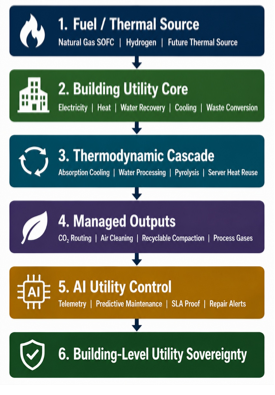
The first major theoretical claim is that every New Vistas building is a utility node. It is not merely a passive consumer connected to a remote utility grid. Each apartment building and mirrored industrial building contains a complete utility system capable of supporting electricity generation, heat recovery, cooling, water recovery, waste conversion, CO₂ routing, air cleaning, recyclable compaction, server-farm support, process-gas potential, and AI-managed operational control. This is a shift from utility dependence to utility sovereignty. A building is no longer simply a load. It becomes a semi-autonomous micro-utility plant. The building is both a utility consumer and a utility organism.
Figure 2. Building as Utility Organism
Architectural Reliability Through Duplicated SOFC Systems
Reliability in Agency 23 is not merely a service promise. It is physically embedded in the building. Each utility-enabled building contains two duplicate high-temperature solid oxide fuel-cell systems. If full building demand is represented by D, each unit is sized at approximately 1.25D. Total installed capacity is therefore 2.5D. Under normal operation, each unit supplies about 0.5D, meaning each unit operates at roughly 40% of its rated capacity. If one unit fails, the remaining unit can still supply the full building demand D, while retaining a 0.25D reserve margin. This means New Vistas utility reliability begins with architecture. The SLA follows the physical redundancy. It does not substitute for it.
Table 3. SOFC Redundancy Logic
| Reliability Element | New Vistas Design |
| Full building demand | D |
| Number of SOFC units | 2 |
| Capacity of each unit | 1.25D |
| Total installed capacity | 2.5D |
| Normal output per unit | 0.5D |
| Normal load rate per unit | About 40% of rated capacity |
| Failure case | One unit fails |
| Remaining unit capacity | 1.25D |
| Load carried by remaining unit | D |
| Reserve margin after failure | 0.25D |
| Reliability meaning | SLA is supported by physical duplicate capacity |
Thermodynamic Cascade: Utilities as One Exergy System
Agency 23 does not govern utility silos. It governs a unified thermodynamic envelope. Electricity, heat, cooling, water, waste, CO₂, air filtration, server cooling, process gases, and recyclable compaction are connected flows. The fuel-cell or thermal-source system produces electricity and recoverable heat. Heat then supports absorption cooling, water treatment, waste pyrolysis, building heating, industrial processes, server-farm cooling, and other productive uses. Water is created through fuel-cell operation, supplemented by rain capture, recycled, filtered, and reprocessed. CO₂ is routed to greenhouses, vertical farms, algae systems, chemical processing, polymer pathways, carbonates, mineralization, synthetic fuels, or other productive uses. Carbon-rich waste can become carbon black, biochar, syngas, carbon-fiber precursor streams, and other industrial inputs. Glass, aluminum, and steel are compacted into standardized recyclable blocks. The central principle is that waste is input.
Figure 3. Thermodynamic Utility Cascade
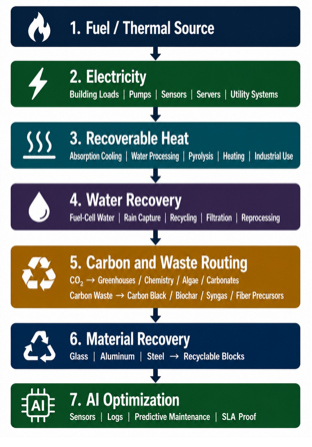
Table 4. Utility Streams and Productive Uses
| Utility Stream | Productive Use |
| Electricity | Building loads, commercial/industrial functions, pumps, sensors, servers, communications |
| Recoverable heat | Absorption cooling, water processing, waste pyrolysis, building heating, industrial processes |
| Cooling | Space cooling, server cooling, AI-center cooling, thermal comfort |
| Water | Fuel-cell water, rain capture, recycling, filtration, reprocessing, safe delivery |
| CO₂ | Greenhouses, vertical farms, algae systems, chemistry, polymers, carbonates, mineralization, synthetic fuels |
| Carbon-rich waste | Carbon black, biochar, syngas, carbon-fiber or microfiber precursor streams |
| Air cleaning | Odor, VOC, particulate, smoke, chemical, and contaminant filtration |
| Recyclable materials | Glass, aluminum, and steel compaction into standardized blocks or bricks |
| Server heat | Reused in the thermal cascade instead of being wasted |
| Process gases | Hydrogen, oxygen, or other useful streams where technology permits |
Waste as Industrial Feedstock
A major contribution of the work is the reframing of waste. Human, biological, municipal, and carbon-rich waste streams are not treated as mere disposal burdens. They become managed industrial inputs. Through pyrolysis, carbonization, gasification, and related thermal systems, waste can become carbon black, biochar, syngas, carbon-rich intermediate products, carbon microfiber precursors, filtration materials, polymer additives, conductive materials, and carbon-reinforced cement-tile inputs. This links Agency 23 directly to Agency 22 because utility waste conversion produces material streams that support long-term material continuity. Agency 23 governs utility conversion standards, air cleaning, water treatment, carbon routing, and waste-processing obligations. Agency 22 governs downstream material standards, recycled-content pathways, raw-stock quality, and material continuity. Agency 23 governs continuous utility service-provision standards; Agency 22 governs material continuity and first-stage material standardization; Agency 24 governs movement capacity and routing. No agency collapses the others into itself.
AI-Managed Utilities and Cybernetic Infrastructure
Agency 23 utilities are cybernetic thermodynamic systems. Each building contains server systems, AI inference capacity, telemetry, sensors, control software, robotics interfaces, predictive-maintenance tools, and operational dashboards. These systems are part of the utility organism, not external add-ons. AI agents monitor fuel-cell performance, heat flows, water quality, air quality, filter condition, pump performance, pressure, vibration, server heat, cooling demand, waste conversion, CO₂ routing, recyclable compaction, repair needs, and SLA anomalies. Server systems consume electricity and require cooling, but they also help optimize the utility system that powers and cools them. This allows small village-scale utility companies to perform tasks that historically required large, centralized utility organizations. Standardized modules, repeated building designs, AI telemetry, predictive maintenance, and contractor specialization reduce the coordination advantage of centralization. AI supports utility proof and optimization, but it does not become a constitutional officer, utility operator, title holder, financier, underwriter, or audit authority.
Table 5. AI Utility Functions
| AI Function | Utility |
| Predictive maintenance | Detects likely failures before service interruption |
| Fuel-cell monitoring | Tracks performance, load, temperature, and degradation |
| Heat-flow optimization | Routes heat to cooling, water, pyrolysis, heating, or industrial use |
| Filter management | Monitors air filter condition and replacement timing |
| Water-quality monitoring | Tracks purity, pressure, pathogen control, and recycling rate |
| CO₂ routing | Manages flow to agriculture, algae, chemistry, or industrial use |
| Server heat integration | Reuses compute heat inside the thermal cascade |
| Repair scheduling | Coordinates response and service-correction obligations |
| SLA proof | Produces logs, alerts, repair records, and compliance evidence |
| Anomaly detection | Triggers review, correction, or audit when needed |
Proof Without Surveillance
Agency 23 requires proof, but not general surveillance. Utility performance must be digitally provable through logs, receipts, sensors, alerts, repair records, SLA evidence, settlement records, access controls, and compliance events. But Agency 23 does not need unrestricted visibility into unrelated steward data. Agency 11 records workflows, logs, sequencing, APIs, version histories, and receipts. Agency 16 governs accounting truth. Agency 18 supplies measurement standards. Agency 15 audits only when triggered by deviations, failures, anomalies, SLA breaches, or compliance failures. Agency 14 must embed privacy, data-access, and contract controls into utility agreements. This preserves the New Vistas doctrine: total proof for constitutional accountability, limited visibility for personal and business privacy.
Table 6. Utility Proof Object
| Proof Element | Purpose |
| Logs | Record utility-system events and performance |
| Receipts | Confirm work, parts, service, and settlement |
| Sensors | Measure temperature, voltage, water quality, air quality, pressure, vibration |
| Alerts | Identify anomalies, risk signals, or SLA issues |
| Repairs | Track corrective action and repair timing |
| SLA records | Prove uptime, availability, reliability, and service quality |
| Settlement records | Link utility charges to delivered services |
| Access controls | Limit visibility to authorized workflows |
| Version histories | Preserve system changes and software updates |
| Trigger events | Support Agency 15 audit only when conditions require it |
Village-Scale Competition and Benchmarking
Agency 23 creates competition without allowing utility monopolies. Each utility company serves exactly ten buildings. Because all utility companies operate at the same constitutional scale, their performance can be compared directly. Utility firms compete on uptime, cost per service unit, heat recovery, water recovery, CO₂ routing, air quality, waste conversion, filter discipline, recycling yield, repair speed, server cooling, telemetry quality, and lifecycle fee accuracy. Poor performers can be corrected, replaced, or rebid. Strong performers reveal best practices that can be copied across the system. This creates a learning market inside constitutional standards. It is competition under enforceable utility obligations. Lease architecture and 10-building scale prevent both monopoly concentration and unstable fragmentation.
Table 7. Utility Performance Benchmarking
| Performance Area | What Is Compared |
| Availability | Uptime, outage duration, redundancy, SLA performance |
| Cost | Cost per delivery service unit |
| Heat recovery | Useful heat captured and routed |
| Water recovery | Fuel-cell water, rain capture, recycling, treatment rate |
| CO₂ routing | Capture, purity, delivery uptime, industrial or agricultural use |
| Air quality | Odor, VOC, particulate, smoke, chemical filtration |
| Recycling yield | Glass, aluminum, steel, and recyclable compaction output |
| Repair speed | Response time, service-correction performance |
| Server cooling | AI/server uptime, cooling efficiency, thermal integration |
| Telemetry | Sensor quality, logs, predictive-maintenance evidence |
| Lifecycle discipline | Whether fees cover true current and lifecycle obligations |
Lifecycle Pricing Without Reserve Drift
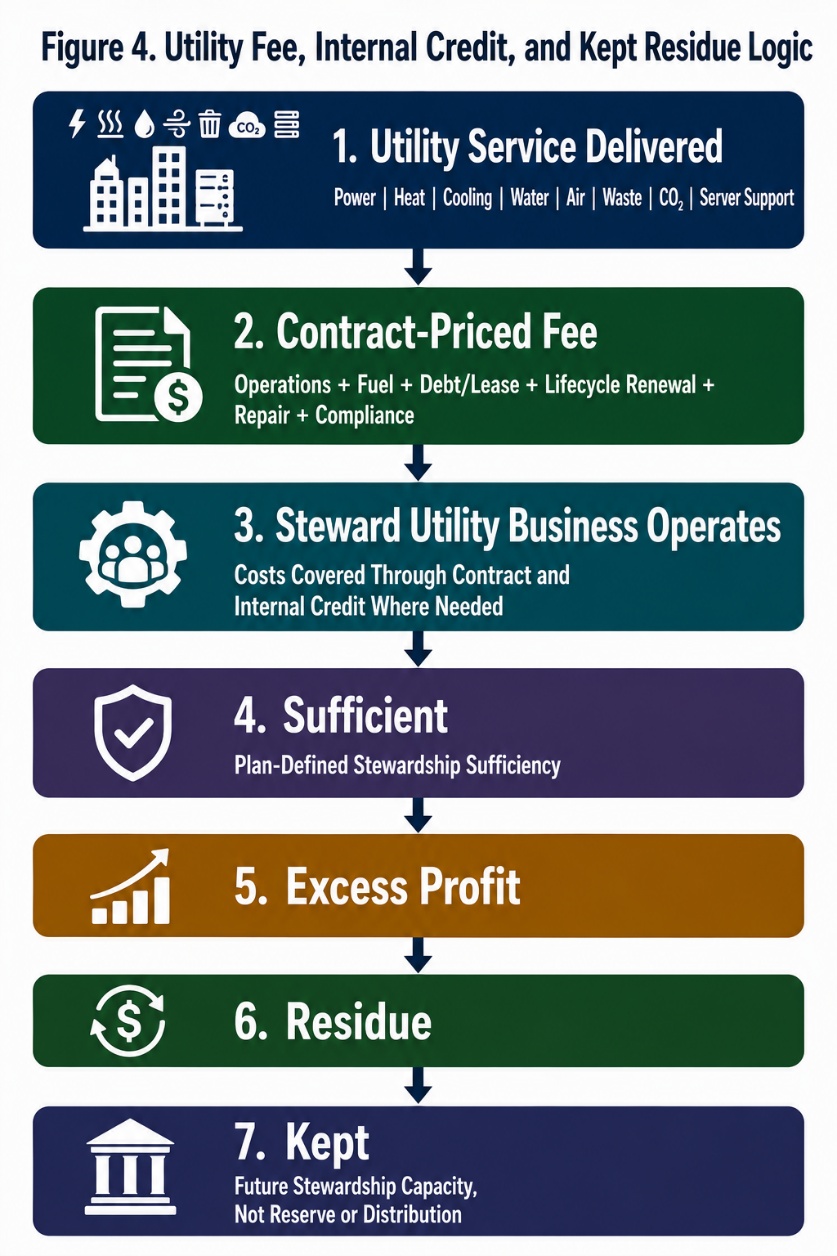
The older reserve-based model must be corrected. Utility providers do not build private reserve funds. Agency 23 does not hold renewal reserves. Utility stewards operate through contracts, internal operating credit where needed, lifecycle obligations, and fee-by-agreement pricing. Utility fees must cover real service costs: operation and maintenance, fuel and input costs, debt service or lease cost through Agency 8/9 rails, lifecycle renewal charges, repair and service-correction obligations, filter replacement, telemetry, proof systems, compliance costs, and audit-readiness. These are contract-priced obligations, not reserve balances. If a utility stewardship generates profit after obligations and sufficient, the excess becomes residue. That residue is kept through the proper rails. It is not retained by the utility steward as a private reserve and is not held by Agency 23. Excess profit above sufficient is always kept, and stewards administer by creating self-financing systems. Utility stewards do not borrow directly from external bankers. External borrowing risk belongs to the community. Viable utility stewardships may receive internal operating credit through proper agency due process, supported by community-governed credit capacity, original contributed properties, community-governed profits, and unrestricted community net worth as represented by the proper rails.
Figure 4. Utility Fee, Internal Credit, and Kept Residue Logic
Source-Agnostic Energy Transition
SOFC systems are treated as the first commercially plausible implementation layer for building-scale combined heat-and-power utility organisms. Natural gas or LNG-fed SOFCs may serve as the bridge technology because high-temperature fuel cells can provide electricity, heat, water, and process streams within the building. However, Agency 23 is not dependent on natural gas, LNG, SOFCs, Nernst Electric, or any single technology timeline. The durable architecture is the building-scale utility topology. The primary thermal source may change over time, while the downstream utility organism remains useful.
Mirrored Industrial Zone Integration
Agency 23 depends on the paired geometry of the NewVistas community. The mirrored industrial zone is not outside the community in an unrelated sense. It is structurally paired with the residential zone. Mirrored industrial buildings can receive CO₂, heat, utility support, water flows, processed materials, recyclable blocks, carbon products, and data-driven utility coordination from the same building-centric utility logic that supports apartment buildings. This shortens transport distances, improves thermal reuse, simplifies logistics, supports distributed repair ecosystems, and strengthens resilience.
The residential and industrial zones form a coupled utility metabolism: power, heat, water, carbon, waste, compute, air, and material flows circulate through short, visible, governable pathways. This also strengthens Bureau VIII integration. Agency 23 utility flows support Agency 22 material continuity through recyclable compaction, carbon products, and utility-refinery outputs. Agency 24 supports the movement layer required to move parts, recyclables, equipment, waste streams, replacement units, and service contractors.
Table 8. Utility Services and New Vistas SLA Metrics
| Utility Service | SLA Metric | Operational Measure | Governance Meaning |
| Power | Availability, voltage corridor, redundancy | Uptime, voltage stability, outage duration, SOFC module status | Reliability is measured by availability, quality, and duplicate fuel-cell capacity |
| Heat | Heat availability and useful recovery | Heat captured, heat-tier allocation, supply/return temperature | Heat becomes a utility stream, not a waste product |
| Cooling | Cooling availability and thermal efficiency | Chilled-water temperature, absorption capacity, server cooling continuity | Cooling is integrated with recoverable heat and compute loads |
| Water | Availability and quality corridor | Fuel-cell water, rain capture, pressure, purity, pathogen control, recycling rate | Water includes creation, capture, recycling, reprocessing, and safe delivery |
| Waste / Sewer | Conversion throughput and compliance | Treatment capacity, blockage rate, pyrolysis throughput, discharge quality | Waste is governed as conversion, not merely disposal |
| CO₂ Utility | Capture, routing, purity, delivery uptime | CO₂ flow, compression, pipeline continuity, greenhouse/industrial delivery | CO₂ becomes agricultural and industrial feedstock |
| Air Cleaning | Odor, VOC, particulate, smoke, chemical filtration | Filter condition, replacement interval, pressure control, contaminant thresholds | Air quality is constitutional infrastructure in dense communities |
| Server / AI Utility | Compute uptime and thermal integration | Server uptime, compute load, cooling load, telemetry latency | Servers are both utility loads and control infrastructure |
| Pyrolysis / Carbon Conversion | Carbon conversion rate | Carbon black, biochar, syngas, carbon-fiber precursor output | Carbon waste becomes industrial feedstock |
| Recyclable Compaction | Material compaction yield | Glass, aluminum, steel block output | Recyclable waste becomes standardized material flow |
| Process Gases | Gas availability, purity, routing | Hydrogen, oxygen, or other useful streams where available | Process gases become part of the utility refinery |
Table 9. Research Foundations and Agency 23 Adaptation
| Literature Area | Conventional Insight | Agency 23 Adaptation |
| Utility Regulation | Utilities often become natural monopolies | Utility firms are fixed at 10-building scale to prevent monopoly |
| Reliability Engineering | Uptime depends on redundancy and repair | Reliability is physically embedded through duplicated SOFC systems |
| Lifecycle Costing | Infrastructure fails when replacement costs are hidden | Costs are contract-priced into fees, not accumulated as reserves |
| Microgrids | Local energy improves resilience | Every building becomes a micro-utility organism |
| Combined Heat and Power | Heat should be reused | Heat drives cooling, water processing, pyrolysis, server management, and industrial use |
| Thermal Cascading | Heat quality should match use | Agency 23 governs integrated exergy architecture |
| Circular Systems | Waste can become resource | Waste becomes input for carbon, CO₂, material, and energy pathways |
| AI Infrastructure | Sensors and predictive systems improve reliability | Utilities become cybernetic thermodynamic systems |
| Institutional Economics | Boundaries prevent conflicts of interest | Standards, title, finance, custody, execution, accounting, measurement, and audit remain separated |
| Council-of-50 Coordination | Distributed systems learn through comparison and repetition | Up to 9,600 comparable utility firms support learning without monopoly |
| LAW/PLAT Residue Sequence | Sufficient produces residue; residue is kept; stewards administer | Utility stewardships must be self-financing, residue-generating, and future-capacity producing |
| Original Documentary Reconstruction | Original words, numbers, and dependencies govern modern translation | Agency 23 is framed as Bureau VIII’s continuous utility service-provision standards rail |
Governance Boundaries
Agency 23 is powerful in standards but powerless in operation. This is essential to its legitimacy. It may define utility standards, SLA targets, redundancy rules, procurement and installation specifications, safety protocols, interface rules, fee formulas, lifecycle obligations, air-quality thresholds, water standards, CO₂ routing rules, filter requirements, proof requirements, and recovery procedures. Agency 23 may not own assets, operate fuel cells, run utility companies, employ utility labor, hold title, finance equipment, possess custody, accumulate reserves, absorb losses, operate server farms, collect utility profits, distribute surplus, lend to stewards, or become a utility monopoly. Its power comes from admissibility, not ownership. Agency 23 therefore cannot be described as administering utilities in the bureaucratic sense. Utility stewards administer by operating productive utility businesses inside Agency 23 standards.
Table 10. Constitutional Separation of Agency 23 from Other Rails
| Function | Proper Rail |
| Utility standards, redundancy, SLA rules, lifecycle fee standards, continuous utility service standards | Agency 23 |
| Long-duration infrastructure title and finance | Agency 8 |
| Equipment title and finance for fuel cells, pumps, chillers, filters, sensors, utility skids | Agency 9 |
| Utility lease and service-custody agreements | Agency 3 |
| Workflow logs, receipts, APIs, version histories, compliance events | Agency 11 |
| Accounting truth and settlement representation | Agency 16 |
| Measurement standards, thresholds, metrics | Agency 18 |
| Trigger-bound audit | Agency 15 |
| Privacy, data-access, contract controls | Agency 14 |
| Plan, market, and underwriting validation | Agencies 19–21 where applicable |
| Internal operating credit representation and clearing | Agency 7 through proper due process |
| Physical execution | Steward utility businesses, certified contractors, subcontractors |
| Council-scale learning | Council of 50 |
| External borrowing risk | Community, not individual stewards |
Council-of-50 Utility Learning
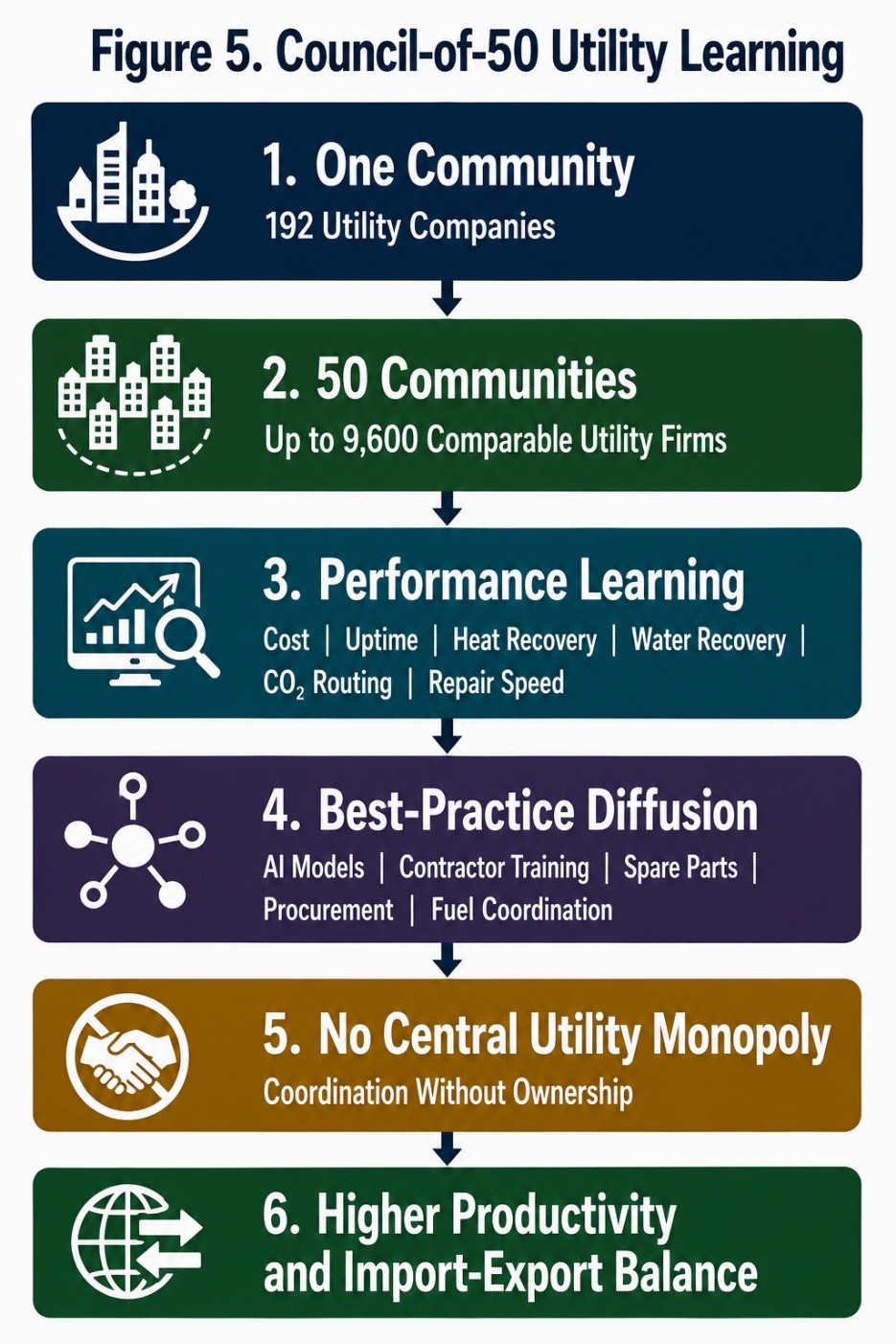
A single community contains 192 utility companies. Across fifty communities, this creates up to 9,600 comparable utility-company observations. This makes large-scale utility learning possible without centralizing ownership. The Council of 50 supports comparison, publication, procurement coordination, contractor learning, fuel coordination, spare-part standardization, AI model improvement, equipment replacement planning, import/export awareness, and best-practice diffusion. It does not become the owner or operator of utilities. This is important for the no-deficit rule. New Vistas will still import some specialized inputs: chips, boards, sensors, fuel-cell components, membranes, filters, control systems, robotics parts, and other precision systems. Agency 23 does not govern trade directly, but reliable utilities support the productivity needed to export enough value to balance unavoidable imports. A utility system that only consumes imported inputs weakens kept capital. A utility system that supports high-productivity manufacturing, AI services, food systems, water services, carbon products, materials processing, utility services, and industrial output strengthens the community’s ability to balance imports with exports.
Figure 5. Council-of-50 Utility Learning
Agency 23 is not a reserve system, subsidy system, redistribution mechanism, or public works bureaucracy. It governs a self-financing utility stewardship system in which utility stewards operate productive utility businesses under standards of reliability, measurement, thermodynamic integration, source-agnostic design, and contractual discipline. Once a utility stewardship becomes productive and reaches sufficiency, excess profit becomes residue. That residue is kept and administered by stewards to create, restore, and preserve other stewardships, thereby expanding future utility and community capacity. Utility profits are therefore not held as private reserves, consumed by Agency 23, or distributed as ordinary surplus; they become kept residue for future stewardship capacity. Community-governed profits, original contributed properties, and unrestricted community net worth may support the community-backed master credit line, which is allocated internally to viable stewards through agency due process. No utility steward borrows directly from an external banker; external borrowing risk belongs to the community rather than to individual stewards.
Agency 23 shows how New Vistas can replace centralized utility monopolies with a decentralized, building-centric, AI-managed, thermodynamically integrated utility civilization. Every building becomes a utility organism. Every utility company serves a fixed ten-building domain. Every utility service is priced to cover real current and lifecycle costs. Every proof record remains domain bound. Every profit above sufficient becomes residue and is kept. It is not merely a utility standards agency. It is Bureau VIII’s continuous utility service-provision rail inside the larger stewardship-replication engine. Reliable utilities make productive stewardships possible. Productive stewardships become sufficient. Excess profit becomes residue. Residue remains kept. Stewards administer by creating, restoring, and preserving additional stewardships. Its deeper contribution is therefore civilizational: it makes dense New Vistas life technically reliable, thermodynamically efficient, economically self-financing, source-agnostic, no-reserve, privacy-bounded, and constitutionally decentralized across generations.