
Agency 24: Transportation
Decentralized Mobility Custody and Capacity-Feasible Transportation in New Vistas
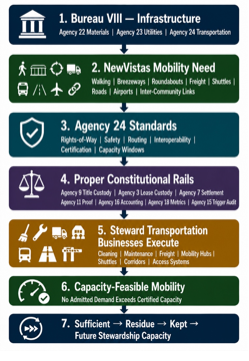
Agency 24 transforms transportation from a centralized public bureaucracy, speculative corridor monopoly, or unmanaged mobility commons into a lease-governed, steward-operated, capacity-feasible mobility system. It governs standards for rights-of-way, routing, interoperability, certification, safety, congestion windows, corridor service, movement capacity, and proof while transportation stewards operate through leases, service agreements, lifecycle-priced fees, transparent performance, and proper constitutional rails. Agency 24 governs movement capacity, routing, corridor service, interoperability, transportation standards, and rights-of-way discipline. It does not allocate downstream use by preference, operate transportation assets, own corridors, finance fleets, hold custody, accumulate reserves, or become a transportation department. Transportation stewards administer through productive mobility work. Agency 24 governs standards. Excess profit above sufficient becomes residue and is kept as future stewardship capacity. Transportation must therefore be self-financing, no-reserve, internally credit-compatible, and steward-executed rather than agency-operated, subsidy-dependent, or reserve-funded.
Overview
This paper develops Agency 24, Transportation, as the constitutional standards rail for mobility in the New Vistas lease-only system. Unlike conventional transportation systems that rely on centralized public ownership, municipal transit operation, road congestion, or private corridor monopolies, New Vistas organizes movement through walkability, assigned custody, steward operation, separated title, lease governance, payment clearing, digital proof, accounting truth, metrics, trigger-bound audit, Council-of-50 coordination, and no-reserve lifecycle cost recovery.
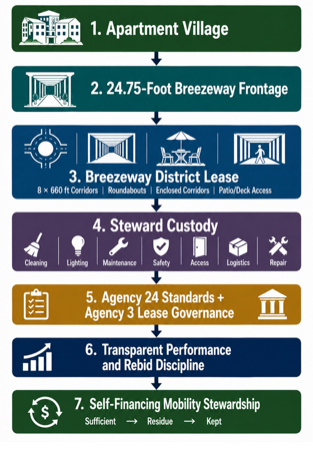
Every apartment has a 24.75-foot breezeway in front. Apartments form villages. Breezeways, roundabouts, corridors, mobility hubs, freight routes, autonomous shuttle systems, utility access routes, agricultural access, roads, rail links, airports, aviation systems, seaport logistics, regional freight routes, and inter-community corridors all require standards and custody. These spaces are not unmanaged commons and are not operated by Agency 24. They are assigned to steward businesses through leasing and service-custody agreements governed by Agency 3, while Agency 24 defines the standards those agreements must satisfy. A typical breezeway district lease may include approximately 8 × 660 feet of corridor, interconnecting roundabouts, enclosed corridors, patio and deck systems above corridors, windows, doors, flooring, ceilings, lighting, environmental systems, airflow or filtration coordination, cleaning, maintenance, safety monitoring, logistics coordination, and access or subscription systems where applicable. If one village is not enough to support a viable business, a transportation steward may receive custody over two to four villages.
Agency 24’s central governance result is capacity-feasible mobility: no admitted demand should exceed certified capacity in critical corridors, logistics windows, airport access, autonomous routes, freight systems, or inter-community movement channels. Transportation remains human-scaled for daily life and rule-governed where scarcity, safety, and throughput require coordination. The deeper constitutional work claim is that transportation becomes stewardship space. Breezeways, roundabouts, corridors, roads, airports, mobility hubs, fleets, patio and deck access, autonomous routes, freight systems, and regional links become assigned custody domains. Stewards operate them, but do not own the underlying substrate. Agencies govern standards, but do not operate the system. The Council of 50 coordinates regional continuity but does not become a sovereign transportation owner.
Table 1. Agency 24
| Dimension | Agency 24 Governs | Agency 24 Does Not Do |
| Constitutional Role | Transportation standards, safety, routing, interoperability, certification, rights-of-way, movement capacity, corridor service | Does not operate transportation services |
| Mobility Architecture | Breezeways, roundabouts, corridors, mobility hubs, freight routes, roads, airports, rail, aviation, seaport links, inter-community corridors | Does not treat mobility as a centralized public department |
| Custody Logic | Standards for lease-based mobility custody | Does not hold custody itself |
| Title Boundary | Transportation title custody primarily through Agency 9; Agency 8 only where land or fixed right-of-way classification formally applies | Does not own corridors, fleets, roads, airports, or mobility assets |
| Lease Governance | Standards embedded into Agency 3 leases and service-custody agreements | Does not award itself operating rights |
| Competition | Multiple stewards, performance review, rebidding, transparent metrics, anti-concentration logic | Does not create one dominant mobility monopoly |
| Congestion Tools | Wardrop, PoA, marginal external cost, and VCG for scarce capacity windows | Does not over-control ordinary walking or basic breezeway movement |
| Finance | Lifecycle-priced tolls, subscriptions, freight fees, access payments, service charges, contract-priced obligations | Does not hold reserves, finance fleets, lend, or accumulate funds |
| LAW/PLAT | Transportation stewards become sufficient, generate residue, and keep residue | Does not consume residue, distribute surplus, or build agency reserves |
| Credit Discipline | Internal operating credit may support viable transportation stewards through proper due process | No transportation steward borrows directly from an external banker |
| Council-of-50 Role | Coordination, interoperability, corridor assignment, toll-clearing compatibility, best-practice diffusion, reassignment after failure | Does not become a sovereign transportation owner |
Figure 1. Agency 24 Constitutional Mobility Chain
Why This Agency Matters
Transportation is the circulation system of New Vistas. It connects residents, services, gardens, restaurants, utilities, farms, industrial buildings, recycling, maintenance, emergency-adjacent movement, inter-community trade, imports, exports, remote work, aviation, roads, rail, logistics, autonomous freight, and regional productive exchange. Agency 24 matters because mobility cannot be left to unmanaged congestion, political road departments, centralized transit authorities, or private corridor monopolies. It must remain continuous, safe, clean, low-friction, interoperable, financially truthful, and constitutionally separated.
Table 2. New Vistas Mobility Architecture
| Mobility Domain | Description | Stewardship Meaning |
| Apartment Breezeways | 24.75-foot breezeway in front of every apartment | Core pedestrian, circulation, service, and environmental infrastructure |
| Village-Side Breezeways | Breezeways integrated into apartment podium structures | Managed internal movement and service flow |
| Garden-Side Breezeways | Breezeways within landscaped street corridors | Pedestrian access, environmental circulation, village life |
| Internal Enclosed Corridors | Climate-controlled year-round movement paths | Clean, safe, walkable internal circulation |
| External Open Corridors | Open routes for large-item movement and logistics | Freight, large equipment, service, utility, and industrial movement |
| Roundabouts | Interconnecting circulation nodes | Require custody, safety standards, cleaning, routing, and flow management |
| Mobility Hubs | Transfer and service points | Shuttles, access systems, deliveries, routing, passenger/freight coordination |
| Autonomous Shuttles | Low-speed or automated mobility systems | Operated by certified stewards under Agency 24 standards |
| Freight Corridors | Logistics movement routes | Capacity windows, routing rules, proof, and possible allocation mechanisms |
| Agricultural Access | Routes for farms and equipment | Connects production, food systems, farms, and service movement |
| Utility Access Routes | Access for maintenance and infrastructure service | Supports Agencies 22, 23, and related steward operations |
| Roads / Rail / Airports | Regional and inter-community infrastructure | Council-of-50 coordination with steward operation |
| Aviation / Seaport Links | Inter-community and external logistics interface | Supports import/export, freight continuity, and regional mobility |
| Patio / Deck Access | Above-breezeway access systems where applicable | May use subscription or service access models |
Breezeway Custody as the Starting Point
Agency 24 begins with New Vistas’ concrete architecture, especially the breezeway system. Breezeways are not decorative common areas. They are transportation, circulation, environmental, and service infrastructure. They require cleaning, maintenance, lighting, air movement, filtering coordination, safety monitoring, repair, logistics flow, access management, and coordination with utility stewards. A transportation steward may hold lease-based custody over one village’s breezeway domain, including relevant roundabout segments. If one village is not enough to support a viable business, the custody domain may cover two to four villages.
A typical breezeway district lease may include 8 × 660 feet of corridor, interconnecting roundabouts, enclosed corridors, patio and deck systems above corridors, windows, doors, flooring, ceilings, lighting and environmental systems, cleaning, repair, safety, airflow, logistics, and access obligations. This turns circulation space into an accountable stewardship domain rather than a neglected public common area or centrally operated municipal service. Productive custody domains should become viable stewardships, become sufficient, generate residue, keep residue, and support future stewardship capacity.
Figure 2. Breezeway District Custody Model
Competitive Stewardship and Anti-Monopoly Mobility
Transportation leases are not awarded only to the highest bidder. Lease architecture itself is a constitutional regulatory tool. Agency 3 may divide transportation systems by corridor segment, service class, freight specialization, passenger specialization, maintenance district, overlapping routing right, patio/deck access domain, or mobility service type. Multiple stewards may operate within the same transportation framework if they meet Agency 24 standards. Users may select providers based on toll rates, reliability, cleanliness, speed, maintenance quality, comfort, safety ratings, service reputation, and published performance.
This structure prevents both public monopoly and private corridor capture. No steward should control all breezeways, all roads, all fleets, all freight corridors, all airports, all autonomous routes, or all regional access systems. Competition is produced by lease architecture, not by private ownership of transport assets. Agencies govern standards, while stewards and certified contractors execute. Agency 24 does not become an operating bureaucracy. The transportation steward’s authority is bound by lease, proof, standards, capacity, performance, and rebid discipline.
Table 3. Competitive Mobility Stewardship
| Conventional Failure | Agency 24 |
| Centralized public road bureaucracy | Standards-only Agency 24 with steward execution |
| Private toll-road monopoly | Lease-based custody with anti-concentration rules |
| Unmanaged common space | Assigned steward responsibility and proof |
| Highest-bid concession logic | Lease design based on competition, service quality, and capacity |
| Deferred maintenance | Lifecycle costs priced into fees and service agreements |
| Hidden subsidy | Cost-covering tolls, subscriptions, freight charges, access payments, and service contracts |
| Fragmented private systems | Interoperability standards and proof |
| Operator self-protection | Performance review, rebidding, and trigger audit |
| Agency mission drift | Agency 24 remains standards-only, not operator, owner, financier, custodian, or reserve holder |
| Residue confusion | Profit above sufficient becomes kept residue, not steward reserve or agency fund |
Table 4. Mobility Theory and Proper Use
| Tool | What It Explains | New Vistas Use | Limit |
| Wardrop User Equilibrium | Private route choice may create congestion | Freight, roads, autonomous routes, regional links | Not for ordinary walking |
| System Optimum | Coordinated routing lowers total system cost | Scarce corridors, logistics routes, airport windows | Must not become total movement control |
| Price of Anarchy | Measures loss from unmanaged routing | Governance metric for congestible subsystems | Not needed where walkability solves demand |
| Marginal External Cost | Prices congestion burden and service externality | Freight, peak corridors, scarce access, regional routes | Not a profit device, reserve source, or ordinary walking charge |
| VCG Allocation | Truthful allocation of scarce slots | Freight priority, airport slots, autonomous corridors, industrial logistics | Too complex for basic breezeway use |
| TOK Validation | Tests major capacity decisions | Fleet expansion, depots, corridors, airports, large contracts | Not for every trip or resident walk |
Capacity-Feasible Mobility
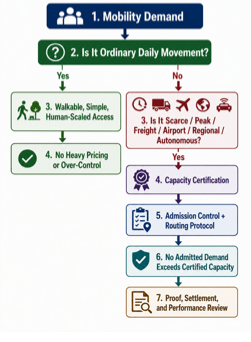
Agency 24’s strongest concept is capacity-feasible mobility. The goal is not to promise zero congestion. The goal is to prevent collapse by ensuring that scarce routes, corridors, freight windows, autonomous channels, airport slots, and inter-community mobility systems do not admit more demand than they can safely handle. For ordinary daily movement, the system remains simple, walkable, and human-scaled. For scarce or high-value movement, Agency 24 may use routing protocols, access windows, slot allocation, subscription rights, toll logic, marginal external cost rules, or mechanism design. This creates a balanced transportation system: freedom for ordinary movement, discipline for scarce capacity.
Figure 3. Capacity-Feasible Mobility
Generalized Mobility Cost
New Vistas transportation is not only travel time. In breezeways, corridors, roundabouts, logistics systems, and dense pedestrian environments, mobility cost may also include crowding, safety, maintenance burden, airflow stress, comfort, cleanliness, accessibility, reliability, and logistics interference. This allows Agency 24 to govern mobility quality rather than merely vehicle speed. A corridor that is fast but unsafe, dirty, poorly lit, uncomfortable, unreliable, inaccessible, or damaging to maintenance systems is not truly efficient. Agency 24 therefore frames movement as a full service-quality problem.
Table 5. Generalized Mobility Cost Components
| Cost Component | Meaning |
| Travel time | Time required to move through a link or corridor |
| Crowding | Density, congestion, discomfort, or crowd pressure |
| Safety | Collision risk, conflict, hazard, emergency-adjacent concern |
| Maintenance burden | Wear, cleaning load, repair stress, infrastructure use |
| Airflow stress | Burden on ventilation, filtration, and environmental conditioning |
| Comfort | Lighting, temperature, airflow, access quality, user experience |
| Cleanliness | Surface condition, waste removal, hygiene, corridor condition |
| Reliability | Predictability, availability, missed-window rate |
| Accessibility | Ease of use for different users, service types, and mobility needs |
| Logistics interference | Conflict between pedestrian movement and freight/service flows |
Lifecycle Pricing Without Reserve Drift
Transportation must cover real costs, but it must not create reserve accumulation. Transportation stewards do not build idle reserves. Agency 24 does not hold funds. Mobility operates through tolls, subscriptions, freight charges, patio-access subscriptions, autonomous routing charges, cargo-handling fees, VCG payments, access charges, and service contracts. Fees must cover cleaning, maintenance, lighting, safety systems, repairs, debt service, equipment replacement, corridor renewal, inspections, certification, compliance, logs, proof systems, settlement, and service-correction obligations. These are contract-priced cost components, not reserve funds.
Any profit after obligations and sufficient becomes residue and is kept through the proper rails. Transportation can therefore be self-amortizing and financially durable without allowing stewards or Agency 24 to accumulate idle liquidity. Stewards do not borrow directly from external bankers. External borrowing risk belongs to the community. Viable transportation stewardships may receive internal operating credit through agency due process, supported by community-governed credit capacity, original contributed properties, community-governed profits, and unrestricted community net worth as properly represented by the relevant rails.
Figure 4. Transportation Fee, Internal Credit, and Kept Residue Logic
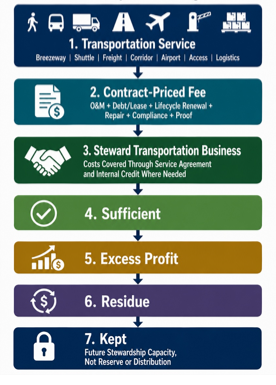
Table 6. Transportation Revenue and Cost Logic
| Revenue / Payment Type | What It Supports |
| Tolls | Corridor use, roads, special access, routing burden |
| Subscriptions | Patio/deck access, recurring mobility services, corridor access |
| Freight fees | Cargo movement, industrial logistics, delivery windows |
| Autonomous routing charges | Use of autonomous corridors or scheduling systems |
| Cargo-handling fees | Loading, unloading, transfer, storage, logistics support |
| Access fees | Airport, regional, inter-community, or scarce rights-of-way |
| VCG payments | Scarce peak slots where private valuation matters |
| Service contracts | Cleaning, maintenance, shuttles, mobility hubs, safety systems |
| Cost Component | Meaning |
| Operations and maintenance | Cleaning, labor, service, ordinary upkeep |
| Debt / lease service | Title or equipment finance cost through proper rails |
| Lifecycle charge | Contract-priced renewal and replacement obligation |
| Service correction | Repairs, SLA failures, emergency response, correction |
| Compliance | Logs, inspections, safety records, certifications, proof |
| Settlement | Cleared through Agency 7 |
| Accounting truth | Represented through Agency 16 |
| Internal operating credit | Allocated through proper due process where needed; not external steward bank debt |
| Residue treatment | Profit above sufficient is kept, not held as reserve |
TOK Discipline
TOK validation strengthens Agency 24, but it must not be overused. TOK should not be required for every walk, trip, ordinary resident movement, or basic breezeway use. Its proper role is in major transportation capacity decisions: fleet expansion, new road segments, airport functions, depots, freight corridors, autonomous routing infrastructure, industrial logistics windows, large service contracts, major regional corridors, and inter-community transport systems. This prevents speculative transportation expansion. A new logistics corridor should not be built merely because a contractor expects future revenue. It must be linked to validated demand from farms, industrial producers, utility systems, recycling systems, imports, exports, or Council-of-50 coordination. This is consistent with the LAW sequence. Transportation capacity must support viable stewardships and future stewardship capacity. It should not become speculative infrastructure, idle capital, or a long-term consumer of community capacity.
Interoperability Across Many Modes
New Vistas transportation is not a single-mode system. It includes walking, breezeways, shuttles, freight systems, utility access routes, autonomous logistics, agricultural machinery routes, external roads, airports, rail links, aviation systems, seaport logistics, LNG or energy-logistics corridors, and regional routes. Agency 24 makes these modes compatible through standards for pickup points, routing protocols, transfer timing, safety rules, access rights, vehicle interfaces, toll clearing, service levels, corridor assignments, proof records, and performance reporting.
Because Agency 24 belongs to Bureau VIII, this interoperability also connects transportation to Agency 22 Materials and Agency 23 Utilities. Waste, recyclables, carbon products, equipment, parts, food, fuel, and industrial output all require continuity of transport. Agency 24 therefore governs the movement layer that lets the upstream infrastructure bureau function without turning transportation into downstream allocation authority.
Council-of-50 Coordination
Transportation systems extend beyond one community. Roads, rail systems, airports, autonomous freight routes, aviation systems, logistics corridors, toll-clearing systems, seaport links, LNG or energy-logistics routes, regional freight routes, and import/export corridors require quarterly Council-of-50 coordination. The Council of 50 coordinates standards, publishes comparisons, assigns corridor responsibility, supports interoperability, coordinates toll-clearing compatibility, and spreads best practices. It does not own transportation infrastructure and does not become a sovereign transport authority. The Council may assign operational responsibility for a regional transportation domain to a particular community. That community then governs steward leasing through Agency 3. If that community fails operationally, the Council may reassign coordination authority without disturbing Agency 9 title continuity, corridor ownership, or regional mobility continuity.
This preserves federated coordination without centralized ownership. It also supports the no-deficit discipline because transportation enables productive imports and exports to move efficiently. Mobility is not only local circulation. It is the physical condition for regional productive exchange.
Figure 5. Council-of-50 Transportation Coordination
Governance Boundaries
Agency 24 is powerful in standards but powerless in operation. This is essential to its legitimacy. It may define transportation standards, routing rules, rights-of-way rules, safety protocols, corridor specifications, certification requirements, congestion windows, access rules, performance obligations, interoperability protocols, and capacity-feasibility conditions. Agency 24 may not own transportation assets, operate fleets, finance vehicles, hold title, possess custody, accumulate reserves, hold toll revenue, employ transportation labor, operate corridors, control all mobility, allocate downstream use by preference, or become a transportation business. Its power comes from admissibility, not ownership. agencies govern only; stewards and certified contractors administer productive work. Agency 24 therefore cannot be described as administering transportation in a bureaucratic sense. Transportation stewards administer by operating productive mobility businesses inside Agency 24 standards.
Table 7. Constitutional Separation of Agency 24 from Other Rails
| Function | Proper Rail |
| Transportation standards, routing, safety, interoperability, movement capacity, corridor service | Agency 24 |
| Transportation infrastructure and mobility asset title custody | Agency 9 |
| Land or fixed right-of-way title where formally applicable | Agency 8 |
| Lease and operational custody governance | Agency 3 |
| Payment clearing and settlement | Agency 7 |
| Route logs, toll receipts, maintenance records, workflow proof | Agency 11 |
| Accounting truth | Agency 16 |
| Metrics and performance measurement | Agency 18 |
| Trigger-bound audit | Agency 15 |
| Legal templates and privacy/data-access controls | Agency 14 |
| Major plan, market, and underwriting validation where applicable | Agencies 19–21 |
| Internal operating credit representation and clearing | Agency 7 through proper due process |
| Physical execution | Steward transportation businesses and certified contractors |
| Regional coordination | Council of 50 |
| External borrowing risk | Community, not individual stewards |
| Kept residue treatment | Proper LAW/PLAT rails; not Agency 24 funds or steward reserves |
| Result | Main Finding | Institutional Meaning |
| 1 | Transportation competition is produced by lease architecture | Competition comes from steward custody, not private corridor ownership |
| 2 | User equilibrium can be inefficient | Private route choice may not minimize total mobility cost |
| 3 | System-optimal routing may require non-intuitive assignments | Longer routes may reduce total congestion, delay, safety risk, or service burden |
| 4 | Price of Anarchy measures unmanaged routing loss | Agency 24 can reduce inefficiency in scarce mobility domains |
| 5 | VCG makes scarce access capacity-feasible | Peak slots can be allocated without political favoritism |
| 6 | Admission control plus routing prevents collapse | Scarce systems do not admit demand beyond certified capacity |
| 7 | Transportation is lifecycle-cost-covering without reserves | Fees cover real costs; profits become residue and are kept |
| 8 | Council-of-50 coordination preserves continuity | Regional mobility remains coordinated without centralized ownership |
| 9 | Breezeways are stewardship infrastructure | 24.75-foot breezeways require custody, maintenance, proof, and performance |
| 10 | Agency 24 is standards-only | It does not own, operate, finance, hold custody, or accumulate reserves |
| 11 | TOK applies to major capacity decisions | Fleet expansion, depots, corridors, airports, and large contracts must be demand-validated |
| 12 | Mobility supports no-deficit discipline | Transportation enables imports and exports to move efficiently |
| 13 | Transportation stewards support LAW replication | Productive mobility businesses become sufficient, generate residue, and expand future capacity |
| 14 | Agency 24 belongs to Bureau VIII Infrastructure | It governs movement capacity, routing, and corridor service as upstream infrastructure |
| 15 | Agency 24 must be read through original documentary reconstruction | Modern transportation language must remain anchored to LAW/PLOT/HOUSE/DOCS constitutional method |
| 16 | Agency 24 administers nothing bureaucratically | Stewards administer through productive mobility work; Agency 24 governs standards |
Transportation profits are not held as steward reserves. They are not consumed by Agency 24. They are not distributed as ordinary surplus. They become residue and are kept as future stewardship capacity. Community-governed profits, original contributed properties, and unrestricted community net worth may support the community-backed master credit line. That credit may be allocated internally to viable transportation stewards through agency due process. No transportation steward borrows directly from an external banker. External borrowing risk belongs to the community, not to individual stewards.
Agency 24 shows how New Vistas can build a transportation system without becoming car-dependent, bureaucratic, monopolistic, or chaotic. It begins with walkability, breezeways, village custody, steward operation, and human-scaled movement. It then adds routing protocols, interoperability standards, capacity windows, proof systems, lifecycle pricing, Council-of-50 coordination, and carefully limited congestion tools only where scarcity requires them. Agency 24 is not merely a transportation standards agency. It is Bureau VIII’s movement-capacity and corridor-service rail inside the larger stewardship-replication engine. Reliable mobility makes productive stewardships possible. Productive stewardships become sufficient. Excess profit becomes residue. Residue remains kept. Stewards administer by creating, restoring, and preserving additional stewardships. Agency 24’s deeper contribution is therefore civilizational: it preserves continuous movement, competitive mobility service, no-reserve cost truth, regional coordination, documentary constitutional boundaries, and future stewardship capacity across generations.