
Agency 22: Materials
Circular Material Governance and Precision Resource Stewardship in New Vistas
Agency 22 transforms raw materials from speculative commodities into long-horizon civilizational continuity assets. It governs the standards that make reuse, repair, remanufacture, recycling, recovery, substitution, precision extraction, material passports, balanced imports, and material-flow proof admissible within New Vistas. It does this without owning resources, operating mines, financing equipment, holding custody, trading commodities, accumulating reserves, consuming steward residue, or becoming a centralized materials authority. Bureau VIII supplies the upstream prerequisites of stewardship: materials, utilities, and movement capacity. Within that bureau, Agency 22 governs materials, extraction admissibility, recovery standards, raw-stock quality, artificial-ore recognition, precision extraction, and first-stage material standardization. It does not control downstream allocation by preference, own materials, operate extraction, run recycling systems, finance equipment, hold custody, or become a resource ministry. Agency 22 must also be read through the kept and administer. Materials are governed so that productive stewardships can be created, restored, preserved, and expanded while residue remains kept as future stewardship capacity. Agency 22 does not administer by operating. Stewards administer through productive material work; Agency 22 governs standards.
This paper develops Agency 22, Materials, as the constitutional standards governor of long-term raw-material continuity in the New Vistas LAW/PLAT system. Its purpose is not to maximize mining, extraction volume, commodity exports, speculative ownership, industrial scale, or centralized materials control. Its purpose is to preserve the physical material base required for New Vistas buildings, utilities, transportation systems, manufacturing equipment, robotics, server infrastructure, fuel-cell systems, polymers, glass, cement tiles, stainless steel components, computational platforms, and steward enterprises. The paper argues that a technologically advanced civilization cannot rely on short-run commodity markets, open-pit extraction, speculative mineral ownership, dangerous underground labor, centralized mega-refineries, or monopolistic material systems. New Vistas requires a different framework: a recovery-first, digitally provable, no-reserve, no-deficit, steward-executed, contractor-based material governance system.
Agency 22 begins with a simple hierarchy: reuse before recycling, recycling before virgin extraction, precision extraction before mass excavation, and distributed specialized systems before centralized mega-systems. Waste streams are treated as “artificial ore deposits.” Stainless steel scrap, copper, aluminum, electronics, batteries, catalysts, polymers, glass, obsolete machinery, fuel-cell components, precision equipment, vehicles, appliances, and industrial waste are not merely disposal problems. They are already refined, concentrated material stores that can reduce the need for new extraction and extend the effective material horizon. Where virgin extraction becomes necessary, Agency 22 favors precision methods: PCD drilling, directional drilling, drill-and-ream systems, robotic extraction, remote operation, surface-based human supervision, digital hole records, assay records, material passports, and backfill documentation. Extraction becomes admissible only when tied to TOK-validated physical demand, binding off-take, safety certification, Agency 22 standards, proper lease and title rails, and digital proof.
The paper’s central contribution is to show how a standards-only agency can secure material continuity for a network of approximately fifty communities and five million people without becoming a mining company, resource owner, finance authority, materials merchant, reserve holder, or centralized planning ministry. Agency 22 support the larger LAW sequence: productive stewards administer through viable material stewardships; excess profit above sufficient becomes residue; residue remains kept; and the system expands through self-financing stewardship replication rather than extraction, redistribution, reserve accumulation, or agency operation.
Table 1. Agency 22
| Dimension | Agency 22 Governs | Agency 22 Does Not Do |
| Documentary Position | Bureau VIII Infrastructure role translated from the PLOT reverse-side agency/bureau structure | Does not function as an improvised modern mining department or resource ministry |
| Constitutional Role | Material continuity standards | Does not own resources |
| Bureau VIII Function | Materials, extraction admissibility, recovery standards, first-stage standardization, raw-stock quality | Does not control downstream allocation or collapse materials, utilities, and transportation into one operating authority |
| Material Strategy | Reuse, repair, remanufacture, recovery, recycling, substitution, precision extraction, balanced import | Does not maximize mining or extraction volume |
| LAW/PLAT Function | Standards that allow material stewardships to create, restore, preserve, and expand productive capacity | Does not consume residue or administer as a bureaucracy |
| Resource Access | Admissible recovery, recycling, substitution, and precision extraction pathways | Does not operate mines, refineries, factories, or recycling plants |
| Contractor System | Certification, raw-stock standards, proof requirements, assay standards, material passports | Does not employ or control contractors as an operating agency |
| Finance Boundary | Standards for material pathways linked to proper title, lease, credit, and proof rails | Does not finance equipment, issue liens, lend, or hold reserves |
| Steward Credit | Material stewardships may use internal operating credit through proper agency due process | No steward borrows directly from an external banker |
| Custody Boundary | Defines admissibility for material use | Does not hold custody or trade commodities |
| Digital Proof | Hole records, assays, material passports, custody records, off-take proofs, backfill records | Does not create total business surveillance |
| External Trade | No-deficit discipline for strategic imports | Does not pursue autarky |
| Council-of-50 Role | Coordination, comparison, specialization, forecasting, best-practice propagation | Does not create centralized resource sovereignty |
Figure 1. Agency 22 Constitutional Architecture
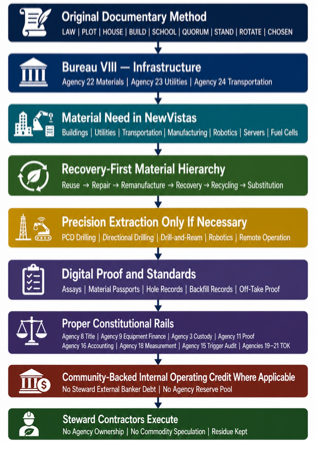
Why This Agency Matters
Material continuity is one of the physical foundations of the New Vistas civilization model. No advanced community can maintain housing, utilities, transportation, food systems, communication networks, robotics, server farms, fuel-cell infrastructure, manufacturing tools, computational systems, or productive stewardships without reliable flows of essential materials. In conventional economies, materials are often treated as commodities. They are extracted when prices justify investment, traded through global markets, financed through credit cycles, accumulated by firms seeking private return, and depleted according to short-run market incentives. New Vistas requires a different constitutional treatment. Materials are not merely inventory to monetize. They are long-duration productive capital embedded in the physical continuity of the community.
Agency 22 therefore reframes raw materials as civilizational continuity assets. How can New Vistas preserve material availability across generations while avoiding speculative depletion, unsafe labor, monopoly control, hidden deficits, reserve accumulation, external steward debt, and dependence on volatile commodity cycles? Agency 22 is not a mining ministry, resource-planning office, commodity trader, fiscal extractor, or public materials department. It is a bounded standards rail inside the original-documentary New Vistas structure. Agencies govern; stewards administer. Agency 22 governs material admissibility so that material stewardships can become productive, become sufficient, generate residue, keep residue, and expand future stewardship capacity. It must therefore be understood as part of the larger stewardship-replication system. Material stewardships must become productive. Productive assets must support themselves. Operating credit must support productive activity. Excess profit above sufficient becomes residue and remains kept. The goal is not extraction for its own sake; the goal is future stewardship capacity.
Table 2. Material Stack Governed by Agency 22
| Material Domain | Examples | Why It Matters |
| Structural Metals | Stainless steel, chromium, nickel, alloying elements | Structural continuity, modularity, corrosion resistance, long-life building systems |
| Cement and Mineral Inputs | Cement ingredients, limestone, aggregates, silica | Cement tiles, mass, fire resistance, compression, bracing |
| Glass Systems | Façade glass, daylighting components, envelope systems | Visibility, lighting, standardized building envelope |
| Polymer Systems | Gap fillers, thin films, EPS insulation, coatings | Sealing, tolerance control, vibration damping, thermal isolation, moisture protection, acoustic buffering, UV resistance |
| Carbon Materials | Carbon black, biochar, syngas, carbon-rich intermediates, carbon microfiber precursors | Cement-tile reinforcement, crack resistance, long-term reduction of imported material dependence |
| Electronics and Compute | Semiconductors, sensors, server components, precision electronics | Buildings as computational organisms, AI systems, automation, communication |
| Utility Materials | Fuel-cell components, catalysts, industrial gases, utility-refinery materials | Distributed energy, process heat, chemical systems, fuel-cell infrastructure |
| Manufacturing Inputs | Precision machine parts, robotics components, modular equipment | Steward production, repair systems, fabrication, automation |
| Recovered Waste Streams | Scrap steel, copper, aluminum, electronics, batteries, obsolete machinery | Artificial ore deposits that reduce extraction pressure |
| Stewardship Inputs | Productive assets, equipment, tools, inventory, systems, material-processing capacity | Support viable stewardships capable of becoming sufficient and generating residue |
Artificial Ore: Waste Streams as Strategic Material Assets
A major innovation of the paper is the concept of waste streams as artificial ore deposits. Modern industrial society discards large volumes of refined, concentrated, and partially processed materials. These materials may be richer than many natural ore bodies because the outside world has already paid the cost of extraction, refining, alloying, transportation, and manufacturing. Agency 22 therefore treats stainless steel scrap, copper, aluminum, electronics, batteries, catalysts, polymers, glass systems, industrial equipment, precision components, vehicles, appliances, and obsolete machinery as material sources. Recovery is not merely environmental policy. It is industrial strategy and stewardship capacity.
This recovery-first system also becomes an AI learning system. Every recovered material stream generates data for alloy recognition, contamination detection, automated disassembly, robotic handling, process optimization, material classification, quality verification, and failure-mode learning. The more New Vistas recovers, sorts, remanufactures, and reuses, the smarter its industrial recovery system becomes. This recovery system must also be productive. It cannot become a long-term consumer of capacity. Recovery businesses, remanufacturing systems, modular refineries, logistics stewards, verification contractors, and material-passport providers must operate as viable stewardships. They must become sufficient, generate residue, and expand future stewardship capacity.
Figure 2: Artificial ore and Recovery First Material Flow
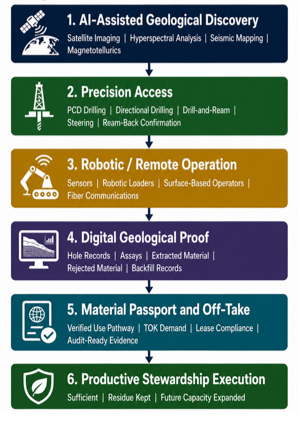
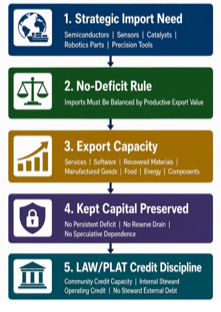
This hierarchy prevents virgin extraction from becoming the default response to scarcity. If recovered materials, recycled stocks, substitution, modular refurbishment, or balanced imports can meet validated demand, new extraction is not constitutionally justified. Strategic imports remain allowed, but they must follow non-deficit discipline. New Vistas is not autarkic, it may import advanced semiconductors, sensors, catalysts, robotics parts, precision machine tools, fuel-cell components, specialty electronics, and other specialized inputs. But persistent deficits are not allowed. Imports must be balanced by productive exports, so that kept capital is not consumed. This hierarchy also reflects the “kept and administer” rule. Materials are not released into the system for speculative resale or idle accumulation. They are admitted so that stewards can administer productive capacity: creating stewardships, restoring weakened stewardships, preserving viable stewardships, acquiring productive land, building productive facilities, and sustaining future community expansion.
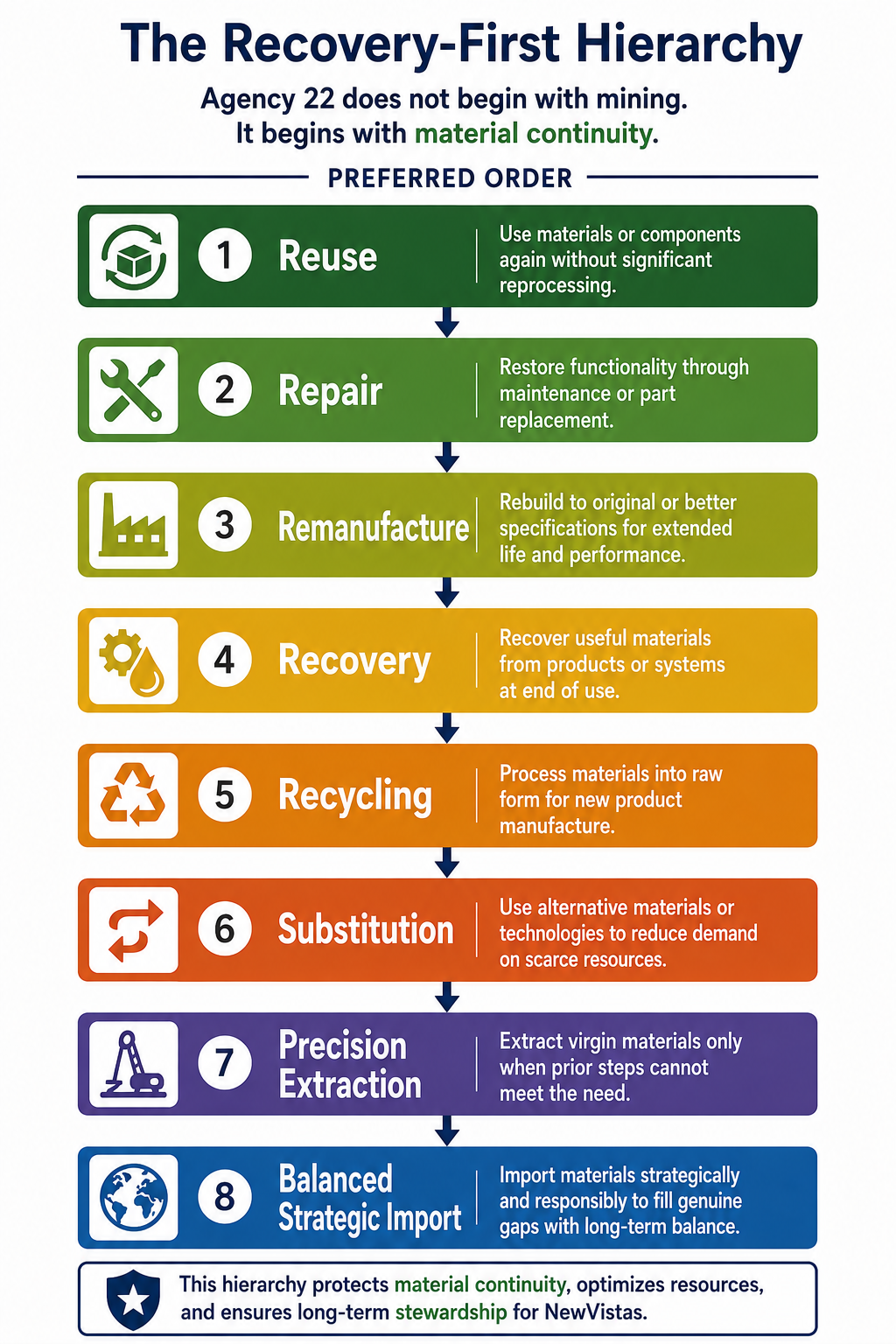
Table 3. Conventional Resource Logic vs Agency 22 Logic
| Conventional Resource Regime | Agency 22 Material Governance |
| Extract when price is favorable | Extract only when tied to TOK-validated physical demand |
| Treat resources as commodities | Treat materials as civilizational continuity assets |
| Favor large mines and centralized scale | Favor distributed contractor systems and precision methods |
| Rely on open-pit or drill-and-blast extraction | Favor PCD drilling, directional drilling, drill-and-ream, robotics, and remote operation |
| Place workers underground in dangerous conditions | Keep humans on the surface where feasible; send drills, reamers, sensors, or robots underground |
| Permit speculative ownership of mineral stock | Separate title, custody, finance, standards, proof, and execution |
| Use global commodity cycles as allocation signals | Use standards, TOK demand, off-take, proof, and lease admissibility |
| Treat waste as disposal | Treat waste as artificial ore |
| Allow imports without structural discipline | Permit imports only under no-deficit export balance |
| Centralize extraction power | Distribute execution among certified steward contractors |
| Treat extraction revenue as institutional income | Excess profit above sufficient becomes residue and remains kept |
| firms borrow externally against resource claims | Stewards receive internal operating credit; no steward external banker debt |
| Build reserves from extraction activity | No Agency 22 reserve pool; community credit capacity follows proper LAW/PLAT rails |
| Collapse infrastructure domains | Agency 22 stays materials/first-stage standardization; Agency 23 utilities and Agency 24 transportation remain separate |
Precision Extraction Instead of Mass Excavation
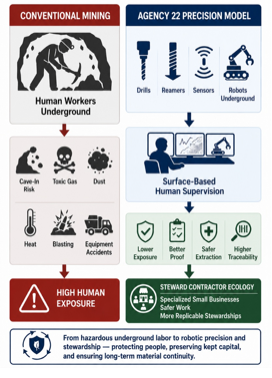
Where virgin extraction is necessary, Agency 22 rejects the assumption that civilization must rely on massive open-pit mines, enormous tailings systems, destructive drill-and-blast methods, unsafe underground labor, centralized mega-refineries, or highly concentrated extraction monopolies. The preferred New Vistas trajectory is smaller, smarter, safer, higher-yield, and more precise. Agency 22 favors satellite imaging, hyperspectral analysis, seismic mapping, gravimetric analysis, magnetotelluric systems, AI geological inference, PCD drilling, directional drilling, drill-and-ream systems, ream-back confirmation, steering systems, robotics, remote operation, and surface-based human control. The drill, reamer, sensor, or robot goes underground where feasible. The human operator remains safely above ground. This transforms extraction from a destructive mass-excavation model into a precision material-access system. This does not make Agency 22 an extraction operator. The work is performed by steward contractors: geologists, seismologists, drilling specialists, robotic extraction firms, assay laboratories, micro-refining stewards, logistics stewards, recovery firms, material-passport providers, and verification contractors. Agency 22 governs admissibility standards; stewards administer through productive work.
Figure 3: Precision Extraction Model
Digital Proof Without Surveillance
Agency 22 depends on total proof with limited visibility. Material movements must be provable, but proof must not become universal business surveillance. Every material pathway should generate records showing source, grade, assay, custody, processing path, recycled content, contractor certification, off-take, backfill, substitution, and final deployment. Precision extraction must record drilled holes, pilot holes, reamed zones, extracted materials, rejected materials, assay results, backfilled material, closure procedures, and material passports.
Where possible, disturbed or rejected material should be returned to the same drilled opening or to a verified placement zone. This prevents future geological confusion, repeated drilling into unknown disturbed zones, and loss of subsurface accountability. Agency 22 needs material passports, not visibility in every part of a contractor’s business. Raw private business data, proprietary processes, and unrelated steward information remain domain-bound and protected. This is consistent with the broader New Vistas rule that proof must support constitutional accountability without becoming surveillance or agency operation.
Table 4. Digital Proof Requirements
| Proof Element | Purpose |
| Hole Records | Show where drilling or reaming occurred |
| Pilot-Drilling Records | Establish initial geological pathway |
| Assay Results | Verify grade, composition, and material quality |
| Extracted-Material Records | Record what was removed |
| Rejected-Material Records | Record what was not usable |
| Backfill Records | Show what was returned and where |
| Material Passports | Track identity, composition, custody, and deployment |
| Off-Take Proof | Link material to validated downstream demand |
| Contractor Certification | Verify the operator is admissible under Agency 22 standards |
| Custody Records | Preserve accountability without giving Agency 22 ownership |
| Credit and Lease Proof | Show that the material pathway is routed through proper internal credit, title, custody, and lease rails |
| Residue Representation | Ensure excess profit above sufficient is represented as kept residue through proper accounting rails |
Methodology
The paper models Agency 22 through a material-continuity optimization framework. The objective is not to identify the most profitable extraction path in commodity-market terms. The objective is to show how a standards-only agency can preserve long-run material availability while remaining constitutionally barred from ownership, operation, custody, finance, reserve accumulation, commodity trading, and direct administration of businesses.
The methodology has eight linked layers. First, it expands the material base beyond natural deposits to include artificial ore streams such as scrap, obsolete equipment, electronics, batteries, polymers, glass, fuel-cell components, semiconductors, sensors, and industrial waste. Second, it applies the recovery hierarchy: reuse, repair, remanufacture, recovery, recycling, substitution, precision extraction, and balanced import.
Third, it uses Hotelling-style scarcity logic only as a supporting tool to show that extracting today has future opportunity costs. Scarcity rent is not a speculative premium for Agency 22 to trade. It is a constitutional signal that future material capacity should not be liquidated for short-run gain. Fourth, it introduces TOK-validated demand gating so extraction cannot respond merely to price, credit, or speculation. Fifth, it models material balance across secondary supply, primary precision extraction, and strategic imports. Sixth, it models recovery and processing capacity as assets titled and financed through Agencies 8 and 9, not Agency 22. Seventh, it introduces precision extraction and digital proof. Eighth, it uses Council-of-50 coordination and no-deficit external trade discipline to preserve long-term material continuity across communities.
Material systems must operate as self-financing stewardship systems. Productive assets and operating credit are tools of stewardship, not endings themselves. Operating credit must support productive activity. Excess profit above sufficient becomes residue and remains kept. Agency 22 cannot be described as consuming residue, holding reserves, or funding operations from material extraction revenue. Agency 22 must also be placed within the original-documentary Bureau VIII structure. It should be written as the materials and first-stage standardization standards rail of the infrastructure bureau, not as a modern mining agency, resource department, or centralized industrial planning office.
Table 5. Core Variables and Governance Meaning
| Symbol | Meaning | Governance Meaning |
| Rₜ | Remaining in-ground resource stock | Title or rights under Agency 8 where applicable; standards under Agency 22 |
| Wₜ / Aₜ | Recoverable artificial ore stock | Scrap, obsolete equipment, electronics, industrial waste, recoverable streams |
| qₜ | Primary precision-extraction rate | Admissible only under Agency 22 standards and validated demand |
| Η | Usable yield from extraction | Certified through assay and processing standards |
| Sₜ | Secondary or recycled material supply | Recovery, recycling, remanufacturing, substitution, modular processing |
| Iₜ | Strategic import supply | Permitted only under no-deficit trade discipline |
| Xₜ | Productive export value | Must offset imports to preserve kept capital |
| mₜ | Delivered usable material flow | Must serve validated downstream use |
| Dₜᵀᴼᴷ | TOK-validated physical demand | Derived from Agencies 19–21 validation |
| Kₜʳᵉᶜ | Recovery and recycling capacity | Title/finance under Agencies 8/9; operated by steward businesses |
| Kₜᵖʳᵒᶜ | Processing or modular refining capacity | Title/finance under Agencies 8/9; execution by certified contractors |
| λₜ | Scarcity value of in-ground stock | Used indirectly in depletion corridors and lease standards |
| Ω₂₂ | Agency 22 admissible material pathways | Published standards defining acceptable recovery, recycling, substitution, and precision extraction |
| Proofₜᵐᵃᵗ | Material proof object | Hole records, passports, off-take, backfill, deployment evidence |
| Learningₜ⁵⁰ | Council-of-50 learning function | Cross-community comparison, forecasting, specialization, best-practice propagation |
| Creditₜᶦⁿᵗ | Internal operating credit available to material stewards | Allocated through community-backed master credit line and agency due process, not steward external debt |
| Residueₜ | Excess profit above sufficient | Always kept as future stewardship capacity |
| Sufficientₜ | Plan-defined sufficient level for the stewardship | Comes before residue; stewardships must become sufficient before generating residue |
| BureauVIII | Agency 22’s infrastructure-bureau role | Materials, extraction admissibility, recovery standards, and first-stage standardization |
Technical Backbone
Agency 22’s material-flow logic is straightforward: delivered material supply comes from precision extraction, secondary supply, and strategic imports. However, secondary sources must come first through recovery, reuse, repair, remanufacturing, recycling, or substitution. Precision extraction is allowed only when validated demand cannot be met through recovered supply, and strategic imports are allowed only when balanced by productive exports. New extraction is not admissible if recovered supply and balanced imports can meet demand. Material activation requires TOK validation, binding off-take, Agency 22 standards, safety certification, digital proof, and correct finance, title, lease, and internal-credit rails. Extraction cannot proceed merely because prices rise, credit is available, or resale profit exists; it must serve verified productive deployment.
When a steward material business becomes sufficient, excess profit becomes kept residue. Stewards then administer by creating, restoring, and preserving other stewardships. Community-governed profits, original contributed properties, and unrestricted net worth support master credit capacity, while stewards receive internal operating credit through due process, not external banker loans. Within Bureau VIII, Agency 22 governs materials, recovery, raw-stock standards, artificial ore, extraction standards, and first-stage standardization. Steward contractors execute the work. Agency 22 does not operate businesses, hold reserve pools, or engage in commodity speculation.
Table 6. Key Results
| Result | Main Finding | Institutional Meaning |
| 1 | Material continuity is broader than extraction | Natural deposits and artificial ore both matter |
| 2 | Scarcity rent is a constitutional signal | Future material capacity must not be liquidated for short-run gain |
| 3 | Recovery extends the material horizon | More secondary supply means less primary extraction |
| 4 | Demand-gating prevents extraction races | Extraction must serve verified productive use |
| 5 | Precision extraction replaces mass excavation | Safer, smarter, smaller, traceable methods become preferred |
| 6 | Agency 22 governs standards only | No ownership, operation, finance, custody, trading, or reserves |
| 7 | Contractor pluralism enables competition | Many stewards compete inside standards, not through open-access depletion |
| 8 | Council-of-50 coordination creates scale | Specialization and forecasting without centralized resource sovereignty |
| 9 | No-deficit trade protects kept capital | Imports must be balanced by productive exports |
| 10 | Digital proof enables accountability | Material passports and records allow auditability without surveillance |
| 11 | Material stewardships must be self-financing | Agency 22 does not consume residue or create extraction-dependent agency revenue |
| 12 | Operating credit is internal and governed | Stewards do not borrow externally; credit is allocated through community-backed due process |
| 13 | Material systems support stewardship replication | Recovery, extraction, logistics, proof, and processing businesses expand future stewardship capacity |
| 14 | Agency 22 belongs to Bureau VIII Infrastructure | It governs materials and first-stage standardization as an upstream infrastructure rail |
| 15 | Agency 22 must be read through original documentary reconstruction | Modern materials language remains anchored to LAW/PLOT/HOUSE/DOCS constitutional method |
| 16 | Agency 22 administers nothing bureaucratically | Stewards administer through productive material work; Agency 22 governs standards |
Figure 4. Demand-Gated Material Activation
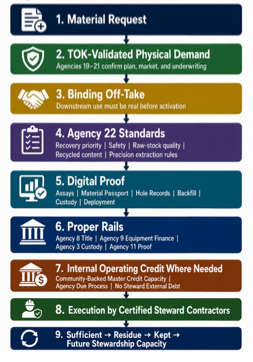
Table 7. Research Foundations and New Vistas Adaptation
| Literature Area | Conventional Insight | Agency 22 Adaptation |
| Nonrenewable Resource Economics | Extraction today reduces future stock | Scarcity becomes a constitutional signal for continuity |
| Hotelling Framework | Scarcity rent rises along an efficient extraction path | Used as a supporting tool, not a speculative trading logic |
| Commons Theory | Open access can create depletion races | Extraction is demand-gated and standards-bound |
| Ostrom Governance | Communities can manage shared resources through rules and monitoring | Agency 22 uses lease standards, material passports, TOK validation, and proof |
| Incomplete Contracts | Bundled control can create opportunism | Title, custody, finance, execution, standards, proof, and audit are separated |
| Circular Economy | Reuse and recycling reduce resource pressure | Waste streams become artificial ore deposits |
| Technology-Dependent Reserves | Recoverable resources depend on tools and institutions | PCD drilling, directional drilling, robotics, AI inference, and modular refining expand practical horizons |
| Standards-Based Governance | Rules can shape system behavior before execution | Material pathways become admissible only if standards are met |
| LAW/PLAT Residue Sequence | Sufficient produces residue; residue is kept; stewards administer | Material systems must create self-financing stewardships and future capacity, not consume residue |
Governance Boundaries
Agency 22 is deliberately powerful in standards but powerless in operation. This is central to its legitimacy. It may define admissible material sources, recovery standards, recycled-content requirements, raw-stock specifications, precision-extraction methods, assay requirements, modular-processing standards, material-passport rules, substitution pathways, backfill documentation, contractor certification, off-take discipline, quantity gates, safety protocols, and audit-trigger conditions.
It may not own resources, operate mines, operate recycling plants, operate refineries, run factories, control logistics fleets, finance equipment, issue liens, hold custody, sell commodities, trade resource claims, accumulate reserves, collect transition funds, consume steward residue, allocate external loans to stewards, or become a materials merchant.
Its power comes from admissibility, not ownership. Agency 22 governs but does not administer in a productive sense. Stewards administer; Agency 22 provides the standards through which material stewardships can become viable, sufficient, residue-generating, and capable of expanding future stewardship capacity. Agencies govern only; stewards and certified contractors administer productive work. Agency 22 therefore cannot be described as administering materials in a bureaucratic sense. Material stewards administer by operating productive material businesses inside Agency 22 standards.
Table 8. Constitutional Separation of Agency 22 from Other Rails
| Function | Proper Rail |
| Material standards, extraction admissibility, recovery standards, and first-stage standardization | Agency 22 |
| Long-duration resource rights, land, and infrastructure title | Agency 8 |
| Equipment title and financing | Agency 9 |
| Equipment leases and operational custody | Agency 3 |
| Facility and land-use leasing interfaces | Agency 2 |
| Workflow logs, receipts, material proofs, compliance events | Agency 11 |
| Accounting truth | Agency 16 |
| Measurement standards | Agency 18 |
| Triggered audit | Agency 15 |
| Plan, market, and underwriting validation | Agencies 19–21 |
| Internal operating credit representation and clearing | Agency 7 with proper due process |
| Legal templates for stewardship business-value transfers | Agency 14 |
| Physical execution | Steward businesses and certified contractors |
| Council-scale coordination | Council of 50 |
| External borrowing risk | Community, not individual stewards |
| Utility service provision standards | Agency 23, not Agency 22 |
| Movement capacity, routing, and corridor service standards | Agency 24, not Agency 22 |
| Kept residue treatment | Proper LAW/PLAT rails; not Agency 22 funds or steward reserves |
Council-of-50 Material Coordination
Agency 22 is designed for a system of roughly fifty cooperating communities, or about five million people. One community may not support every specialized material function internally. But fifty communities can coordinate demand, recovery streams, contractor specialization, import needs, export capacity, recycling flows, and infrastructure schedules. This coordination does not create centralized ownership. The Council of 50 does not become a resource sovereign. It provides comparison, publication, specialization, interoperability, forecasting, and best-practice propagation.
One community may specialize in stainless steel recovery. Another may specialize in glass systems. Another may specialize in polymers. Another may specialize in carbon materials. Another may specialize in drilling services. Another may specialize in electronics recovery. Together, the system gains scale without monopoly. Council-of-50 coordination must also help multiply stewardships. Material specialization should create more productive stewardships, more operating opportunities, more recovery businesses, more processing contractors, more logistics stewards, more proof providers, and more maintenance systems. The objective is not central coordination for its own sake. The objective is future stewardship capacity.
No-Reserve, No-Deficit, and Kept Residue Discipline
Agency 22 does not build reserve funds, hold idle liquidity, accumulate material profits, or operate from extraction revenue. Steward material businesses operate through productive plans, lease structures, internal operating credit where needed, and certified steward execution. Fees and lease terms must cover current and lifecycle costs. Excess profit above sufficient becomes steward residue and is always kept. Steward residue is not consumed, distributed, converted into a reserve, or used as agency spending capacity. Community-governed profits and original contributed properties are distinct from steward residue. They may support the community’s unrestricted net worth and master credit capacity through proper agency due process. Internal operating credit may then be allocated to viable stewards according to certified business plans. No steward has a loan with an external banker. External borrowing risk belongs to the community, not to individual stewards. The no-deficit rule is equally important. New Vistas is not autarkic, but it cannot live permanently beyond its productive capacity. Strategic imports are allowed, but they must be balanced by exports of equivalent value. External material dependence is lawful only when supported by productive export capacity, accounting discipline, credit discipline, residue preservation, and material-flow ratios.
Safety and Labor Transformation
Agency 22 rejects systems that place workers underground in dangerous conditions when surface-operated, robotic, or remotely operated systems can perform the work. Conventional mining exposes workers to cave-ins, toxic gases, heat, dust, blasting hazards, water intrusion, equipment accidents, and long-term health risks. New Vistas moves toward a model in which the drill, reamer, robotic extraction system, autonomous loader, or sensor enters the subsurface, while human operators remain safely above ground. This is not merely labor reduction. It is a constitutional safety doctrine: dangerous human exposure should be replaced by supervised robotic industrial systems wherever feasible. This safety doctrine also supports stewardship replication. Safer extraction allows smaller specialized contractor stewardships to operate without reproducing the old hazards of industrial mining. It makes material recovery and extraction more compatible with a decentralized steward economy.
Figure 6. From Mining Labor Risk to Robotic Precision Extraction
Agency 22 shows how New Vistas can secure raw-material continuity without becoming extractive, speculative, centralized, unsafe, or bureaucratic. It replaces the old model of extract what you can before others do with a recovery-first, artificial-ore, precision-extraction, digitally provable, no-deficit, no-reserve, contractor-executed standards architecture. It also becomes part of the larger stewardship-replication engine. Materials must serve productive stewardships. Productive stewardships must become sufficient. Excess profit becomes residue. Residue remains kept. Stewards administer by expanding future capacity. Agency 22 is Bureau VIII’s materials and first-stage standardization rail. Its deeper contribution is therefore not only material continuity, but civilizational continuity: making materials serve the creation, restoration, preservation, and replication of stewardships across generations while preserving title separation, no-reserve discipline, internal credit order, privacy-bounded proof, and standards-only governance.